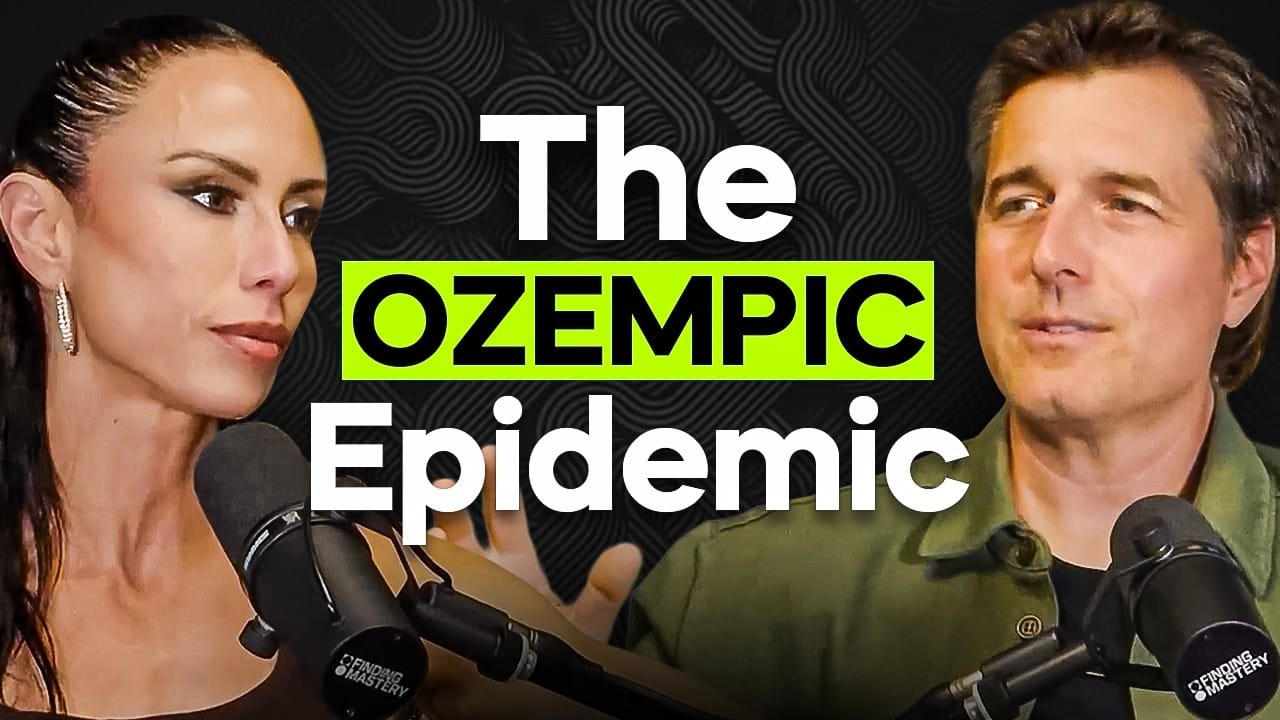
Original source: Finding Mastery
This article is an editorial summary and interpretation of that content. The ideas belong to the original authors; the selection and writing are by Streamed.News.
This video from Finding Mastery covered a lot of ground. 6 segments stood out as worth your time. Everything below links directly to the timestamp in the original video.
Ever found yourself trapped in a loop of negative thoughts you can't shake? Dr. Lyon offers a surprisingly primal, high-intensity solution that might just be the fastest way to hit reset.
Intense Physical Activity Halts Negative Thought Cycles, Says Dr. Lyon
Dr. Gabrielle Lyon asserts that intense physical exertion, such as a 20-second all-out sprint, serves as an immediate and powerful disruptor of negative thought patterns and rumination. She explains that such physical action, whether on a bike, rower, or other equipment, forces the mind to focus entirely on the task, effectively clearing unwanted thoughts. This mechanism, she notes, leverages an ancient, ingrained human response to physical stress, where survival necessitates immediate focus over internal contemplation.
Lyon, drawing on her experience in psychiatry and with high-level operators, posits that this physical intervention provides a direct pathway to mental control and discernment, allowing individuals to break free from being "hooked into a thought." This approach offers a tangible method for individuals struggling with persistent negativity to regain agency over their mental state, highlighting the deep, bidirectional connection between physical action and cognitive function.
"You give me 20 seconds and you put me in an all-out sprint... by the time those 20 seconds are done, I totally forgot why I was upset. You cannot think of anything else. You pull the lever of muscle and it creates this bidirectional relationship of mental control."
Dr. Lyon: Skeletal Muscle is Key to Longevity and Survivability, Not Just Strength
Dr. Gabrielle Lyon underscores the paramount importance of skeletal muscle for overall survivability, revealing that strong individuals in midlife possess a 2.5 times greater chance of living to 100. She emphasizes that muscle is far more than just an aesthetic feature; it functions as a critical metabolic driver, a primary site for glucose disposal, and an oxidizer of fatty acids. Furthermore, muscle serves as an essential amino acid reservoir, crucial for recovery during illness and periods of stress.
Lyon highlights that resistance training can decrease overall morbidity and mortality by 25%, asserting that "nothing is more important than skeletal muscle for overall survivability." She explains that muscle contraction releases myokines, peptide hormones vital for neurogenesis and bone health, establishing a bidirectional link between physical and mental strength. This perspective reframes muscle as the "organ of longevity," essential preparation for the inevitable health challenges that everyone faces.
"There is nothing more important than skeletal muscle for overall survivability... this is the organ of longevity that will allow you to survive not if but when the storm hits because it is coming, my friend. It is coming for everybody."
Prioritizing Muscle Health More Critical Than Weight Loss for Longevity, Says Dr. Lyon
Dr. Gabrielle Lyon asserts that the focus on weight loss as a primary health goal is misguided, advocating instead for a concentrated effort on muscle health. She identifies skeletal muscle as the body's largest organ system, comprising over 40% of body weight, and uniquely, the only organ system under voluntary control. Lyon posits that chronic diseases largely originate in unhealthy skeletal muscle, making muscle health, rather than body fat levels, the causal factor for many serious medical conditions.
Lyon labels muscle as the "organ of longevity," underscoring that the loss of skeletal muscle mass is more detrimental to health than the gain of body fat. She argues that decades spent "chasing weight loss" through restrictive diets often yield no long-term agency over outcomes. Instead, cultivating muscle through nutrition and exercise upgrades metabolism and other vital functions, offering a more effective pathway to becoming a healthier, more resilient organism.
"The loss of skeletal muscle mass is more detrimental than the gain of body fat."
Animal Proteins Outperform Plant-Based Options for Muscle Health, Dr. Lyon Explains
Dr. Gabrielle Lyon clarifies that not all protein sources provide equal benefits, emphasizing a distinct difference between high-quality animal proteins and lower-quality plant proteins. She explains that animal proteins, like chicken breast, offer amino acid ratios closely mirroring human needs, whereas plant-based options present a less optimal profile. For instance, obtaining the amino acid equivalent of a four-ounce chicken breast, which provides nearly 30 grams of protein, would require consuming six cups of quinoa, two cups of rice and beans, or 420 almonds, often with significantly higher caloric intake.
Lyon highlights that plant foods are best utilized for their fiber and phytonutrient content, rather than as primary protein sources. She underscores the critical role of leucine, an amino acid, as the trigger for muscle protein synthesis, with a requirement of approximately three grams per meal for optimal muscle health. This intake is substantially higher than the daily minimum set by the Recommended Dietary Allowance (RDA), which is designed for deficiency prevention, not for promoting optimal physiological function.
"If it is coming from the plant kingdom, it is considered a low-quality protein... high-quality proteins are very similar in ratios to the human need."
GLP-1 Drugs Can Spare Muscle Loss with Strategic Diet and Exercise, Dr. Lyon States
Dr. Gabrielle Lyon clarifies that GLP-1 medications, often used for weight management, do not necessarily compromise muscle mass if individuals adhere to a regimen of slow weight loss, consistent resistance training, and a high-protein diet. She explains that this strategic combination provides a "protein muscle-sparing effect," preventing the accelerated muscle loss that can occur when GLP-1s are used without these complementary interventions. This nuanced understanding addresses a common concern regarding the impact of these drugs on body composition.
Lyon introduces intramuscular adipose tissue (IMAT)—fat embedded within muscle fibers—as a critical, emerging biomarker for metabolic health, potentially more significant than overall body fat percentage. She asserts that GLP-1s positively influence this tissue, transforming metabolically unhealthy muscle (likened to a "Wagyu steak") into healthier muscle (a "filet mignon"). This distinction helps explain why some individuals with higher body fat, like certain athletes, can remain metabolically healthy due to the quality of their skeletal muscle.
"If they are losing weight slowly and they are doing resistance training and they are eating a higher protein diet, there's a protein muscle sparing effect, but it cannot be done just with protein, you have to do resistance training."
▶ Watch this segment — 1:00:06
Dr. Lyon: Protein is Most Essential, Misunderstood Macronutrient for Human Health
Dr. Gabrielle Lyon identifies protein as the most essential, yet controversial, macronutrient, largely due to widespread misconceptions about its role and composition. She explains that humans require twenty amino acids, nine of which are essential and must be obtained through diet because the body cannot produce them. Lyon stresses that these essential amino acids, crucial for optimal muscle health, are most readily and efficiently found in animal-based products, which possess amino acid ratios most similar to human needs.
Lyon notes that many protein bars and food labels inaccurately list "protein" without detailing specific amino acid profiles, contributing to public confusion. She highlights the challenge for vegans, whose average daily protein intake, according to survey data, hovers around 50 grams—significantly below the recommended minimum of 100 grams per day for optimal health. This underscores the need for conscious and deliberate dietary planning to meet essential amino acid requirements outside of animal product consumption.
"Protein is by far and away the most controversial macronutrient... It is the black sheep of the macronutrient family... Protein is the most essential macronutrient for humans."
Also mentioned in this video
- Dr. Gabrielle Lyon discusses the critical role of strength in midlife for… (0:42)
- Dr. Gabrielle Lyon discusses her personal and professional purpose, which is to… (2:08)
- Dr. Gabrielle Lyon shares her educational journey, starting with nutritional… (5:03)
- Dr. Gabrielle Lyon expresses frustration with current medical practices,… (7:08)
- Dr. Gabrielle Lyon explains that skeletal muscle is the primary site for… (13:07)
- Dr. Gabrielle Lyon recommends starting with a 3-4 day a week resistance… (26:56)
- Dr. Gabrielle Lyon advises focusing on effort rather than time for resistance… (35:01)
- Dr. Gabrielle Lyon emphasizes that parents are raising adults and must embody… (36:32)
- Dr. Gabrielle Lyon discusses finding enjoyment in fitness activities like… (38:31)
- Dr. Gabrielle Lyon recommends a daily protein intake of 0.7 to 1 gram per pound… (48:44)
- Dr. Gabrielle Lyon explains that high-protein meals trigger hormones that… (56:01)
- Dr. Gabrielle Lyon discusses the link between muscle health and cardiovascular… (1:02:49)
- Dr. Gabrielle Lyon states that consuming over 50 grams of carbohydrates can… (1:05:03)
Summarised from Finding Mastery · 1:08:41. All credit belongs to the original creators. Streamed.News summarises publicly available video content.
Streamed.News
This publication is generated automatically from YouTube.
Convert your full video library into a digital newspaper.
Get this for your newsroom →