Original source: Barry's Economics
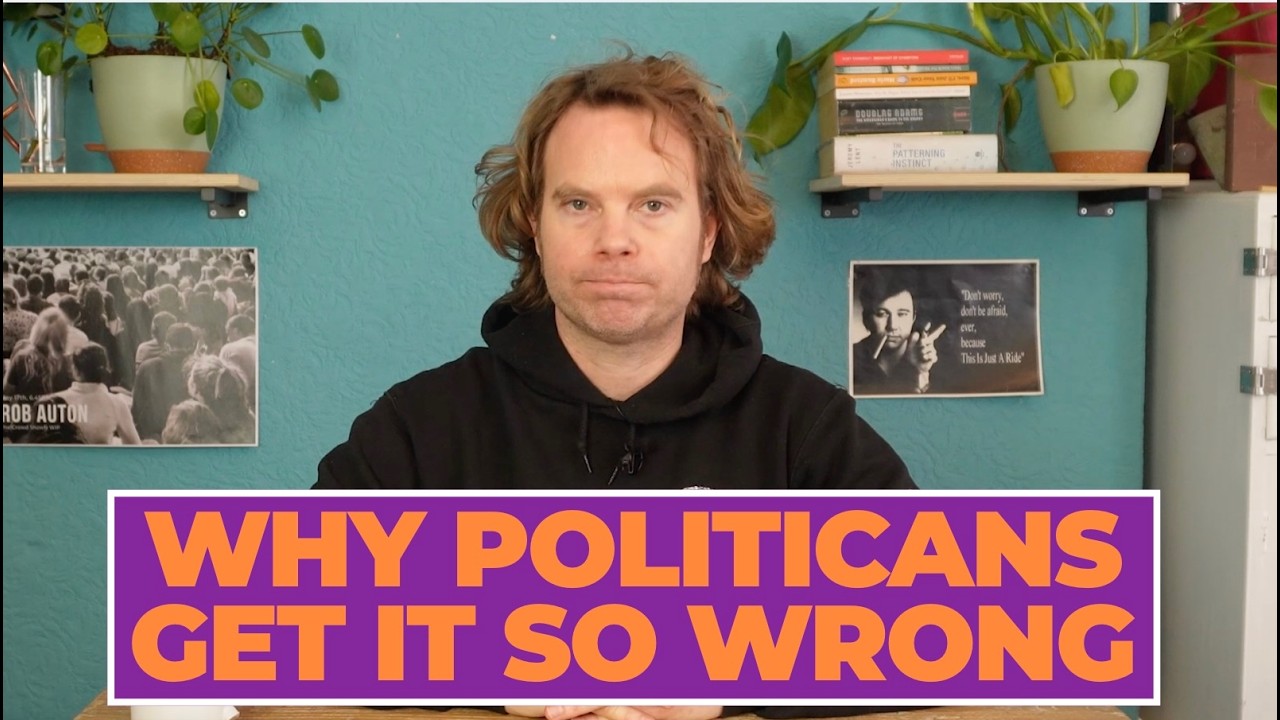
This video from Barry's Economics covered a lot of ground. Streamed.News selected 5 key moments and summarises them here. Everything below links directly to the timestamp in the original video.
The people designing poverty policy may be neurologically and socially insulated from the very problem they are trying to solve. This research explains why evidence of hardship often seems to fall on deaf ears.
Wealth Reduces Empathy at a Neural Level, Creating a 'Structural Filter' on Reality, Research Finds
Dutch researchers have found that wealth and power are linked to reduced activity in the brain's mirror neuron system, the neural architecture for empathy. When this biological tendency is combined with homophily—the natural inclination to associate with similar people—it creates a powerful structural filtering effect. Those in power become neurologically less attuned to suffering and are socially insulated from anyone who might correct their blind spots.
The result is not a conspiracy, but a systemic flaw in how information flows to the top. Evidence of widespread public hardship fails to register with policymakers, whose brains effectively underweight the data and whose homogenous social circles never challenge that fundamental misperception.
"You don't just get people who are less attuned to other's suffering. You get people who are less attuned to other's suffering and who never encounter evidence that might correct that blind spot."
Economic Policymakers Ignore Cognitive Bias Safeguards Common in Medicine and Aviation
We demand rigorous safeguards against cognitive bias in high-stakes fields, using double-blind trials in medicine and error-resistant design in aviation to account for known human vulnerabilities. Yet, when it comes to economic policy—which affects the most people daily—this intellectual honesty is curiously absent. We simply pretend that decision-makers are perfectly calibrated instruments, free from the distortions that wealth and power are known to create.
This selective application of science creates a profound systemic flaw. It is genuinely one of the most elegant conflicts of interest in modern public life, allowing policy to be shaped by demonstrably biased perspectives without any of the checks and balances we insist upon elsewhere.
"In medicine, we insist on double-blind trials because we know that researchers' expectations distort their observations. We say human cognition has known vulnerabilities and we need to design systems that account for them. This is considered so basic it's now just called science."
Integrating Neuroscience Into Policy Requires Challenging the Makeup of Decision-Making Bodies
To correct for wealth-induced empathy gaps, policy debates must consistently question the composition of decision-making bodies. Every discussion about welfare or inequality should ask whether those affected are in the room and if the team's makeup creates the information bias that neuroscience warns about. Solutions may include citizens' assemblies or ensuring committees reflect the country's actual socioeconomic reality, not just the top few percent.
The real danger here is not getting the solution wrong; the real danger is never agreeing that this is the direction we need to move in. Movement towards a more honest, psychologically-informed process matters more than perfection.
"If you care about getting the answer right, you should care about whether the people making the decisions actually see the problem they're trying to solve."
Economic Debates Overlook 'Measurable' Empathy Decline in the Wealthy, Key Research Shows
While economic debates endlessly circle around abstract models like the Laffer curve, they systematically ignore a critical body of hard evidence from psychology and neuroscience. Research by scientists like Dacher Keltner at UC Berkeley demonstrates that as people gain wealth and power, their capacity for empathy and their ability to accurately read others' emotions measurably decreases. This is not a political opinion, but a scientific fact.
To continue crafting policy without this psychological data is akin to designing road safety rules while refusing to look at traffic statistics. It ensures the conversation remains fundamentally disconnected from the human reality it purports to manage.
"As people gain wealth and power, their capacity for empathy measurably decreases. This study doesn't care what you think. It doesn't care about your political ideology. It's a measurable fact."
Privately Educated MPs Dominate Parliament as Policies Favored by Wealthy Are 2.5 Times More Likely to Pass
The composition of the UK Parliament demonstrates a stark disconnect from the public, with 40% of MPs having attended private school compared to just 7% of the general population. This overrepresentation of a narrow elite is not merely a demographic curiosity. Research confirms that policies supported by wealthy individuals are two and a half times more likely to be enacted into law, regardless of broader public support.
This isn't a left or right-wing talking point; it's a scientific observation of a political system where economic power translates directly into policy outcomes. This creates a powerful feedback loop that consistently reinforces the interests of a small, unrepresentative minority.
"If rich people are in support of a particular policy that is two and a half times more likely to be passed into law than if they don't support it."
Summarised from Barry's Economics · 18:07. All credit belongs to the original creators. Barry's Economics Press summarises publicly available video content.