✦ Advanced Writer
Original source: BBC Sport
This video from BBC Sport covered a lot of ground. Streamed.News selected 8 key moments and summarises them here. Everything below links directly to the timestamp in the original video.
When one of the sport's biggest stars starts calculating whether the money is worth it, Formula 1 has a problem that goes beyond one unhappy driver.
Verstappen Confirms He Is Weighing F1 Exit at Season's End
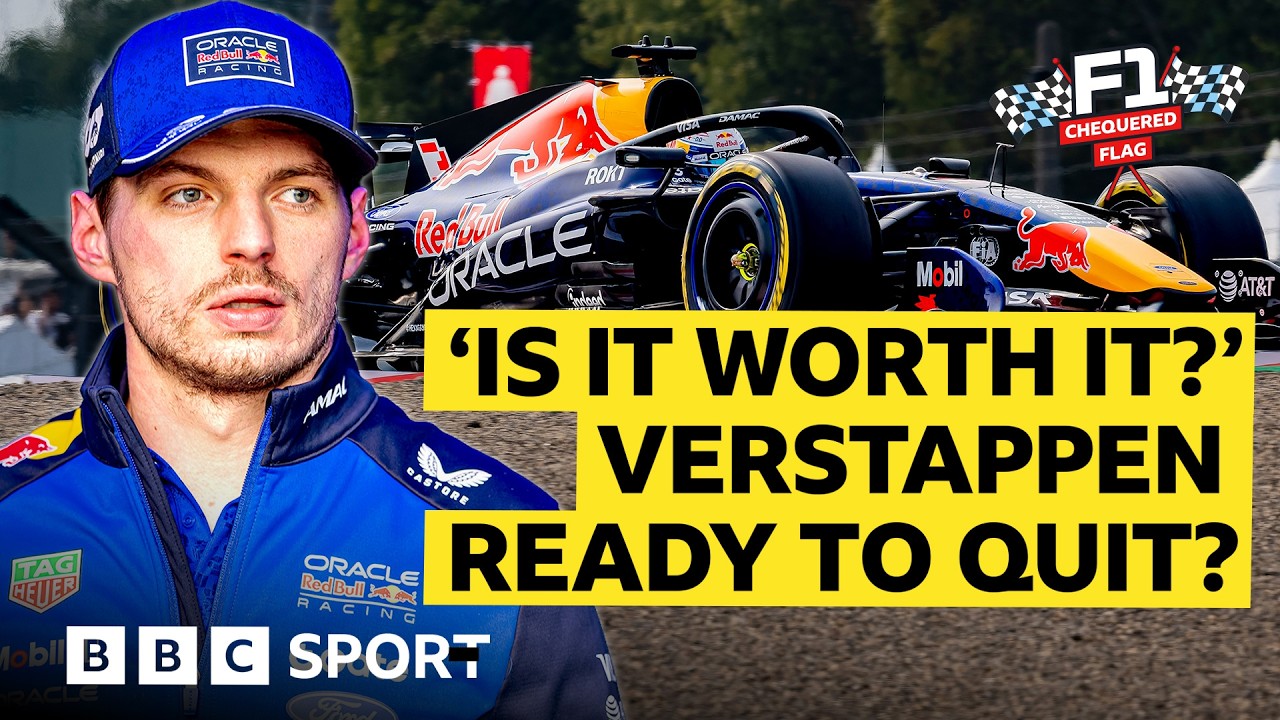
Speaking to BBC Sport's Jenny Gao after the Japanese Grand Prix, Max Verstappen said he is actively reconsidering his future in Formula 1, weighing whether a gruelling 24-race calendar is worth it when he is not enjoying the sport. He cited the desire to spend more time with family and friends as the alternative, making his remarks the clearest signal yet that his departure is a genuine possibility rather than frustration venting.
Verstappen earns an estimated $100 million a year including bonuses, but the panel noted he is currently collecting neither race wins nor the associated bonuses. Losing a four-time world champion to rival categories would represent a significant reputational blow for the sport.
"You also weigh up 24 races and then you just think: is it worth it, or do I enjoy actually being more at home with my family, seeing my friends more, when you're not enjoying your sport."
F1 Faces Choice Between Manufacturer Loyalty and Driver Satisfaction
Verstappen's frustration is not a solo grievance. During Suzuka qualifying on Saturday, drivers across the grid — including those running in the top three — were heard using colourful language about the new regulations, revealing a broad dissatisfaction with cars that cannot be pushed to their limit due to energy harvesting constraints. The panel argued that Formula 1 must now decide whether to prioritise the engine manufacturers who shaped these rules or the drivers who have to race under them.
The stakes are concrete: if the sport loses Verstappen over a regulatory dispute, the beneficiary is most likely GT racing, where he already tests his own team's car and draws large crowds.
"Formula 1 has to make a decision — who do you want to keep happy? Can you keep both the manufacturers and the F1 drivers happy, or ultimately do you have to choose?"
Damon Hill: Verstappen's Regulation Complaints Won't Deliver Leverage
1996 world champion Damon Hill, speaking live from Suzuka, said Verstappen has earned the right to walk away and should not feel obligated to continue if the sport no longer satisfies him. Hill acknowledged that threatening to leave may be a tactic to pressure rule-makers, but was sceptical it would work, predicting Formula 1 would simply tell Verstappen to take time to think and then move on. He pointed to onboard footage of cars visibly slowing before braking zones as evidence that the driving experience has become genuinely strange.
Hill added that the concerns are widely shared across the paddock, suggesting the problem is structural rather than personal to Verstappen, and that it may require a formal regulation change to resolve rather than any one driver's leverage.
"I think the chewing gum loses its flavour a bit. Maybe he needs a break."
Hill Dismisses Toto Wolff's Plan to Shield Antonelli from Title Pressure
Damon Hill rejected Mercedes team principal Toto Wolff's stated intention to protect 19-year-old Kimi Antonelli from the psychological weight of leading the world championship. Hill argued that any teenager who has just outscored a more experienced teammate in just his second Formula 1 season is not going to bed thinking the title is a long shot — he is going to bed thinking he can win it, and Wolff cannot change that. Hill was equally sceptical that Mercedes will suffer during the five-week break ahead of Miami, arguing the team is already operating from a position of advantage and that the Christmas shutdown also helped them pull further ahead of the field.
"He will be going to bed thinking: I have put one over on my teammate in the second season of Formula 1, and things are looking up."
Battery Management Is Making F1 Overtakes Artificial and Reversible
A specific pattern emerged at the Japanese Grand Prix that the panel argued captures the deeper problem with the new regulations: drivers who used their battery charge coming out of the chicane had nothing left on the straight, meaning any overtake was almost immediately reversed by the car behind. George Russell's repeated jousting with Charles Leclerc, and a similar sequence involving Lewis Hamilton and Lando Norris, illustrated how battery deployment timing — rather than raw racecraft — is determining the outcome of passing attempts. Qualifying drew equal criticism, with commentators noting that cars visibly backing off through high-speed corners like 130R removes the spectacle of a driver truly on the limit.
The panel agreed that qualifying in particular needs urgent revision if Formula 1 is to remain compelling for both hardcore fans and the newer audience brought in by Drive to Survive.
"You would almost have to time when you did the overtake knowing that whoever you just overtook, they would come back at you again."
Bearman Survives 50G Crash at Spoon Curve as Speed Differentials Raise Safety Fears
Ollie Bearman walked away — visibly injured but cleared by medics — after a heavy impact at Spoon Curve at over 300 kilometres per hour, a collision the stewards ruled a racing incident involving no fault by either driver. The panel agreed with that verdict, attributing the crash to a dramatic difference in closing speed: Franco Colapinto was harvesting energy and travelling significantly slower, while Bearman was not, leaving neither driver able to anticipate how quickly the gap would close. The incident echoed concerns Lando Norris had raised in Australia about speed differentials created by the new energy regulations.
With the sport entering a five-week gap before the Miami Grand Prix, the crash adds safety weight to the existing driver dissatisfaction with the 2026 rules.
"I don't think either driver expected the closing speed to be that great."
Verstappen's GT Team Activity Signals F1 Exit Is More Than a Threat
The evidence that Verstappen's dissatisfaction with Formula 1 is genuine rather than tactical includes the fact that he arrived at Suzuka from a test session in one of his own GT cars during the preceding week. The panel noted he has been openly building his own GT team and derives visible enjoyment from that environment in a way that has been absent from his Formula 1 appearances this season. He was eliminated in Q2 at Suzuka and finished eighth in the race, unable to pass Pierre Gasly.
Unlike some drivers who are motivated by records and legacy, Verstappen has repeatedly stated that enjoyment is his primary driver — making the current combination of an uncompetitive car and frustrating regulations a more credible exit trigger than it might be for others.
"He's made it quite clear he's not bothered about these records — he just wants to enjoy his racing."
F1 Qualifying Has Become a Test of Energy Programming, Not Driver Skill
The panel, including former racing driver Alice Pal, described the current qualifying experience as fundamentally broken for drivers and fans alike. Rather than a showcase of raw commitment — the classic one-lap, one-mistake format — qualifying now rewards teams whose engineers have best programmed the car's energy deployment, with drivers visibly lifting through previously flat-out corners like 130R at Suzuka rather than attacking them. Pal noted the technique is unnatural for drivers who have never encountered it in any junior category.
The consensus was that qualifying must be changed before the sport can credibly claim to be showcasing the best drivers in the world.
"We want to watch a qualifying session where it favours those that push the car to the absolute limit — we're not getting that at the moment."
Summarised from BBC Sport · 31:37. All credit belongs to the original creators. Chequered Flag summarises publicly available video content.