Original source: Nils Bach
This video from Nils Bach covered a lot of ground. Streamed.News selected 8 key moments and summarises them here. Everything below links directly to the timestamp in the original video.
An improperly tensioned batten can ruin your sail's performance. Here's a simple visual check from the end of your boom to instantly diagnose and fix a common tuning error.
Visual Cue From Boom End Reveals Incorrect Windsurf Batten Tension
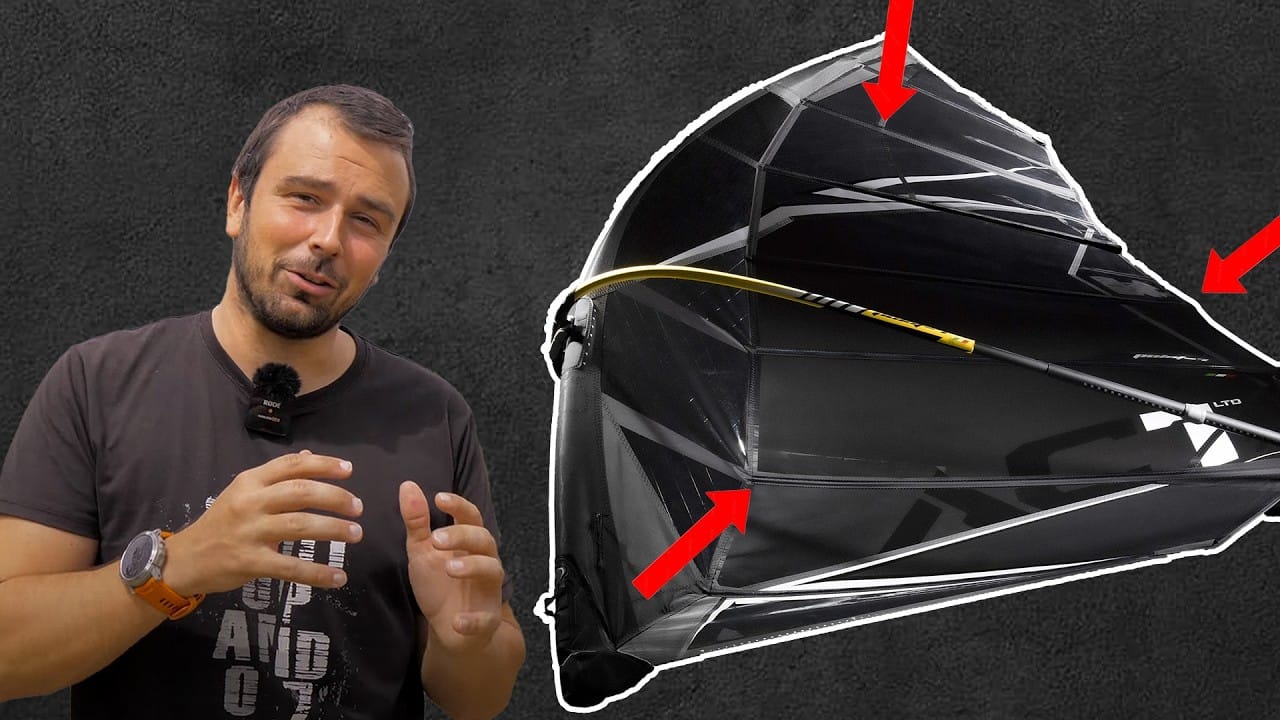
A simple visual inspection from the boom's clue end can diagnose incorrect batten tension. When viewed along this axis, the sail battens should form a continuous straight line descending towards the boom, with only the top batten curving slightly upwards. If any single batten protrudes noticeably from this line, it indicates that it has been over-tensioned, a condition that also creates a visible dent in the sail material where the batten is pushing inward.
The consequence of such an overtightened batten is a significant disruption to the sail's aerodynamics. The protrusion obstructs clean airflow across the leech, inducing turbulence that makes the sail feel draggy and unresponsive. This inefficiency translates into increased backhand pressure and undue force on the fin, ultimately compromising both handling and overall speed. This diagnostic technique allows for a quick and precise correction to restore the sail’s intended performance characteristics.
"If one batten is coming out of this line, you have too much tension. The wind will push against this batten, create turbulence, and the sail will feel very draggy, hard to handle, with a lot of backhand pressure."
Sail Tuning Requires Minimal Tension for Middle Battens, Slight Tension at Extremes
The correct method for setting batten tension involves a differentiated approach across the sail's profile. For the middle battens, specifically from the sixth to the second when counting from the top, only minimal tension should be applied. The objective is merely to remove the most prominent wrinkles without creating a deep profile. A guiding principle is to turn the adjuster no more than one full rotation after feeling the first point of resistance.
This minimal-tension strategy for the main body of the sail is crucial for allowing the battens to form a natural S-shape, which is essential for efficient airflow. In contrast, the lowest and highest battens require slightly more tension. The lowest batten helps to close the sail's gap at the bottom for better power, while tension in the top batten guides the wind to exit cleanly, preventing it from stalling at the sail's peak.
"From the first moment I feel tension, the maximum I turn is one rotation. Not more than this. And this I repeat for all the battens from this one up towards batten number two."
Correct Batten Tension Aims for S-Shape Profile, Not Wrinkle Removal
The fundamental role of a sail batten is to support the sail’s inherent aerodynamic profile, not to force a new one by eliminating all wrinkles. A common misconception leads riders to apply excessive tension in an effort to create a perfectly smooth surface. This practice is counterproductive because it forces the batten to bend too much towards its trailing edge, which disrupts the intended airflow and creates drag.
The optimal configuration for most of the sail's battens is an "S-shape," where the batten holds a profile near the mast but can flex into a reverse curve near the leech under wind pressure. This shape allows the wind to detach cleanly from the sail, preventing the formation of turbulence. It is important to acknowledge that this natural S-shape can only occur if the battens are not over-tensioned, underscoring that a wrinkle-free appearance is not the primary goal of proper tuning.
"What you actually want in most parts of the sail is an S-shape of the batten, so that the batten has profile towards the front but in the end, under pressure, it will have curvature towards the opposite side."
Equal Stiffness Across All Cambers Is Key to Proper Sail Rotation
For cambered sails, the tuning process centres on ensuring that the cambers—which lock the sail's profile to the mast—exhibit correct and uniform tension. The primary diagnostic method involves laying the sail down and applying pressure directly to each camber. An ideally tuned sail is one where all cambers present a similar degree of stiffness and resistance to this pressure.
An imbalance in camber tension directly compromises the sail's ability to rotate smoothly during manoeuvres like a jibe. If one camber feels noticeably looser than the others, a spacer must be added to increase its effective length and thus its tension. Conversely, if a camber is excessively stiff and impedes rotation, it may need to be sanded down slightly to reduce its length. This meticulous adjustment is critical for achieving a balanced, stable profile and predictable handling.
"What I want is that all three cambers have an equal stiffness to them. If one were loose, I would add a spacer. If one were way too stiff, I might even sand down the camber."
Downhaul Setting for Slalom Sails Prioritizes Leech Opening at Batten Five
When setting the downhaul on a race slalom sail, the primary objective is to create a leech that opens rapidly, a characteristic that enhances control and minimises side-forces during high-speed, downwind sailing. A key visual indicator of a correct setting is that the leech begins to fall away, or "open," starting from batten number five, counting from the top of the sail. This configuration ensures the sail releases excess power efficiently and remains stable.
As a practical guide, the loose leech should extend approximately one hand-width from the mast pocket when measured at the third sail panel from the top. It is important to acknowledge, however, that this is a starting point, as ideal settings vary between brands. Riders should be wary of relying solely on factory-printed trim indicators, as their placement can be inconsistent by as much as 20 centimetres from one sail to the next, making direct observation the more reliable method.
"The one point is that the sail is opening from batten five, falling nicely down. The other indicator I usually use is that I want the sail to open to about one hand's width from the end of the mast pocket in the third panel."
Batten Position Relative to Mast Is Crucial for No-Cam Sail Outhaul
For no-cam sails, the correct outhaul tension is primarily determined by the final resting position of the battens relative to the mast. The ideal setting is achieved when the end of the batten aligns with the halfway point of the mast's diameter. This specific alignment allows the sail to develop a sufficiently deep profile to generate power while remaining structurally stable and easy to handle.
The central question of outhaul tuning becomes one of avoiding two performance-degrading extremes. Applying too much outhaul pulls the batten away from the mast, which flattens the sail excessively and critically reduces its power. Conversely, applying insufficient outhaul allows the batten to press too far over the mast, a configuration that will significantly hinder the sail's ability to rotate smoothly during manoeuvres. The halfway point represents the optimal balance between power and handling.
"The perfect setting here is if the batten ends right here, about half the width of the mast."
Sail Leech Design Balances Power Against Handling for Windsurfers
The design of a windsurfing sail's leech—its trailing edge—presents a fundamental dichotomy between power generation and rider control. A "closed" leech, which exhibits minimal twist, is engineered to generate maximum power and provide a superior upwind pointing angle. However, this configuration creates significant side forces that make the sail more physically demanding and difficult to handle, a problem exacerbated in stronger winds.
In contrast, an "open" leech, which twists away significantly at the top, sacrifices some raw power for a vast improvement in handling by allowing excess pressure to spill off. This twist is aerodynamically necessary because wind speed increases with altitude; the top of the sail must set at a different angle to the wind than the bottom. An open leech allows each section to achieve its optimal angle of attack, a critical factor for a rig managed by a human operator rather than by the fixed rigging of a boat.
"A closed leech gives more power and a better pointing ability, but it also makes the sail more difficult to handle. An open leech, in contrast, will give the sail less power but make the sail much easier to handle."
Downhaul Tuning Principles for Race Sails Apply to Freerace Models
The core principles for setting downhaul on a high-performance race sail are directly applicable to freerace no-cam models. The primary objective remains the same: to create a sufficiently loose leech that allows the sail to twist and release excess power, ensuring stability and control at speed. As with a race sail, a key visual target is to ensure the leech begins to open up in the area around the fifth batten.
Even without the clearly defined mast pocket of a cambered sail, the extent of the loose leech can be effectively assessed. The goal is to achieve a twist that extends approximately two-thirds of the way into the top panel, a distance that can be estimated using a hand-width as a simple measuring tool. This ensures the sail achieves the necessary balance between power generation in its lower sections and power release at its peak, which is fundamental to its performance envelope.
"The principle about the downhaul remains the same as it is with a full-on race sail... I wanted it to be about two-thirds, which is again the hand width from this line here in the top."
Also mentioned in this video
- A video on fine-tuning windsurfing sails for maximum performance, sharing his… (0:00)
- Downhaul is the most crucial sail setting, determining the sail's shape, depth,… (0:45)
- The speaker prepares to demonstrate sail fine-tuning using three different… (5:01)
- Visual indicators on the sail to determine the correct downhaul setting, noting… (5:32)
- The downhaul tuning for a freewave sail, noting that despite fewer battens, the… (9:30)
- Nils Bach confirms that the batten tension check applies to all sails except… (16:16)
- Nils Bach concludes the video by summarizing the importance of understanding… (20:11)
Summarised from Nils Bach · 21:08. All credit belongs to the original creators. Streamed.News summarises publicly available video content.