Original source: Nico Prien
This article is an editorial summary and interpretation of that content. The ideas belong to the original authors; the selection and writing are by Streamed.News.
This video from Nico Prien covered a lot of ground. 4 segments stood out as worth your time. Everything below links directly to the timestamp in the original video.
Understanding how windsurfers strategically interact with ocean waves during a jibe reveals a crucial layer of skill that goes beyond raw speed, directly impacting race outcomes.
Windsurfing Racers Prioritize Wave Alignment for Critical First Jibe Advantage
Effective jibing, especially the initial turn, is paramount in windsurfing races, with success largely determined by aligning with the ocean swell. As the swell's power often exceeds that of the wind, racers must position themselves to exit the jibe on the crest of a wave, enabling immediate acceleration downwind rather than struggling against it. This critical wave alignment can sometimes necessitate slowing down more than desired before the jibe, potentially closing gaps with competitors but ultimately proving more vital for post-jibe speed.
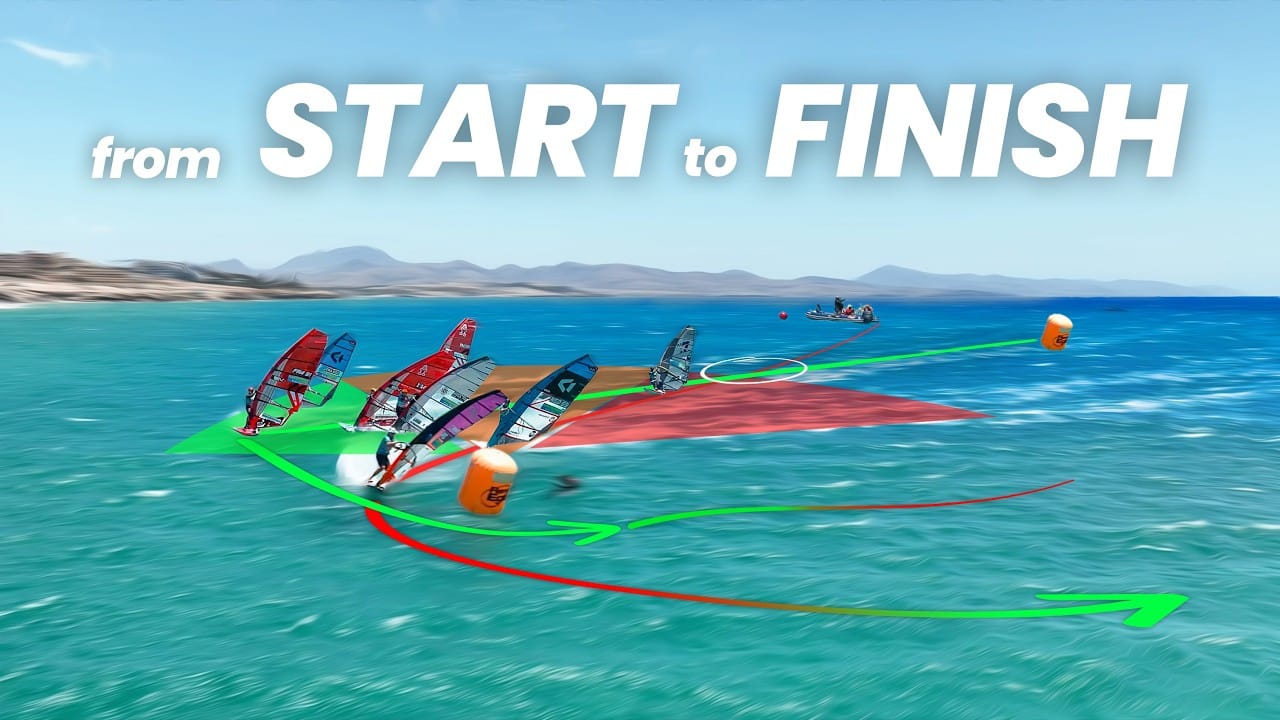
The ideal jibe trajectory involves entering wide and exiting tightly around the mark, which secures clearer wind and allows for greater acceleration downwind. However, unpredictable conditions and the presence of other racers frequently force tactical deviations from this optimal line. An advanced maneuver involves sailing slightly past the mark to find an area with cleaner wind, allowing a racer to regain planing speed and navigate through congested areas more effectively, a strategy that can yield significant advantages in certain race conditions.
"You always have to jibe in line with the waves, even when you're fully powered up. Coming out of the jibe well with the wave is just so much more important."
Slalom X Windsurfing Introduces Obstacles Demanding Advanced Jumping and Wave Reading
Since 2024, Slalom X windsurfing races have incorporated obstacles, often referred to as 'sausage,' which present significant challenges requiring precise timing, high speed, and adept jumping techniques. Racers face a high-risk, high-reward choice: either maintain full downwind speed and jump, or slow down and head slightly upwind to leverage the wind for greater lift. While jumping upwind with wind assistance is generally easier, a full-speed downwind jump can create a substantial advantage by preserving momentum, as demonstrated by one racer gaining distance on an opponent who opted to slow down and go upwind.
Successfully clearing these obstacles hinges on anticipating wave patterns at least five seconds in advance, a complex task given the frequent mixture of large ocean swells and smaller wind waves. Large swells typically provide more lift, allowing for an easier jump, whereas attempting to jump between waves requires intense effort and risks a nose-dive upon landing. This intricate interplay of timing, experience, and trust in one's jumping ability is crucial for navigating the demanding Slalom X courses.
"The more you're under pressure from people behind you or around you, the more risk you need to take at the sausage."
Windsurfing Racers Leverage Speed and Wind to Dominate 'Reach' Segments
During the 'reach' segment of a windsurfing race, speed is the paramount factor, enabling competitors to control their opponents tactically. A racer with superior speed can overtake from an upwind position, positioning themselves to cast turbulent wind onto the trailing competitor, thereby slowing them down and forcing them to adjust their course upwind. Conversely, from a downwind position, a racer can strategically force opponents further upwind, dictating their path and creating opportunities for an overtake.
One effective maneuver is to 'shoot down' behind an opponent, using the generated extra speed from a downwind trajectory to surprise and overtake them. This tactic requires closing the distance as much as possible to minimize time spent in the opponent's turbulent wind, creating a narrow window for a rapid pass. This strategy is particularly effective when an opponent's focus is diverted, such as when approaching an obstacle, allowing a well-timed, high-speed surge to gain a significant advantage.
"What you want to do with your speed is to control the others. You use the extra speed you generate through going downwind. Because when you go downward, you can accelerate."
PWA Windsurfing Starts Rely on Precise Timing and Strategic Positioning
PWA windsurfing races employ a 'flying start' system, featuring a four-minute countdown where crossing the starting line before the zero mark results in immediate disqualification and the entire race being abandoned. Optimal starting involves crossing the line precisely at zero seconds with maximum speed. Competitors typically choose from three main starting positions: the boat end, the middle, or the pin end, each offering distinct advantages and risks that influence early race performance.
The boat and pin ends provide clearer visual references for the starting line but tend to be more crowded. A boat start places a racer upwind, facilitating a faster, more downwind course, though it requires overtaking those further downwind. The pin end carries the risk of being immediately disadvantaged by an opponent's turbulent wind if not fast enough. Conversely, the middle start is less crowded and offers more room to accelerate, but its lack of clear reference points makes precise timing more challenging, making it a high-reward option for skilled timers or a safer bet to avoid congestion.
"Starting well is crucial. Starting in the middle can pay off if you time your start well."
Also mentioned in this video
- The video provides an insight into Slalom X fin racing, focusing on starts,… (0:00)
- Racing involves unpredictable factors like other riders, making decisions… (0:57)
- The PWA features downwind slalom racing, which is described as the fastest,… (1:45)
Summarised from Nico Prien · 17:10. All credit belongs to the original creators. Streamed.News summarises publicly available video content.
Streamed.News
This publication is generated automatically from YouTube.
Convert your full video library into a digital newspaper.
Get this for your newsroom →