Original source: Nico Prien
This article is an editorial summary and interpretation of that content. The ideas belong to the original authors; the selection and writing are by Streamed.News.
This video from Nico Prien covered a lot of ground. 6 segments stood out as worth your time. Everything below links directly to the timestamp in the original video.
Learn the critical technical adjustments in equipment and technique that can add several kilometers per hour to your windsurfing speed.
Windsurfing Speed Relies on Minimizing Wetted Surface and Fin Pressure
To achieve optimal windsurfing speed, riders must minimize the board's wetted surface area and maintain consistent, strong pressure on the fin. This involves precise board angling to allow it to glide freely over the water, reducing drag. A common mistake is to focus solely on railing the board without adequate fin pressure, which limits actual speed despite appearances.
The challenge lies in selecting equipment that provides enough power to rail the board steadily without causing the rider to inadvertently release fin pressure during gusts—a crucial error that prevents forward momentum. The correct balance of sail, board, and fin size is essential, as too much power can be counterproductive, hindering rather than enhancing speed.
"A lot of pressure on the fin is exactly what makes you move forward."
Muscle Weight Outperforms Body Fat for Windsurfing Speed and Control
While increased body weight can contribute to windsurfing speed by allowing more fin pressure, gaining muscle weight is significantly more effective than accumulating body fat. Muscle mass, particularly developed through hypertrophy and core training, enhances body tension, which directly improves performance in light wind conditions and increases overall speed potential.
This targeted approach to physical conditioning not only broadens a windsurfer's effective wind range but also avoids the drawbacks of non-muscle weight, such as hindering maneuvers like jibes and early planing. Investing in core strength and muscle development offers long-term benefits for speed potential and extends beyond athletic performance.
"Putting on some muscle weight will be much more effective because with a high body tension, you can improve your performance in light wind while also improving your speed potential."
Windsurfing Equipment Types Offer Distinct Speed Benchmarks
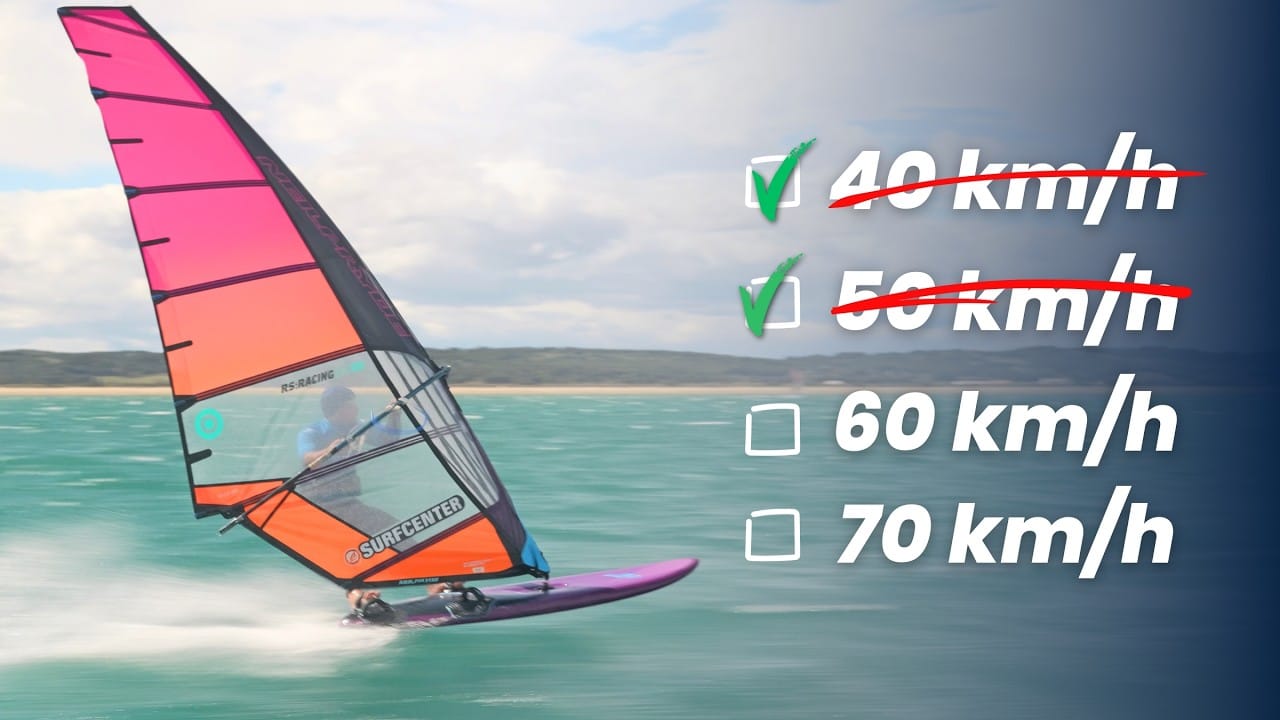
Windsurfers can expect varying top speeds depending on their equipment setup, though these figures are approximate and influenced by factors like board, sail, conditions, and rider weight. For pure wave equipment with a thruster or quad fin setup, a speed of 55 km/h is considered excellent. Switching to a longer single fin with wave gear can push speeds closer to 60 km/h.
Moving to a freeride setup, typically around 120 liters with a 7 square meter sail, a rider achieving 65 km/h is deemed very fast. The highest speeds are generally found with free race boards paired with free race or race sails, where windsurfers can reach approximately 70 km/h. These benchmarks provide a general guide for performance expectations across different windsurfing disciplines.
Heavier Windsurfers Often Achieve Higher Top Speeds in Strong Winds
Counterintuitively, while lighter windsurfers gain an advantage in early planing, heavier individuals can often achieve higher top speeds, particularly in strong winds. This phenomenon, encapsulated by the phrase "fat is fast," is attributed to the increased ability of heavier riders to apply more consistent pressure to the fin and maintain better control over their gear when wind conditions intensify.
The distribution of weight is also critical. While being lighter can allow for switching to smaller gear more quickly, beneficial in certain situations, ultimate GPS speed readings in sufficiently windy conditions show a correlation between more weight and greater speed. This is why some speed sailors even use weight vests, highlighting weight's role as a potential limiting factor for maximum speed.
"Purely looking at GPS when it's windy enough for your weight and for your gear setup, more weight will get you to more speed."
Instinctual Fear Creates 'Personal Barrier' to Windsurfing Speed
Many windsurfers encounter a "personal barrier" that prevents them from reaching higher speeds, characterized by instinctual micro-hesitations when strong gusts hit. This barrier manifests as automatically opening the sail slightly or releasing fin pressure, often without conscious awareness, effectively aborting the mission to accelerate further.
This reaction stems from a primal instinct designed to prevent risk, causing the body to react before the conscious brain can process the intense sensory overload of increased wind noise, spray, and board impact. Recognizing this inherent fear, which varies among individuals but is universal, is the first step towards understanding and eventually overcoming these speed-limiting reflexes.
"Your body reacts before your conscious brain does... your body your instincts has abort mission."
Gradual Exposure Retrains Brain to Overcome Speed Barrier in Windsurfing
Overcoming the "personal barrier" to speed in windsurfing requires retraining the brain to perceive higher speeds as safe and controllable, rather than attempting to eliminate fear entirely. This process involves incrementally pushing one's comfort zone, typically by increasing speed by just 1 or 2 km/h beyond the current limit, thereby resetting the comfort threshold.
Similar to learning other challenging skills, this approach avoids forcing the progression and instead gradually stretches the rider's perceived limits. By demonstrating control at slightly higher velocities, the brain learns that these new speeds are manageable, ultimately moving the psychological barrier further out. This continuous, gradual expansion of the comfort zone is crucial for advancing at any skill level.
"You have to teach your brain that this new speed is still safe, that you're still in control."
Summarised from Nico Prien · 16:02. All credit belongs to the original creators. Streamed.News summarises publicly available video content.
Streamed.News
This publication is generated automatically from YouTube.
Convert your full video library into a digital newspaper.
Get this for your newsroom →