Original source: Goya Windsurfing
This video from Goya Windsurfing covered a lot of ground. Streamed.News selected 8 key moments and summarises them here. Everything below links directly to the timestamp in the original video.
Ever wonder why a high-end surfboard feels so responsive? A tiny error in fin angle, a detail managed in this step, can change everything.
Precision Jigs Are Critical in Surfboard Fin Box Installation
In the surfboard routing room, technicians install fin boxes using specialized jigs and router bits set to precise depths. They use these tools to cut cavities for systems like FCS or Future fins, which are then secured with resin. Another set of jigs ensures the fin boxes are set at the exact angle specified by the design, a critical quality control measure.
This meticulous process is essential because an error of just two degrees in a fin's angle can dramatically alter a board's performance and feel on the water. It highlights how small, manual adjustments in manufacturing directly translate to the high-performance characteristics of the final product.
"You're off two degrees on one side and another, the board's going to feel completely different."
Surfboard Design Blends Machine Precision With a Master Shaper's Touch
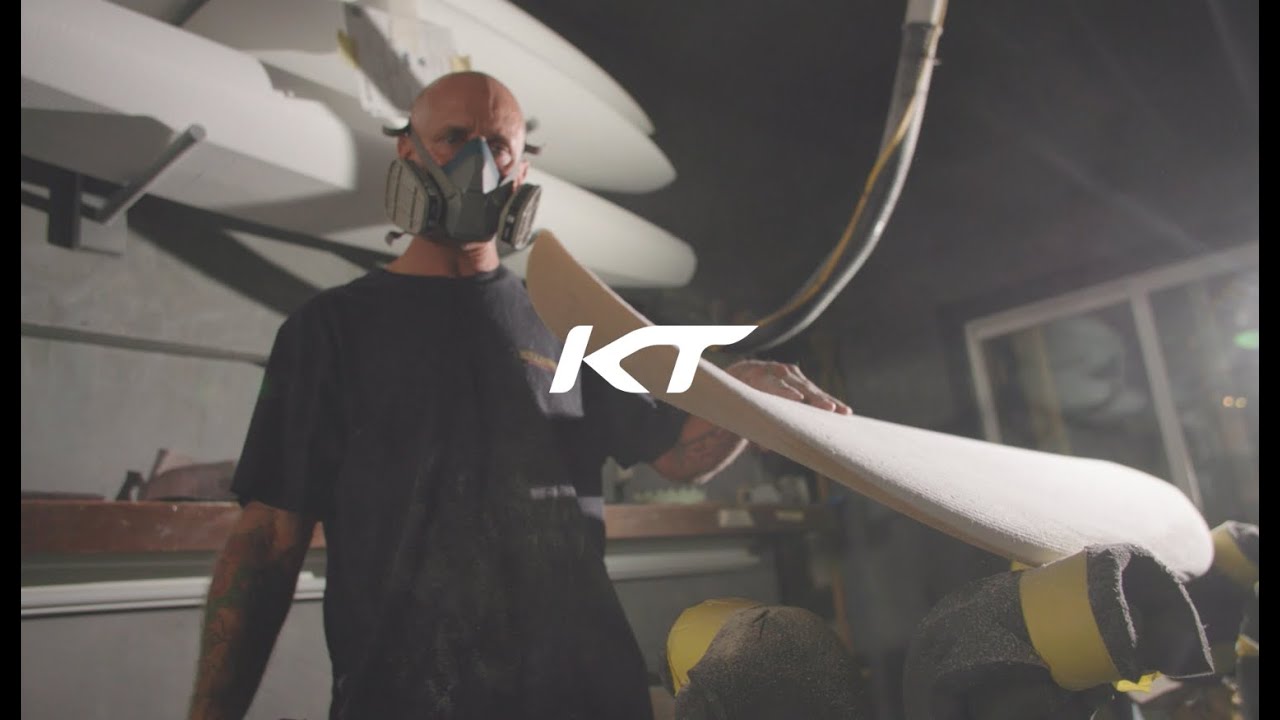
At the Cobra factory, machine-cut surfboard blanks are refined through a collaboration with a veteran shaper who has reportedly made over a million boards in 35 years. The designer works directly with this master craftsman to fine-tune critical elements like the board's rails, ensuring the feel and performance of KT boards match the intended design. This hands-on process allows the designer to leave confident that production will maintain quality.
This blend of automated shaping and expert hand-finishing illustrates a hybrid manufacturing model that leverages both technology for consistency and human expertise for nuanced performance characteristics.
"I can leave feeling confident that I'm going to get what I need."
Surfboard Lamination Requires Segregated Resins and Precise Application
In the lamination stage, each surfboard receives a specific resin mix tailored to its design. For polyurethane boards with wood stringers, workers apply a 4-ounce layer of epoxy resin to the bottom and a double 4-ounce layer to the deck. Each side is laminated and allowed to cure separately before work on the other side begins.
To prevent chemical reactions that would ruin the board, polyester and epoxy resins are kept and used in entirely separate rooms. This strict segregation highlights the chemical sensitivity of the materials and the procedural discipline required for a durable product.
"We always keep them separate to [avoid] contamination."
Experienced Shapers Hand-Finish 8-10 Boards Daily, Refining Machine-Cut Blanks
In the shaping bays, highly experienced craftsmen manually refine the surfboard blanks that come from CNC machines. These shapers, described as some of the most prolific on the planet, focus on details like rail roundness and edge tuck, using physical templates to check their work against the design specs. Each shaper is capable of finishing between 8 and 10 boards per day.
This stage demonstrates that despite automation in initial shaping, the final, subtle contours that define a board's performance remain the domain of skilled human hands.
"The pre-shape is there... and then I work with the with the local shapers here and I tune them up on how I want my rails round, where I want my edge tuck."
Cobra Factory Uses 12 Aqua CNC Machines for Precise Surfboard Milling
The Cobra factory's CNC section utilises a dozen Aqua* shaper machines, an industry standard, to mill surfboard blanks with precision and speed. The process involves securing the blank with vacuum cups and using actuators to ensure correct thickness when the board is flipped for milling on the other side. A board can be milled in about 20 minutes, producing a highly consistent pre-shape.
This automation provides the foundation for the entire production line, ensuring that every board starts with the exact same dimensions before it moves to the hand-finishing stages.
"We have the vacuum cups that hold the board down. And we have these things... called actuators. And that's basically when you flip a board... that makes sure that the thicknesses are correct."
Final Surfboard Inspection Checks Fin Fit, Blemishes and Rail Sharpness
Before being boxed and shipped, every surfboard undergoes a meticulous final quality control inspection. Technicians check for any cosmetic blemishes, ensure logos are correctly applied, and verify the sharpness of the board's rails. A key part of the process is testing the fin boxes to guarantee a proper fit, preventing issues like sticky fins for the customer.
This final check acts as the last line of defence to ensure the finished product meets all design and performance specifications, underscoring the importance of process control throughout manufacturing.
"We wouldn't want to have a board that has a sticky fin."
Surfboard Blanks Undergo Triple Check With Traceability System After Milling
Immediately after emerging from the CNC machine, surfboard blanks pass through a rigorous "triple check" quality control station. Inspectors verify the board's rocker—its lengthwise curve—and check for any potential bubbles or flaws in the blank itself. Each board is accompanied by a production card that is signed at every stage of the manufacturing process.
This system creates a traceable record for accountability. It allows managers to identify exactly who handled a board and at which stage a problem might have occurred if a customer later files a claim.
"We can go back to the production card... and we can see who signed and did what and at which stage there was a problem."
Surfboard Finishing Involves Hot Coat, Sanding and Final Sealing Spray
The final surface finishing of a surfboard involves several key steps, beginning with a "hot coat" of resin. This layer fills in the weave of the fiberglass and any small voids, creating a smooth, sandable surface that restores the board's original shape. After a detailed sanding, the board receives a light spray finish for a uniform look, followed by a final clear coat to completely seal it.
This multi-stage process is what gives a new board its flawless, ready-to-sell gloss and ensures it is watertight and durable for use on the water.
"[The hot coat's purpose is] to fill any little voids, fill the weave, and basically create a surface that can be sanded and bring the shape back to the original."
Summarised from Goya Windsurfing · 19:30. All credit belongs to the original creators. Goya Windsurfing summarises publicly available video content.
