🌐 Also available in: 🇪🇸 Español
Original source: Nate Hagens
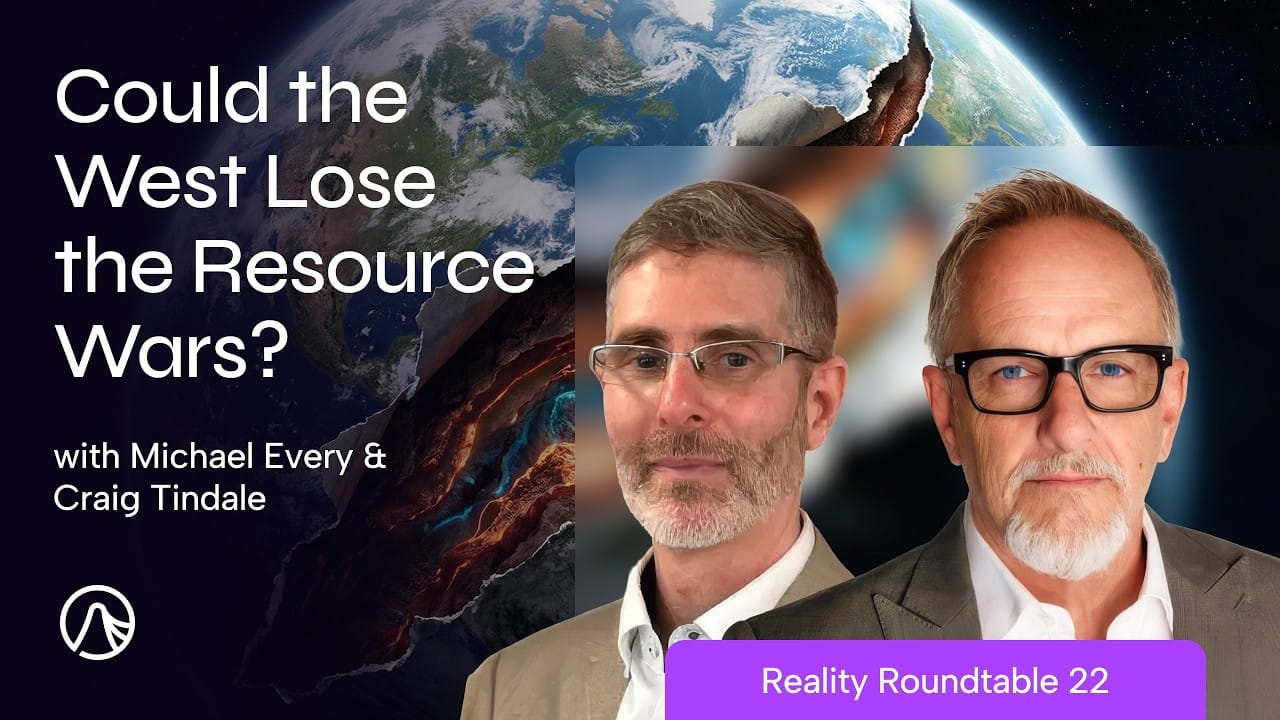
This video from Nate Hagens covered a lot of ground. Streamed.News selected 8 key moments and summarises them here. Everything below links directly to the timestamp in the original video.
Understanding this proposed strategy is crucial for grasping how major powers might navigate the complex, resource-constrained global economy, potentially impacting international trade, energy prices, and geopolitical alliances.
Michael Every Proposes US Economic Statecraft and Military Leverage to Avert War with China
Michael Every outlines a "benign path" to prevent war between the United States and China, advocating for aggressive US economic statecraft. This strategy involves substantial state involvement in industry, securing critical resource choke points like Venezuela and Iran through military means, and encouraging China to transition its economic model from export-driven manufacturing to domestic consumption. Such a rebalancing, he suggests, would stabilize global trade dynamics.
This approach signals a departure from purely free-market ideologies, acknowledging a geopolitical landscape where state-backed economic power dictates access to vital resources. By leveraging military strength to control supply chains, the US could establish a position of strength, compelling China to adjust its economic structure and potentially defuse escalating tensions that threaten global stability.
"I think the clearest path towards avoiding war is to pivot very aggressively towards economic statecraft, which is more state involvement."
Geopolitical Tensions Force Countries to 'Pick a Side' as India Faces Defense Vulnerabilities
Michael Every advises nations to choose a side in the escalating geopolitical and economic struggle between the United States and China, emphasizing that neutral positions are increasingly untenable. Craig Tindale highlights India's precarious defense situation, revealing its overwhelming reliance on Russia and China for critical defense metals and components. This dependence leaves India with a dangerously limited munitions supply, estimated at only 14 to 30 days.
This vulnerability underscores the profound biophysical constraints impacting national security in an era of complex global supply chains. India's reliance on specific external powers for essential materials illustrates how industrial interdependence can translate directly into strategic weakness, forcing difficult choices and potentially reshaping regional power dynamics.
"Ultimately you're going to have just a bifurcation of different models."
US Recognizes Geopolitical Struggle, Europe Remains Divided, as China Maintains Economic Advantage
Michael Every observes that the United States has gained a clearer understanding of the ongoing geopolitical struggle, but its ability to implement a coherent strategy is hampered by deeply entrenched vested interests. In contrast, Europe remains divided and beholden to outdated market regulations, struggling to adapt. China, meanwhile, continues to leverage its existing economic model, while the US aims to utilize its military power to secure critical raw materials and pressure China to rebalance its manufacturing-heavy economy towards greater consumption.
This dynamic illustrates the inherent inertia within complex human systems, where the recognition of systemic challenges often outpaces the capacity for collective action. The pursuit of resource control by the US reflects a fundamental biophysical reality: access to raw materials underpins industrial capacity and military strength, shaping the trajectory of global power in an era of declining net energy and increasing competition.
"America gets it, but Europe is doing very little. It's incredibly hard to coordinate when they each has their own vested interests."
China's Control Over Rare Earths Creates Economic Choke Points for Western Nations
Craig Tindale asserts that Western nations face an economic siege due to China's dominant control over rare earth metals and essential chemicals. This control establishes critical choke points, making it financially unviable for Western countries to develop their own refining capacities, particularly given high ESG (Environmental, Social, and Governance) costs. For instance, a Canadian rare earth refinery project was canceled because the ESG costs alone amounted to nearly 9% of the project's total cost, making it unprofitable.
This situation exemplifies a form of economic warfare, where state-capitalist strategies exploit the free market system. The inability of Western private capital to compete with state-subsidized adversaries for essential material throughput highlights a fundamental biophysical constraint: without direct control over the refining of critical elements, industrial economies remain vulnerable, limiting their capacity for independent action and adaptation in a resource-constrained world.
"It's a form of state capitalism recapping the golden, I call the golden screw, and that's not obtainable."
US-China Dynamic Described as 'Conjoined Struggle'; US Control of Iran Seen as Key to Power Balance
Craig Tindale characterizes the US-China dynamic as a "Chinese burn" or "Siamese twins," suggesting both nations are hurting each other while being inextricably linked, necessitating a mutual withdrawal from conflict. He views US control of Iran as essential for balancing global power. Michael Every emphasizes that European and Canadian perspectives often fail to grasp the fundamental nature of this core US-China struggle, particularly how the US is prepared to act outside traditional market rules to achieve its strategic objectives.
This analysis frames global geopolitics as a contest for material and energetic leverage, where the control of strategic chokepoints like Iran becomes paramount. The inability of some Western nations to understand this underlying biophysical competition reveals a cognitive dissonance, hindering their capacity to adapt to an evolving world order defined by resource scarcity and great power rivalry.
"If you don't understand the existential struggle that's playing out between the US and China, you desperately misread what's going on."
Critical Material Shortages to Prioritize Basic Industry, De-industrializing Renewables
Craig Tindale posits that impending critical material shortages will create a hierarchy of demand, pushing renewable energy projects to the bottom of the priority list. He argues that current economic models, exacerbated by ESG (Environmental, Social, and Governance) costs, accelerate de-industrialization by making material extraction and processing financially prohibitive in Western nations. This necessitates a new economic system rooted in materiality rather than abstract financial ledgers, with AI potentially providing clarity to facilitate this transition.
This perspective reframes economic activity within fundamental biophysical constraints, highlighting how the human superorganism's energy throughput and material requirements will dictate which sectors receive resources. The anticipated de-industrialization of renewables underscores the complexity costs inherent in transitioning to new energy systems, revealing a potential mismatch between societal aspirations and material realities without a foundational shift in economic thinking.
"The way they've built the economic system is that they accelerate de-industrialization because, you know, ESG is about five to 7% of more expensive capital."
AI Job Displacement Concerns Highlighted Amid Calls for Resource Innovation and Distributed Computing
While Michael Every dismisses predictions of 80% white-collar job losses to AI, he warns that even an 8% reduction could further radicalize society, citing the immediate financial pressures on mortgage payments and daily expenses. Craig Tindale counters that societal friction will inevitably drive innovation, particularly in resource reclamation. He also proposes a shift towards distributed edge computing for AI, reducing its massive energy and water footprint, as demonstrated by approaches in China.
This exchange underscores the tension between technological advancement and biophysical constraints within the human superorganism. The potential for social instability due to job displacement conflicts with the imperative for more efficient, less resource-intensive AI architectures. This dynamic points to an evolutionary pressure to align technological development with material realities, or risk exacerbating societal friction in an increasingly constrained world.
"If we lose 8% of our white collar jobs, what about the mortgage payments and the rent payments?"
▶ Watch this segment — 1:06:21
AI Could Expose Industrial Decline and Drive Shift to Materiality-Based Economy
Craig Tindale critiques the current economic pricing model as a lagging indicator that overlooks the industrial sector, creating a false sense of prosperity focused solely on consumption. He suggests that artificial intelligence (AI) could provide unprecedented clarity and granularity, exposing the ongoing hollowing out of industrialization in Western economies. This enhanced visibility, he argues, could force a systemic shift from a fragmented, vertical economic structure focused on financial ledgers to a horizontal, integrated system prioritizing materiality and biophysical realities.
This reframing highlights a critical gap in the human superorganism's self-perception, where financial abstractions have obscured the underlying material and energy throughput. AI, in this context, becomes a potential tool for bridging the gap between what we know and what we do, providing the friction necessary for an evolutionary change towards an economy grounded in physical limits rather than perpetual growth on paper.
"I think the whole pricing model is the problem. It's a lagging indicator. It's like a dashboard that tells you what happened 10 minutes ago."
Also mentioned in this video
- The current market forces, which prioritize 20-30% returns, are insufficient to… (0:00)
- Nate Hagens opens the conversation by asking Craig Tindale and Michael Every… (3:03)
- Nate Hagens sets the stage for the discussion, referencing Craig Tindale's… (4:36)
- Michael Every defines economic statecraft as grappling with the uncomfortable… (10:11)
- Michael Every illustrates the cognitive dissonance in various sectors, where… (14:43)
- In addition to technological changes and material realities, a shift in… (22:26)
- Climate change is far worse than generally understood, and while AI could offer… (47:08)
- Is leading to radicalized political ideas across the spectrum, eroding the… (52:57)
- Michael Every agrees with Craig Tindale's analysis of flawed financial models,… (58:37)
- The prediction of 80% white-collar job losses due to AI, arguing that AI gurus… (1:01:28)
- Craig Tindale envisions a post-capitalist world where AI, used as a programming… (1:14:56)
- Forums like this podcast are crucial for creative thinking and sharing radical,… (1:18:52)
- Craig Tindale believes that providing clear, mechanistic lenses over society… (1:21:01)
- The rarity of such inquisitive minds and worries that declining educational… (1:24:31)
- The importance of connecting hyper-global and hyper-local perspectives by… (1:27:50)
- Accept inevitable friction and change, and prepare themselves rather than… (1:33:14)
Summarised from Nate Hagens · 1:34:59. All credit belongs to the original creators. Streamed.News summarises publicly available video content.