🌐 Also available in: 🇪🇸 Español
Original source: DECODE con DaniNovarama
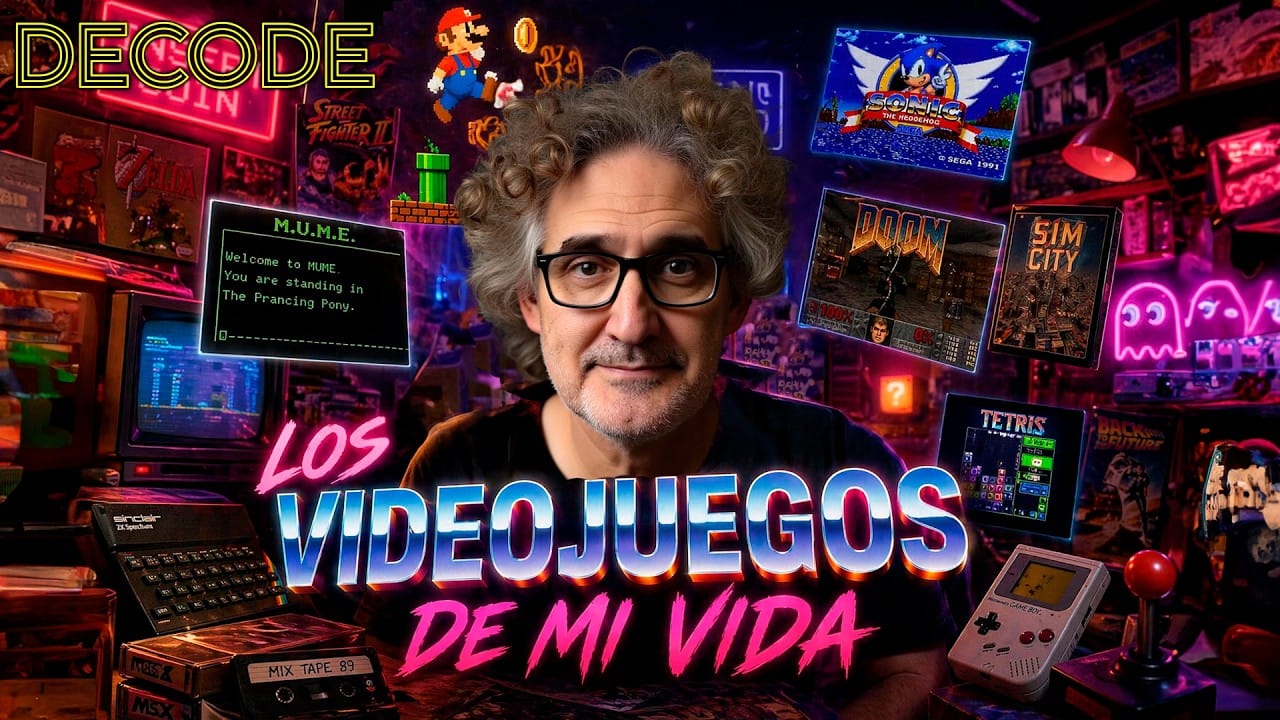
This video from DECODE con DaniNovarama covered a lot of ground. Streamed.News selected 8 key moments and summarises them here. Everything below links directly to the timestamp in the original video.
What does real innovation look like in a saturated market? Invisimals makes a sharp case that originality — not imitation — is the only reliable path to lasting success in games.
DaniNovarama calls Invisimals a 'blockbuster' and a masterclass in disruptive success
DaniNovarama highlights Invisimals (2009), a game he co-designed, as a personal and professional milestone. He calls it a commercial 'blockbuster' — the second best-selling PSP game of its launch year, behind only a FIFA title. The success brought recognition, but more importantly taught him the rules of disruptive innovation: bold, original ideas are what cut through a crowded market.
Invisimals became his framework for understanding success — not as imitation, but as invention. Novarama thrived when it swung for originality and struggled when it played it safe. That contrast sharpens his argument against an industry often criticized for sequels and safe bets.
"Invisimals taught me two lessons: what success is, and what the road to success looks like."
Minecraft: A masterclass in freedom and emergent game design
Minecraft (2011) earns its spot as the ninth featured game for its extraordinary freedom and its ability to generate complex worlds from a simple ruleset. DaniNovarama praises its 'emergent' design — a handful of basic rules combining to produce billions of distinct experiences, keeping players hooked for years.
This approach, which puts player autonomy above linear narrative, makes Minecraft a benchmark for aspiring game designers. The ability to build sprawling infrastructure — like a monorail spanning an entire kingdom — shows how deep its systems run, cementing it as a creative and educational platform well beyond pure entertainment.
"Emergence — how combining simple rules produces billions of different outcomes. That's what you can learn about game design from Minecraft."
Journey: A wordless allegory that moves players and teaches design
Journey (2012) left such a mark on DaniNovarama that he played it twice in a single night — once to feel it, once to take it apart. Created by Jenova Chen, the game works as a powerful allegory for life, death, and human interdependence, communicated without a single written or spoken word.
Its visual storytelling and masterful score make Journey a fully immersive experience — proof that games can tackle deep existential themes as a legitimate art form. Its architectural design and ability to forge emotional connection without dialogue make it essential viewing for anyone tracking where interactive narrative is headed.
"The first playthrough was to feel it. The second was to understand it — to see what the game was doing at the level of design and architecture, and why it was hitting me so hard."
Ico: The First Video Game That Made DaniNovarama Cry and Revealed Gaming as Art
Ico (2001), a PlayStation game designed by Fumito Ueda, ranks fifth on DaniNovarama's list of most impactful titles — and holds a unique distinction: it's the first game that moved him to tears. That emotional experience revealed that video games could transcend entertainment and become a genuine art form. The story — rescuing a princess in a castle, told with almost no dialogue — demonstrated the raw power of interactive narrative.
Ico transformed his understanding of the medium, placing it alongside cinema and literature as art capable of deep emotional connection. His later friendship with designer Fumito Ueda — who also created Shadow of the Colossus and The Last Guardian — underscores Ico's status as a landmark work that redefined what video games could make players feel.
"The ending, honestly, made me realize that a video game could truly be an art form."
DaniNovarama Calls Out the Video Game Industry's Innovation Deficit
DaniNovarama notes that none of his most influential games are recent — the newest is Pokémon Go from 2016. His measure isn't sales figures or graphical fidelity; it's emotional impact and the ability to deliver unforgettable "first times." That standard implies a sharp verdict on where the industry stands today.
In his view, the industry has traded genuine innovation for scale and spectacle. The pursuit of bigger, more visually impressive productions has come at the cost of the breakthroughs that once defined the medium. The paradox: chasing the grandiose, developers lose the moments of wonder and connection that actually leave a mark on players.
"What made this industry great was making us feel new things — like those 15 experiences I've tried to describe today. We're an entertainment industry, but above all we're an industry of emotions."
Shenmue: The Video Game That Became DaniNovarama's Real-World Map
Shenmue (1999), designed by Yu Suzuki for Sega, ranks fourth on DaniNovarama's list — not just for its faithful recreation of the real world, but for a remarkable real-life consequence. During a trip to Hong Kong around the game's launch, he navigated the city using landmarks he already knew from playing it. He describes the experience as "tremendously surreal."
That collision of virtual and physical worlds — Shenmue's meticulous recreation of Hong Kong streets and signage — showed what the medium could become beyond pure entertainment. The anecdote captures how deep immersion can reshape perception of the physical environment, blurring the line between simulation and reality.
"For me, it was the first time a video game represented a world — but that world was the real world, our world. I was literally using the game to navigate the streets of Hong Kong."
Pokémon Go: A Personal and Professional Milestone in Augmented Reality
Pokémon Go (2016) earns its place on DaniNovarama's list for two reasons: it was the first video game he played with his eldest daughter — a memorable shared moment — and it intersects directly with his career. DaniNovarama had previously developed Invizimals for Sony, widely seen as a forerunner of the hunt-monsters-in-the-real-world mechanic, and later spent four years working at Niantic, the company behind Pokémon Go.
The game marked a family milestone and validated his long-held vision for augmented reality in gaming, even though Niantic's execution far exceeded the tech constraints he once faced. His arc — from conceiving Invizimals to collaborating with Niantic — traces the industry's broader shift toward blending play with the physical world, turning gaming into a social, shared activity.
"It was the first time I ever played a video game with my daughter, and I still remember her face. We were obsessed with finding a Pikachu."
Uncharted 2: The Game That Out-Hollywood'd Hollywood
Uncharted 2: Among Thieves is the eighth game that shaped DaniNovarama — and the first time he felt a video game had beaten a Hollywood action film at its own game. It made the player feel like the hero of the story in a way, he argues, that not even Indiana Jones could match. The blend of acrobatics, combat, and set-piece gunfights delivered immersion on an unprecedented scale.
Years later, DaniNovarama got to speak directly with designer Richard Le Marchant about how levels like the iconic train sequence were built. That conversation deepened his appreciation for the game's internal architecture and showed how interactive storytelling can lift action narratives to a level of engagement that passive film simply cannot reach.
"Uncharted was the moment I said, for the first time, this is better than the movie. It's like the films, but I'm the hero."
Also mentioned in this video
- DaniNovarama's first influential game: Abu Simbel Profanation (1:14)
- Second highlighted game: Mume (Multiple Users in Middle Earth), a MUD (3:24)
- Age of Empires (1997): third game that marked DaniNovarama (5:19)
- Battlefield 1942: sixth game, important to DaniNovarama (11:36)
- Guitar Hero (2005): seventh game, influential for physical excitement (13:30)
- Sleeping Dogs: eleventh game, his 'personal GTA' (20:23)
- Assassin's Creed (2007) and Black Flag (2013): twelfth game (22:54)
- Kerbal Space Program (2015): thirteenth game, space simulator (25:06)
- Conclusion: the industry is repeating itself, becoming a formulaic industry (36:05)
Summarised from DECODE con DaniNovarama · 39:04. All credit belongs to the original creators. Streamed.News summarises publicly available video content.