🌐 Also available in: 🇪🇸 Español
Original source: Nate Hagens
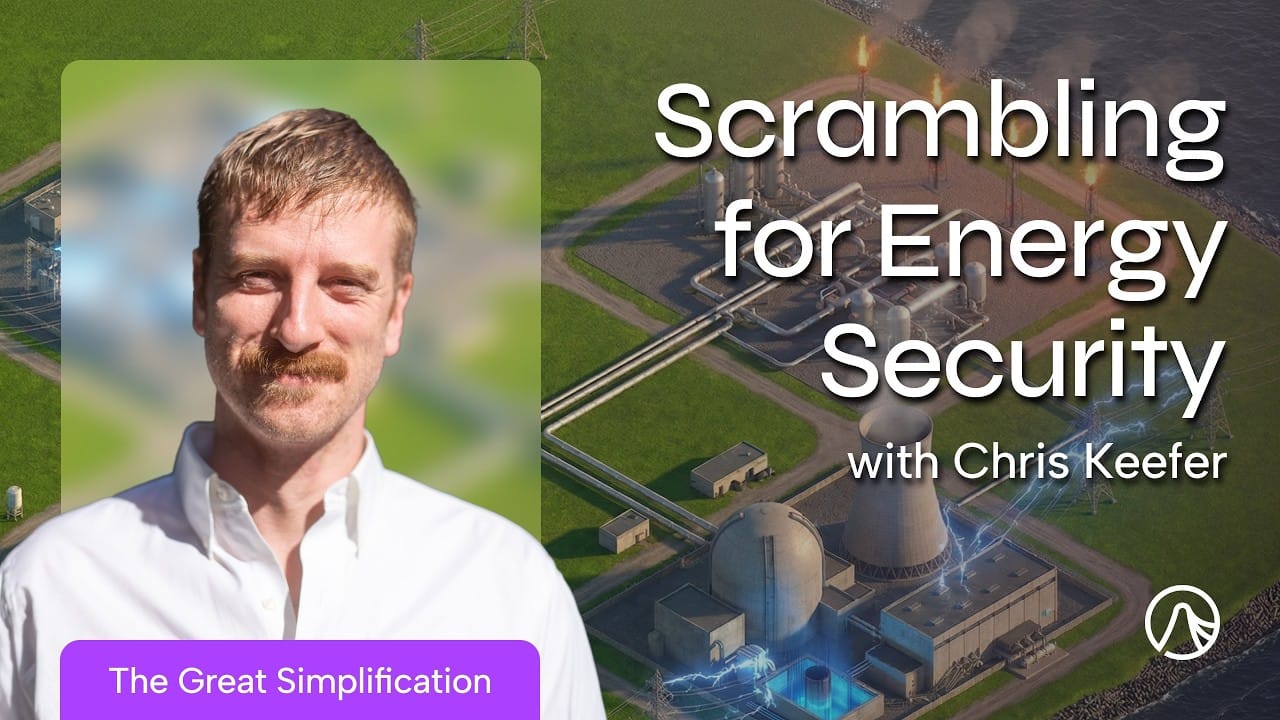
This video from Nate Hagens covered a lot of ground. Streamed.News selected 8 key moments and summarises them here. Everything below links directly to the timestamp in the original video.
Imagine powering millions of homes with just three grams of material. This segment unpacks the astonishing efficiency of nuclear power, revealing why its energy density is a game-changer for industrial society.
Nuclear Power Boasts Unrivaled Energy Density, Researcher Explains
Nuclear power stands out for its extraordinary energy density, a concept often underappreciated in public discourse. A single one-gigawatt nuclear power plant, for instance, requires only about 100 tons of uranium fuel annually. After processing, the actual mass converted to energy is minuscule, approximately three grams per year. This minute amount of mass, according to Einstein's E=mc² equation, generates enough electricity to power between one to three million homes, underscoring its unique efficiency among energy sources.
This extreme energy density is foundational to understanding the biophysical advantages of nuclear technology. In a world facing increasing energy throughput demands and resource constraints, the ability to generate vast amounts of power from a tiny material footprint carries significant systemic implications. It reframes the conversation around industrial society's energy base, highlighting how nuclear offers a path toward meeting high-level energy needs with minimal material extraction and fuel cycle volume, a critical consideration for long-term civilizational complexity.
"If you actually do the calcs, to run that plant that provides a gigawatt of electricity, you need three grams. Three grams."
Chernobyl's Lessons: Reactor Design and Real Radiation Risks Clarified Amidst Geopolitical Tensions
Concerns about nuclear waste management in a 'Great Simplification' scenario often evoke fears of events like Chernobyl. The 1986 Chernobyl disaster, a worst-case scenario, resulted from a specific RBMK reactor design unique to the Soviet Union, which could undergo a power excursion and ignite its graphite moderator. Western light water reactors, by contrast, use water as a moderator and cannot catch fire in the same manner. While initial fatalities at Chernobyl were limited to 30 plant operators and firefighters from acute radiation syndrome, the main long-term health impact has been an increase in thyroid cancers among children and adolescents exposed to radioactive iodine, totaling approximately 15,000 excess cases over the full course, though this cancer is highly treatable.
The global geopolitical landscape, particularly in the Middle East, introduces new risks as nations like Iran operate nuclear reactors. The potential for attacks on nuclear power plants, as recently highlighted by threats against the United Arab Emirates' Barakah Nuclear Power Station, underscores the vulnerability of critical energy infrastructure. While the health consequences of a reactor meltdown are severe, understanding the specific design vulnerabilities of different reactor types, such as the graphite-moderated Chernobyl versus modern water-cooled reactors, is crucial for accurate risk assessment and developing resilient energy security strategies in an increasingly complex and volatile world.
"Chernobyl really is the worst-case scenario. This was a reactor design that's nothing like we build in the West."
▶ Watch this segment — 1:01:13
Nuclear Discourse Outpaces Deployment as Tech Investors Misapply Software Models to Hardware
Despite an accelerating public discourse and media enthusiasm for nuclear power, particularly within the startup sector, actual deployment of new nuclear technologies lags significantly. This discrepancy is largely attributed to a 'category error' by tech investors who mistakenly apply venture capital playbooks, suitable for software development, to the profoundly different realities of complex hardware projects like nuclear reactors. Narratives focusing on 'advanced' or small modular reactors, often based on decades-old experimental designs, attract substantial investment without the grounded understanding of the immense capital, regulatory, and engineering challenges inherent in nuclear construction.
This misapplication of a 'move fast and break things' software ethos to nuclear technology, where debugging during deployment is fundamentally catastrophic, highlights a systemic failure to grasp biophysical constraints. The pursuit of novel, unproven designs, driven by speculative investment rather than proven engineering, diverts attention and capital from the scalable, large-gigawatt water-cooled reactors that historically achieved cost and timeline efficiencies. This phenomenon reflects a broader societal tendency to seek techno-optimist solutions without confronting the intricate, material realities of energy infrastructure, thereby perpetuating a gap between perceived and actual progress in energy transitions.
"There's a category error by the software valley investor, and you've made your fortune picking gutsy startups with good narratives that have then debugged it as they went and turned into multi-billion dollar companies. You kind of look at nuclear in that light, apply the same playbook, but you're talking about two totally different things."
▶ Watch this segment — 1:13:42
Beyond Carbon: Nuclear Power Offers Critical Medical Isotopes and Stable Employment
Nuclear power's benefits extend beyond its zero-emission electricity generation, a key factor in addressing climate change and local air pollution. A less-recognized but vital contribution is its role in producing medical isotopes, such as Cobalt-60, essential for modern healthcare. These isotopes are used to sterilize a vast array of single-use medical devices and in various diagnostic and therapeutic applications. The continuous, reliable operation of nuclear plants ensures a stable supply of these critical materials, which are difficult to produce by other means on an industrial scale.
Furthermore, nuclear power plants provide stable, intergenerational employment, offering high-skill jobs that can sustain communities for decades, as exemplified by a Detroit plant that supported four generations of workers. The long operational lifespan of these facilities, often extending to 80 or 90 years, allows for sustained economic activity and a stable energy base for human populations. However, the high upfront capital expenditure (CapEx) required for construction remains a significant negative, posing challenges within conventional private investment models that demand quicker returns on investment.
"Medical isotopes are, can be produced by CANDU designs, has this property of producing medical isotopes, which enable modern healthcare."
Large Water-Cooled Reactors Remain Most Economic and Proven Nuclear Technology
Amidst persistent hype surrounding 'advanced' and small modular nuclear reactors (SMRs), large gigawatt-scale water-cooled reactors continue to be the most economically viable and proven technology for nuclear power generation. Designs like molten salt reactors and sodium fast reactors, often touted as 'Generation IV' or novel, are in fact older concepts from the 1950s and 60s that failed to achieve commercial competitiveness. These smaller and 'advanced' designs inherently carry higher per-unit costs due to fixed expenses like security, quality assurance, and regulatory compliance, which do not scale down linearly with reactor size.
The economic viability of microreactors, for instance, which produce as little as 10 megawatts, is severely constrained by their tiny revenue streams, making it difficult to cover operational costs like security and operator salaries, let alone recoup construction expenses. The belief that these unproven technologies will revolutionize nuclear power often stems from a fundamental misunderstanding of the biophysical and engineering realities of complex hardware. History demonstrates that large-scale, standardized water-cooled reactors are the most effective path to delivering reliable, affordable nuclear energy, placing the burden of proof on proponents of alternative designs to demonstrate genuine competitiveness.
"My thesis is that's still the case, and the burden of proof is on the people that say, 'Oh, no, it's my small modular reactor' or 'It's my molten salt reactor, it's my sodium fast reactor.'"
▶ Watch this segment — 1:17:34
Europe's Energy Shift: Dependency on LNG Drives De-industrialization Amidst Price Spikes
Europe's energy landscape has fundamentally shifted since cutting off Russian natural gas, replacing it with expensive long-term contracts for Liquified Natural Gas (LNG) from Qatar and the United States. With Europe importing approximately 80% of its hydrocarbons, this pivot has left the continent highly vulnerable to global energy market fluctuations and geopolitical tensions. Despite these changes, some European nations, like Belgium, continue to import Russian LNG, highlighting the complex and often contradictory energy security decisions made under duress. The exorbitant price difference for natural gas—seven times higher in Europe than in the US, with forecasts showing continued elevated prices a year out—is fundamentally reshaping the continent's industrial base.
This high energy cost environment is leading to significant de-industrialization across Europe, particularly in Germany, which traditionally relied on cheap Russian gas. The systemic impact of energy scarcity, driven by geopolitical realignments and the inherent costs of an import-dependent system, manifests as industries relocate or downsize. This situation reveals a critical biophysical constraint: maintaining a complex industrial economy requires abundant, affordable energy. When that foundation erodes, the downstream effects ripple through the entire economic structure, ultimately diminishing societal complexity and living standards.
"How do you maintain an industrial economy with natural gas prices seven times higher? I mean, you don't, frankly."
LNG Infrastructure Vulnerabilities and Geopolitical Shocks Reshape Global Energy Security
Global energy security is increasingly defined by the vulnerabilities of Liquefied Natural Gas (LNG) infrastructure, particularly in light of recent geopolitical disruptions and attacks. Many nations, heavily reliant on energy imports, opted for LNG as a perceived stable source, leading to massive long-term contracts with suppliers like Qatar. However, the high capital investment required for LNG liquefaction plants, concentrated in a few key locations like Qatar's Ras Laffan Industrial City, creates single points of failure. Conversely, receiving terminals are comparatively simpler and cheaper to build, enabling broad adoption but also diffusing risk.
Recent events, including potential force majeure declarations and attacks on LNG infrastructure, have sent shockwaves through global markets, forcing importing countries to reconsider their energy strategies. The criticality of LNG extends beyond electricity generation to vital industrial processes, plastics manufacturing, and food production. This emphasizes how disruptions in highly concentrated energy production points can trigger cascading effects across interconnected global supply chains, fundamentally challenging the assumptions of uninterrupted global trade and energy flows that underpin modern industrial economies.
"If you are living under the illusion as many countries have, that LNG was a reliable energy, you know, we've had freedom of navigation and we've had peace for 80 years. That's a period that we seem to be coming out of."
Western Nuclear Construction Lags Behind China's Efficiency in Plant Development
The time and resources required to construct a new nuclear power plant vary dramatically between Western nations and countries like China. While China has demonstrated the ability to build gigawatt-scale nuclear reactors efficiently, often within 6 to 8 years from groundbreaking to operation, the West struggles significantly with large-scale infrastructure projects. In North America, for instance, there are currently no new nuclear power plants under construction in the United States, and Canada's only new project, a small modular reactor in Ontario, is projected to take 4 to 6 years, a timeline viewed with skepticism by experts.
Historically, Western nations, particularly the U.S. in the 1970s and 80s, were capable of building nuclear capacity at rates comparable to China's current pace, often doubling their grids every decade. However, a decline in collective project management capabilities, loss of specialized industrial knowledge, and complex permitting processes have severely hampered the West's ability to execute such projects. This disparity highlights a critical divergence in industrial capacity and strategic planning, with profound implications for energy security and the ability of Western societies to maintain their energy throughput in the face of biophysical constraints.
"China is currently pulling that off in 6 to 8 years, and we know how fast and efficient they are."
Also mentioned in this video
- The topic of energy crises, referencing the 1970s energy shocks and… (0:00)
- Current events in Iran and the bombing of natural gas fields have shifted the… (2:56)
- The current energy crisis forces a focus on basic physiologic needs, drawing… (4:36)
- Its importance to various countries and the vulnerability of concentrated LNG… (7:55)
- With wet coal and their varied investments in solar, LNG, and nuclear. (16:49)
- Nate Hagens shares Jean-Marc Jancovici's three ways to approach what's coming:… (24:01)
- Nuclear power plants are primarily built during times of energy crisis, with… (25:46)
- Nate Hagens asks Chris Keefer whether Germany and Japan will restart their… (27:10)
- Nuclear has an important role where it is a necessity, citing Taiwan's… (33:59)
- The high upfront capital costs of nuclear power do not fit well in neoliberal… (44:12)
- The need for a different political economy adapted to the current geopolitical… (52:18)
- Despite his pro-nuclear stance, he believes the focus should be on practical… (54:47)
- The danger of fresh nuclear fuel but emphasizes the safety record and… (1:00:09)
- Nate Hagens asks if nuclear power is a 'need to have' technology for a complex… (1:08:26)
- Nate Hagens asks Chris Keefer about the psychological underpinnings of energy… (1:20:41)
Summarised from Nate Hagens · 1:26:04. All credit belongs to the original creators. Streamed.News summarises publicly available video content.