🌐 Also available in: 🇪🇸 Español
Original source: Radio Con Vos 89.9
This video from Radio Con Vos 89.9 covered a lot of ground. Streamed.News selected 7 key moments and summarises them here. Everything below links directly to the timestamp in the original video.
Does the global economic elite's changing view reflect a broader shift in perception toward disruptive leaders, or is it a sign that the honeymoon period for political outsiders is coming to an end?
International coverage of Javier Milei shifts from bewilderment to skepticism, according to The Economist
Global perception of Argentine President Javier Milei has undergone a dramatic shift, moving from initial bewilderment and a degree of fascination over a supposed economic miracle to pronounced skepticism. Influential publications such as The Economist, The Wall Street Journal, and the Financial Times are now reporting on Argentina's economic challenges and corruption scandals, noting the "difficult moment" the president is facing. Journalist Martín Caparrós highlighted an article in The Economist which, in his view, offers a thorough critique of Milei's administration — a significant departure given the outlet's editorial stance, suggesting growing discontent within global corporate and neoliberal circles. This shift in the international narrative reflects a wearing down of Milei's image; he is no longer seen as a strong figure, but rather as a grotesque caricature used to draw comparisons and put local political situations into perspective, particularly in Spain. Milei's media relevance, which once rivaled the attention Raúl Alfonsín received during the military trials, appears to be waning, with his interventions losing impact and drawing indifference from some quarters.
"If The Economist is saying that, it means the people in charge are fed up with this man."
Xenophobia gains ground in Spain as parties push 'national priority' policies for public services
Xenophobia is on the rise in Spain, finding expression in "national priority" policy proposals championed by parties such as Vox and the Partido Popular. These initiatives advocate for giving preference to Spanish citizens in essential public services, such as hospital care, which would mean that foreigners are seen only after nationals — or, in some cases, denied service altogether. Journalist Martín Caparrós lamented that this trend coincides with Victory in Europe Day, which commemorates the defeat of Nazism, while in Germany, parties that openly identify as Nazi are showing potential to win elections in certain states — a development he regards as a failure of Germany's eight-decade effort to eradicate Nazism.
"The strength of xenophobia in these countries, in these times, is growing in a very troubling way."
Spanish media and opposition stoke hysteria over Patagonian 'antavirus' despite zero cases in the country
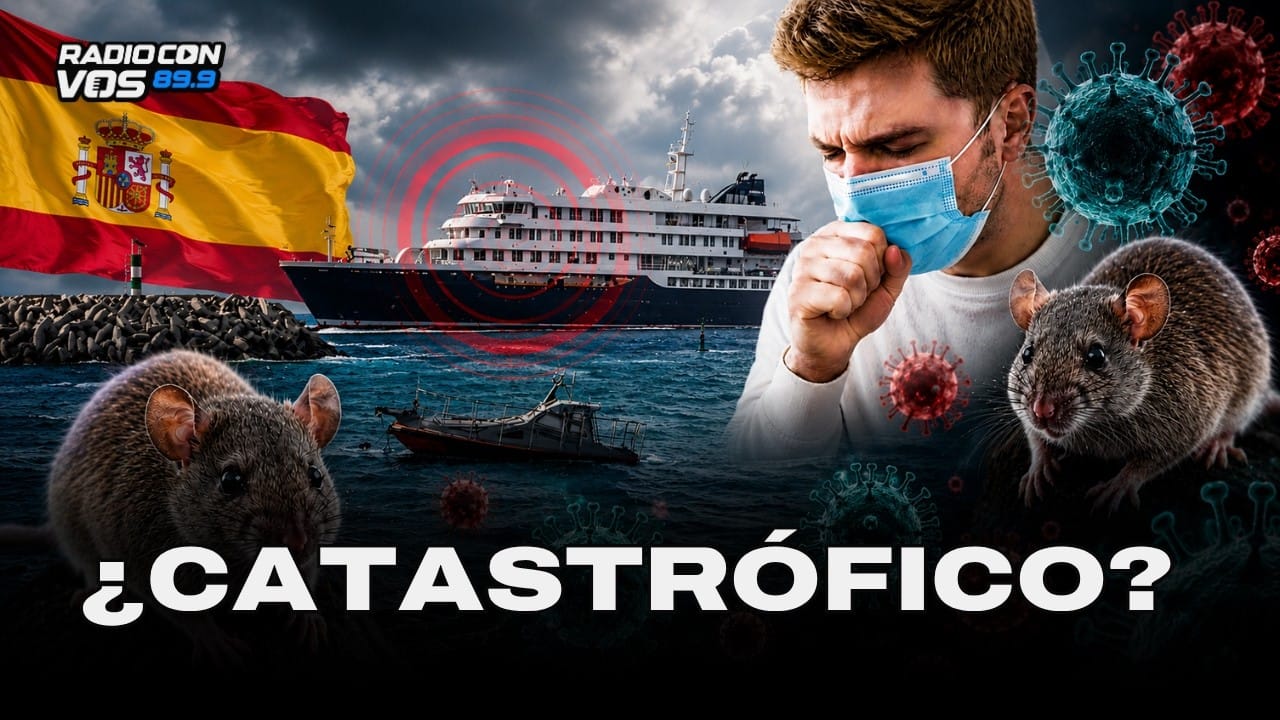
Journalist Martín Caparrós points out that Spain's major media outlets and opposition parties have adopted an unusual strategy: consistently highlighting disasters and crises in order to portray the country as being in a state of "apocalyptic collapse" — in stark contrast to most media around the world, which tend to downplay difficulties. This pattern was on full display in the coverage of the so-called Patagonian "antavirus." Despite no confirmed cases in Spain, a cruise ship incident involving two Dutch passengers who died from the virus — which originated in Ushuaia — triggered unprecedented media and political hysteria, transforming it into the "great threat" of the moment, even though the vessel was turned away from Cape Verde and the Canary Islands and the few patients on board were transferred elsewhere.
"Here, the media only try to prove that everything is constantly falling apart. It's quite remarkable."
Authenticity of Nazism in current German parties under scrutiny
Journalist Ernesto Tenembaum questions the true nature of Nazism within Germany's current political parties, suggesting that extremist ideologies are often diluted once they reach power. He drew comparisons with figures such as Giorgia Meloni in Italy, who, despite being perceived as fascist, has governed as a conventional center-right leader. He also pointed to the evolution of Marine Le Pen in France and other far-right groups, whose xenophobic and radical rhetoric tends to moderate or be absorbed by other priorities once they assume government office. One example of normalcy in Europe is a German mayor from a Green party who celebrated his victory by kissing his male partner — a stark contrast to extremist narratives — raising the question of just how 'Nazi' today's movements that label themselves as such truly are.
"When they come to power, it all melts away. You can even see it in Marine Le Pen's own evolution."
Neo-Nazism adapts its agenda: focus shifts to 'gender ideology' and domestic violence
Martín Caparrós explains that neo-Nazism has adapted its ideological priorities, abandoning the historical persecution of homosexuality — which proved no longer advantageous — to focus instead on new cultural battlegrounds. Current criticism is now directed at 'gender ideology' and women's rights, with concepts such as 'gender-based violence' being reframed as 'domestic violence' to dilute their specific meaning. Meanwhile, Ernesto Tenembaum cited Viktor Orbán as an example of an authoritarian leader in Europe who, despite his anti-democratic rhetoric and actions, was 'humiliated' at the ballot box — suggesting that disruptive phenomena often fail to reach the scale expected, and that democracy continues to function, albeit with difficulty.
"They have set aside something that could bring them no advantage whatsoever — quite the opposite, in fact."
Europe is politically more chaotic than Latin America, says Martín Caparrós
Martín Caparrós argues that, despite the comfort of everyday life, Europe is currently a politically more disordered region than Latin America. Caparrós pointed to ongoing wars, dictatorships such as Vladimir Putin's, and the rise of neo-Nazi groups with genuine electoral prospects in countries like France and Germany. This perspective challenges the widespread belief that Latin America is inherently less stable, suggesting that when Europe is viewed as a whole, the level of conflict and disorder becomes evident — something its own inhabitants try to 'forget.'
"If someone in a Latin American country looked at Europe as a region taken as a whole, what they would see is a space far more chaotic than Latin America."
Hysteria over Patagonian 'hantavirus' grips Spain after deaths aboard Ushuaia cruise ship
A outbreak of Patagonian 'hantavirus' aboard a cruise ship that departed from Ushuaia has sparked widespread hysteria in Spain, dominating media coverage across the country. Two Dutch nationals died on board the vessel, which was carrying mostly European passengers who had paid premium fares. After the virus was detected, the ship was turned away from Cape Verde and later from the Canary Islands, where the regional president publicly refused to allow it to dock — triggering a national debate over crisis management and the risk of contagion, despite the fact that the disease is not highly transmissible and no cases have been reported in Spain. Opposition politicians have accused the government of endangering public health over the potential arrival of the virus, labeling it 'the Patagonian strain' or 'the Andean strain.'
"It's a total mess — like COVID has come back from the dead."
Also mentioned in this video
- Ernesto Tenembaum questions hantavirus transmissibility, to which Martín… (2:29)
- A third participant clarifies that the strain… (4:00)
- Martín Caparrós recounts an incident at an Eric Clapton concert in Madrid… (7:26)
- Martín Caparrós notes that many right-wing and far-right groups are… (13:54)
- Tamara asks Martín Caparrós about a football-related gossip involving… (21:17)
Summarised from Radio Con Vos 89.9 · 25:40. All credit belongs to the original creators. Streamed.News summarises publicly available video content.