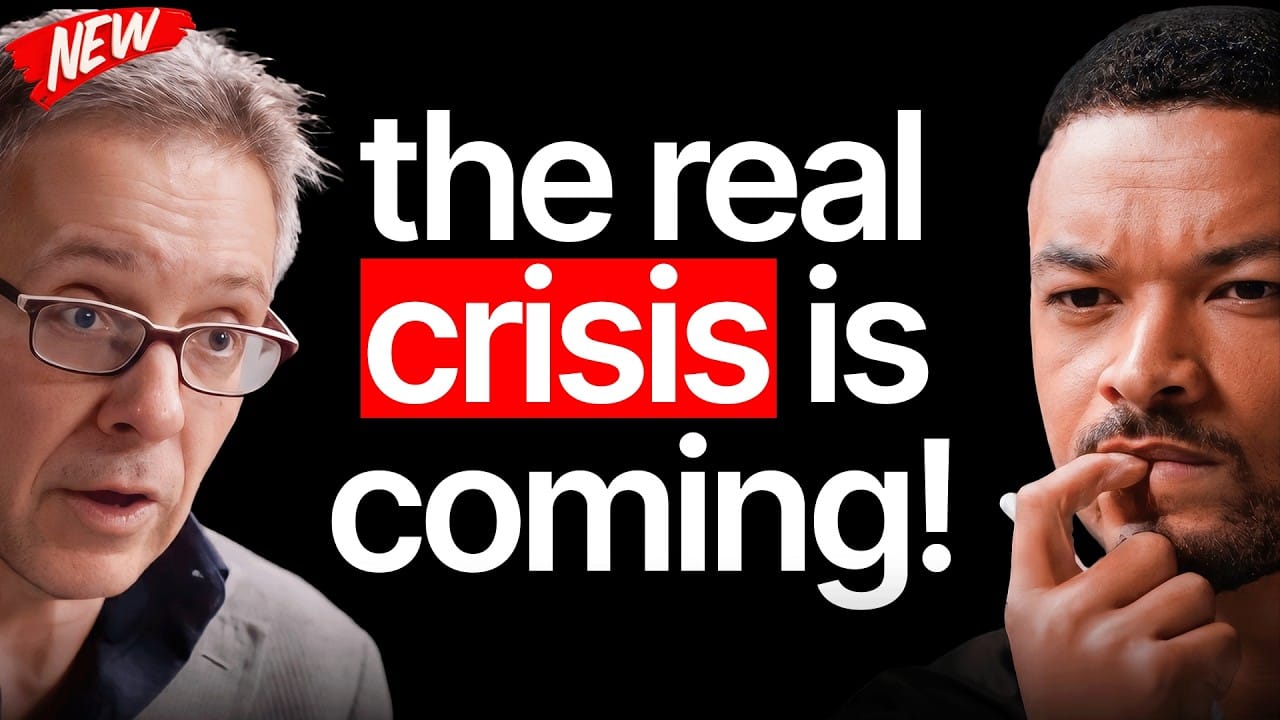
Original source: The Diary Of A CEO
This article is an editorial summary and interpretation of that content. The ideas belong to the original authors; the selection and writing are by Streamed.News.
This video from The Diary Of A CEO covered a lot of ground. 6 segments stood out as worth your time. Everything below links directly to the timestamp in the original video.
The shape of a deal — if one comes — may hinge on whether Iran can collect tolls from the world's most important shipping lane. That trade-off has enormous consequences for global energy markets.
Iran May Trade Nuclear Concessions for Strait of Hormuz Toll Rights, Bremmer Predicts
The most likely resolution to the US-Iran standoff involves Iran compromising on nuclear enrichment in exchange for formalised control over Strait of Hormuz transit, according to political scientist Ian Bremmer. Under this scenario, Iran would be permitted to effectively charge passage fees — framed domestically as war reparations — providing both revenue and a residual deterrent without the nuclear programme that was always, in Bremmer's words, hedged by enormous conditions. The ceasefire, he argues, is already inching toward that outcome, with further substantive talks expected to follow the 21-hour Islamabad negotiations. The alternative scenario is darker: Trump, with nearly 15,000 troops deploying to the region and a new carrier strike group en route, could order the seizure of Kharg Island — a Manhattan-sized facility off the Iranian coast responsible for 90 percent of Iran's oil exports. US Central Command reportedly believes the island is takable with 12,000 to 15,000 troops. Bremmer puts the probability of that order being given at below 50 percent, but its possibility constrains every negotiation now underway.
"The Iranians are more likely to give on the nuclear issue and on enrichment if they're able to maintain a privileged position on transit through the strait — because that will help provide them with money and with security."
Iran's Strait Leverage and Trump's Domestic Weakness Point Toward De-escalation, Analyst Says
The length of the Islamabad talks — 21 hours, led by the US Vice President and attended by Iran's foreign minister, parliamentary speaker, and a team of policy experts — is itself evidence that a deal remains within reach, according to Ian Bremmer. A failed negotiation, he argues, does not last that long. Iran arrived with detailed briefs covering ballistic missiles, proxy actors, Strait transit rights, and nuclear enrichment, demonstrating that the regime remains functionally centralised despite the Israeli and American strikes that dismantled much of its military leadership. Trump, meanwhile, has progressively undermined his own bargaining position: he publicly declared the war would be over in two to three weeks, said the Strait was not his problem, and suspended sanctions to keep oil prices down — signals that Iran's leadership has read as signs of an adversary who cannot absorb prolonged economic pain. Bremmer draws a direct parallel to China's response to Trump's tariffs, arguing that when a counterpart has genuine leverage and the patience to use it, Trump tends to retreat. Iran, he suggests, is betting on the same outcome.
"He keeps saying the strait's not my problem. I hear that as the Iranians — great, he can't take this economic pain. He knows he doesn't have a military solution."
Venezuela Success, Iran's Past Passivity, and Yes-Men Advisers Drove Trump Into Iran Conflict, Bremmer Argues
Ian Bremmer identifies three compounding factors that led Trump to launch military action against Iran, a country he had previously listed among his diplomatic successes. First, a swift and casualty-free operation that removed Venezuela's leader and produced an immediately cooperative successor government left Trump convinced a similar operation could be replicated against Iran at larger scale. Second, Iran's track record of absorbing confrontation without meaningful retaliation — from the assassination of its most celebrated military commander to a 12-day Israeli air campaign during which Iran fired missiles at a US base only after warning American forces in advance — gave Trump a rational, if ultimately flawed, basis for confidence. Third, and most critically, Trump's second-term inner circle is composed of loyalists who shade their counsel toward flattery rather than frank assessment. Bremmer notes that the chairman of the joint chiefs privately considered the Iran operation dangerous and understood that military planners had spent decades war-gaming exactly how Iran could close the Strait — but that scepticism did not reach Trump in any meaningful form. The contrast with advisers from the first term, who occasionally acted to constrain impulsive decisions, is stark.
"What he hears from them is shaded towards how brilliant he is — and that makes him think he will be more successful even when the military thinks this is a horrible idea."
Anthropic Withheld AI Model Capable of Exploiting Critical Infrastructure, Prompting Emergency Regulator Response
Anthropic developed an AI model it deemed too dangerous to release publicly after testing revealed it could systematically identify exploitable security vulnerabilities across software applications underpinning banks, power grids, and water systems — not merely the weaknesses that skilled hackers already target, but effectively every exploitable bug in reach. The decision triggered an immediate response from the Federal Reserve chair and the Treasury Secretary, who convened an urgent meeting of major bank chief executives to discuss internal deployment of the technology to find and patch those vulnerabilities before adversaries acquired comparable tools. Ian Bremmer, who has argued for several years that technology companies now exercise a form of sovereign power previously reserved for nation-states, says he regards the threat as genuine despite an evident marketing dimension to Anthropic's disclosure. The episode illustrates a broader dynamic, he argues: AI capabilities are proliferating fast enough that tools with near-state-level destructive potential will soon be accessible to any actor with a laptop, placing the race to patch vulnerabilities ahead of the race to exploit them at the centre of national security policy.
"If suddenly your systems are hackable by anyone that has access to this tool, your markets are going to go down, your banks aren't going to work, your data is going to be stolen."
▶ Watch this segment — 1:00:13
Two Rival Middle East Blocs Are Forming as Iran's Military Power Erodes and Israel Expands Its Buffer Zone in Lebanon
Israel is moving to occupy a five-to-seven-kilometre strip of Lebanese territory as a permanent buffer zone against Hezbollah rocket fire, a campaign Bremmer describes as the logical extension of Israel's broader strategic position — one in which it can strike any adversary in the region and absorb no meaningful counter-strike in return. Hezbollah, once the most capable non-state military force in the world, has had its leadership systematically assassinated and its military infrastructure degraded to the point where, in Bremmer's assessment, it can no longer deter Israeli action. Iran, whose deterrence capacity was already broken in the 12-day war last June, is now an economy in decline, defending a degraded military with influence over a strait but little else. Against this backdrop, two distinct regional alignments are crystallising: one grouping the UAE, Israel, the United States, and India around security and technology cooperation; and a second drawing Saudi Arabia, Pakistan, Turkey, and Egypt into a more explicitly defence-oriented bloc. Pakistan's nuclear arsenal, Bremmer notes, is already understood to be available to Saudi Arabia if required. The emergence of two such blocs, in a region where American strategic leadership is visibly contracting, represents a structural shift that will outlast the current Iran crisis.
"Iran has influence over the strait, but they're not winning. And this is dangerous long term."
Bremmer Predicts Major Republican Losses in 2026 Midterms and Warns of Leaderless Global Order
Ian Bremmer forecasts that Trump will suffer a significant defeat in the November 2026 midterm elections, driven by policy failures and broad public unpopularity, leaving him effectively a lame duck for the final two years of his presidency as Republican legislators begin prioritising their own political futures. The prediction rests not on optimism about the opposition, but on a reading of structural incompetence: Bremmer argues that Trump's refusal to engage with expertise makes failure on policy nearly inevitable. More consequentially, he warns that a Trump collapse will not resolve the conditions that produced him — economic anxiety and political alienation among working Americans will persist, sustaining demand for radical political change from whichever direction can capture it next. Internationally, Bremmer describes an emerging G0 world — a global order without an effective leader — in which no country or institution is capable of filling the coordinating role the United States has stepped back from. In that vacuum, powerful actors write rules that suit themselves, and smaller nations must navigate without recourse to a functioning multilateral framework.
"If the Americans are no longer willing to act as the global leader, but no one else is capable of filling those shoes, you have a G0 — an absence of global leadership where the powerful make the rules and the weak have to accept that."
Summarised from The Diary Of A CEO · 1:39:42. All credit belongs to the original creators. Streamed.News summarises publicly available video content.
Streamed.News
This publication is generated automatically from YouTube.
Convert your full video library into a digital newspaper.
Get this for your newsroom →