🌐 This article is also available in Spanish.
Original source: Garys Economics
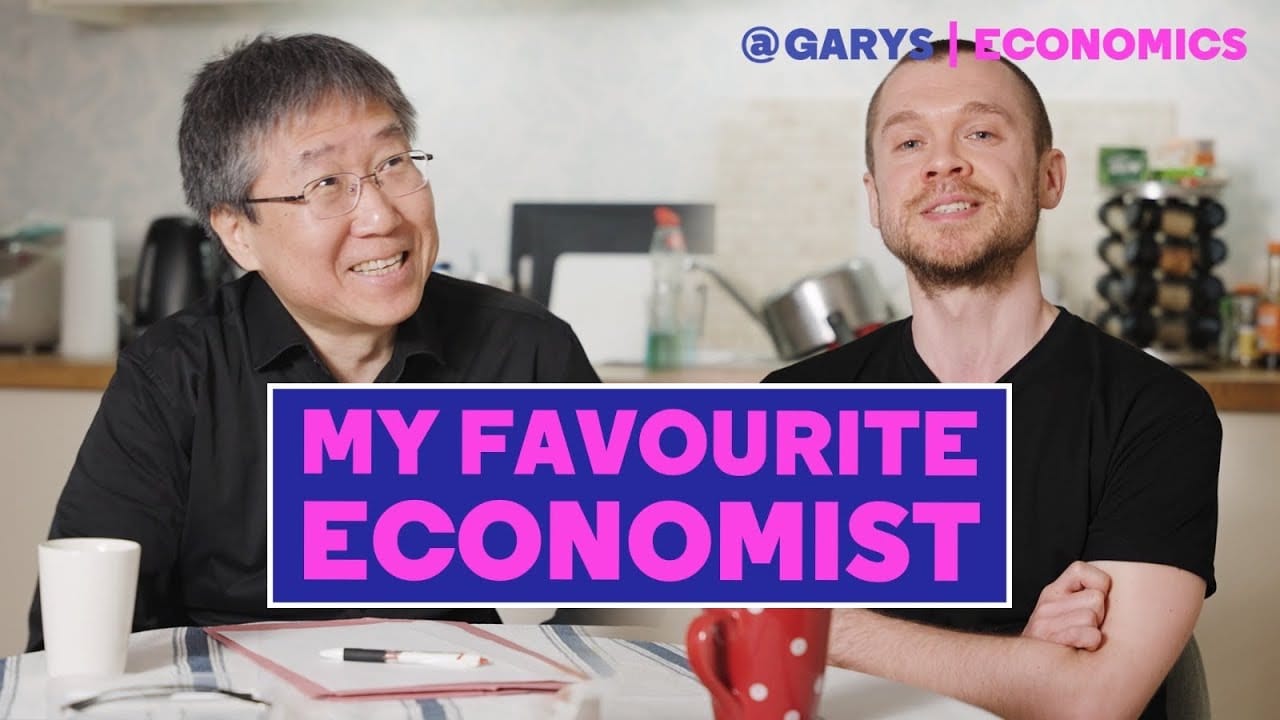
With: Gary Stevenson · Ha-Joon Chang
This article is an editorial summary and interpretation of that content. The ideas belong to the original authors; the selection and writing are by Streamed.News.
This video from Garys Economics covered a lot of ground. 5 segments stood out as worth your time. Everything below links directly to the timestamp in the original video.
If economic debates feel designed to be impenetrable, Chang argues that's not an accident — it's a feature that serves those already at the top.
Economist Ha-Joon Chang: Modern Economics Has Become the New Medieval Latin — A Language of Power That Excludes Ordinary People
Ha-Joon Chang, economist at SOAS University of London, argues that mainstream economics now functions the way Catholic theology did in medieval Europe — as a language controlled by the powerful to justify the existing order and shut ordinary people out of decisions that affect their lives. Just as the Vatican kept scripture in Latin to maintain the clergy's interpretive monopoly, economics uses dense mathematical jargon to ensure that only credentialed insiders can participate in debates about wages, growth, and inequality. A clip of Chang making this argument has recently gone viral online. The parallel extends to content, not just form: medieval theology declared famines and exploitation to be God's will, while modern economics declares whatever the market produces to be the optimal outcome — a concept Chang links to Voltaire's satirical notion that this must be 'the best of all possible worlds.'
"Unless you're able to speak in this language, use these terms, you're basically not allowed to have an opinion."
UK Labour Avoids Wealth Taxes While Historical Record Shows 80% Top Rates Coincided With Faster Growth
The UK Labour government's reluctance to tax the wealthy stems from two overlapping failures, according to Chang and the host: a dependence on financial markets for borrowing — which gives those markets effective veto power over policy — and an inability among Labour economists to construct a credible alternative narrative to decades of free-market orthodoxy. The host pointed to concrete historical evidence that challenges the assumption high taxes harm growth: in the 1960s and 1970s, Britain had a top income tax rate of 80 percent and was growing faster than it has in the thirty years since. The United States at the same time had a 90 percent top rate and also outpaced its recent performance. Chang argued that a government relying solely on borrowing is structurally dependent on the consent of the wealthy, whereas taxation requires no such consent — making the shift from debt to tax politically transformative, not just fiscal.
"If borrowing is your only plan, then you are a slave to the financial markets. If my plan is to tax you, I don't need you to agree to that."
Elite Economics Degrees Are Driving Out the Students Most Curious About the Real Economy
Economics education at elite universities has become so dominated by advanced mathematics that students who enroll wanting to understand inequality, financial crises, or the cost of living are effectively filtered out or intellectually subdued before they can ask meaningful questions, according to Chang and the host. The host described a postgraduate experience at Oxford where a lecturer, explaining why the recovery from the 2008 financial crisis was weaker than expected, answered without irony that it was due to an 'exogenous shock to consumption savings preferences' — academic shorthand for admitting that something outside the model changed, without asking what it was or why. Nobody in the lecture hall laughed. Chang observed that by the time mathematics training is intense enough, students stop distinguishing between the model and the world it is supposed to describe. The broader implication is that the people ultimately placed in charge of economic policy are trained in a discipline that has structurally discouraged them from asking the questions that matter most.
"When you reach the point that you start explaining things in the real world by using technical terms saying something outside the model has changed, I think this captures exactly what has gone wrong."
Ha-Joon Chang: South Korea's Economic Miracle Was Also a Story of Slums, Brutality, and Survival
Ha-Joon Chang grew up in Seoul during South Korea's postwar economic surge, when annual GDP growth regularly hit between 10 and 15 percent and per capita income in the early 1970s stood at roughly 400 dollars — a level at which, as Chang put it, the difference between one and five percent growth was literally the difference between eating or not. But the headline numbers masked a harsher reality: factory workers logged thirteen to fourteen hours a day, six and a half days a week, with some employers deliberately denying workers soup in canteens to avoid giving them toilet breaks. Urban slums expanded as millions migrated from the countryside, and property developers hired thugs to clear informal settlements. The country was under military dictatorship from 1961 to 1987. It was this combination — spectacular aggregate growth alongside pervasive poverty and repression — that first drew Chang toward economics as a tool for understanding what was actually happening around him.
"At that level of development, if your economy grows at 5% rather than 1%, it means that you eat one more bowl of rice."
Billionaire-Funded Think Tanks Dominate the Airwaves on Wealth Taxes While Independent Voices Go Unfunded
The host made a pointed structural argument about why the case for taxing the wealthy struggles to gain traction in mainstream media: advocates like himself appear without payment and without institutional backing, while opponents routinely represent think tanks funded by billionaires whose financial interests align with the policy positions they promote. The result is a systematic asymmetry in who gets to shape public perception of what is economically possible. Chang acknowledged the problem is compounding: growing economic inequality translates directly into growing inequality of political and media power, creating a self-reinforcing cycle that makes redistribution harder to achieve than it was in the postwar decades. Yet both argued the historical record refutes the claim that taxing the rich is impossible — pointing to the significant reduction in wealth inequality that followed the Second World War across Western countries. Chang suggested the debate should not be about whether to tax wealth but about what rate is appropriate, noting the answer does not need to be 90 percent to represent a meaningful departure from the status quo.
"The billionaires are actively paying for people to go on TV, go on the radio and say it's impossible to tax the rich. Who is paying for people like me to make the counter argument? Basically nobody."
Summarised from Garys Economics · 49:52. All credit belongs to the original creators. Streamed.News summarises publicly available video content.
Streamed.News
This publication is generated automatically from YouTube.
Convert your full video library into a digital newspaper.
Get this for your newsroom →