🌐 This article is also available in Spanish.
Original source: Garys Economics
This article is an editorial summary and interpretation of that content. The ideas belong to the original authors; the selection and writing are by Streamed.News.
This video from Garys Economics covered a lot of ground. 6 segments stood out as worth your time. Everything below links directly to the timestamp in the original video.
When an expert field gets its central predictions wrong for over a decade and its leading academics don't notice, that's a problem worth examining — whatever your view on wealth taxes.
Oxford Professor Teaching Interest Rates Was Unaware of Nine Years of Mispredictions, Economist Claims
Stevenson describes returning to Oxford in 2017 for a postgraduate degree and confronting a professor who taught interest-rate theory with data showing that economists had wrongly forecast a return to higher rates every single year since 2008. The professor initially denied the record of error, then acknowledged it after reviewing the evidence — and declined to discuss it further. Stevenson also pushes back against the claim that no credible economists support wealth taxes, pointing to Thomas Piketty and Gabriel Zucman, both decorated by France's leading economics associations, as prominent voices who have made inequality central to their work.
The anecdote is pointed because it targets not just a policy disagreement but the self-awareness of the discipline itself. Stevenson's broader argument is that economics has a structural problem: a field that consistently mispredicts recoveries, inflation, and interest rates for years at a time, yet resists external challenge, has ceased to function as a science and become something closer to institutional orthodoxy.
"Here is this Oxford professor teaching interest rates at Oxford University who is unaware that interest rates have been mispredicted for nine years."
Collapse of Centrist Parties Worldwide Reflects Failure of Economic Orthodoxy, Stevenson Argues
Stevenson contends that the simultaneous decline of centre-left and centre-right parties across Europe and beyond is not a political accident but a direct consequence of mainstream economics consistently delivering falling living standards for ordinary people while enriching those at the top. He argues that demanding academic consensus before considering economic reform is structurally self-defeating: the economists who hold institutional authority are disproportionately drawn from wealthy backgrounds, precisely because academic careers in expensive cities are financially inaccessible to those from poorer ones. Requiring elite sign-off on solutions to elite-driven inequality, he says, is circular by design.
His sharpest claim is methodological. Because economics cannot run controlled experiments the way physics or medicine can, track record of prediction is the only reliable way to judge whose framework is working. He argues that forecasters who correctly called rising inflation, house prices, stock prices, and gold simultaneously before the post-pandemic cost-of-living crisis — when none of those outcomes were consensus expectations — have earned standing to challenge those whose predictions have repeatedly failed, regardless of their institutional affiliation.
"We will not accept any change on growing inequality unless it is mandated by the group of people who are benefiting from the increase in inequality."
UK Greens' Poll Surge Forces Wealth Tax Debate Into Mainstream Politics
Gary Stevenson, an economist and YouTuber who previously traded interest-rate derivatives at a major bank, concedes openly that no broad academic consensus exists for wealth taxes — and argues that is precisely why he started making the case publicly. He traces his scepticism of mainstream economics to the years after the 2008 financial crisis, when forecasters predicted an imminent recovery annually for over a decade while interest rates stubbornly refused to rise. The UK Green Party's recent polling surge, at times placing it first or second nationally, has given the wealth-tax argument its first serious political vehicle in Britain.
The context matters because it reframes the debate. Wealth taxes exist in Switzerland, Norway, and Spain, but have long been dismissed in Britain as fringe policy. Stevenson argues that the Green Party's rise — driven largely by its new leader's energetic advocacy for taxing accumulated wealth — signals that a public exhausted by falling living standards is outpacing the political establishment's willingness to consider structural economic change.
"If it was true that there was a consensus among academic economists that we needed to reduce inequality and we needed to do wealth taxes, then there would be no need for me to do this channel."
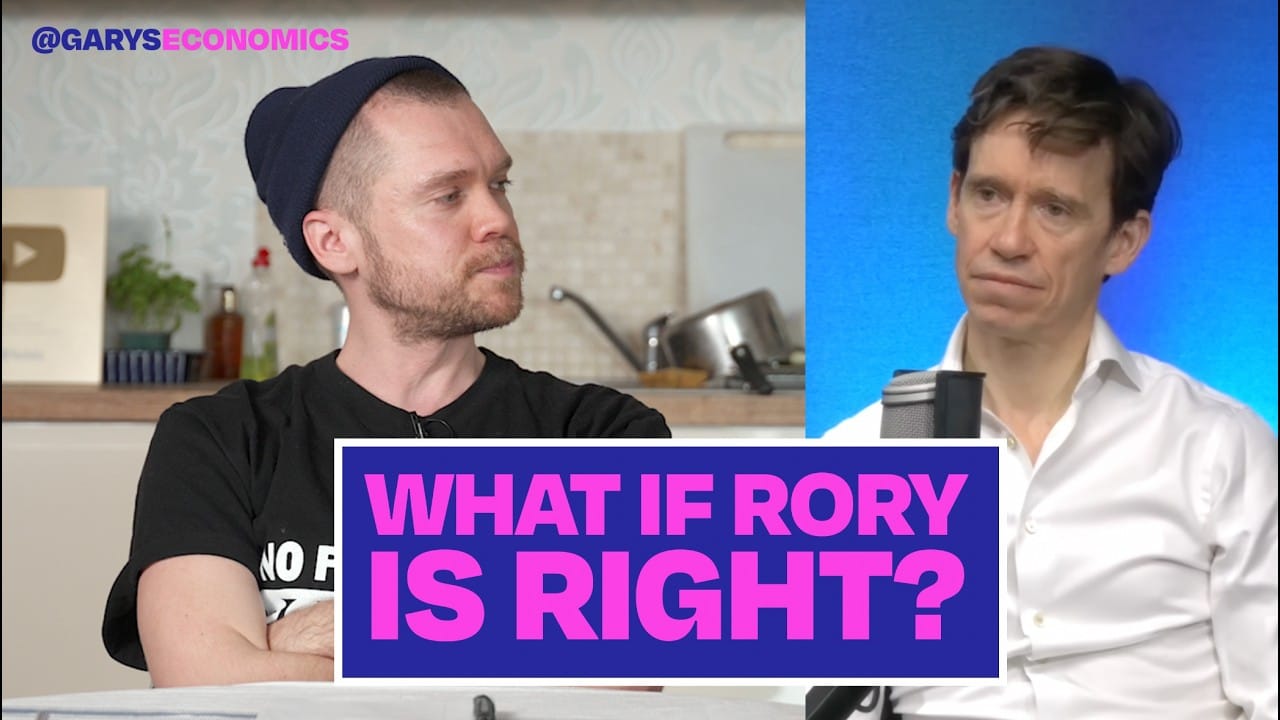
Rory Stewart Challenges Gary Stevenson's Economist Credentials on 'The Rest Is Politics'
On the podcast 'The Rest Is Politics', former Conservative minister Rory Stewart publicly questioned whether Gary Stevenson qualifies as an economist, describing him as a city trader who holds only an undergraduate degree and pressing the Green Party leader being interviewed to name economists with graduate-level academic credentials. The exchange, prompted when the Green leader cited Stevenson among his intellectual influences, drew a sharp line between practitioner and academic economics — a distinction Stewart used to cast doubt on the intellectual foundation of the wealth tax movement.
"He's a city trader. He studied an undergraduate degree in economics. He's not a professional economist."
Top Economics Graduates Overwhelmingly Choose Trading Over Academia, Stevenson Says
Gary Stevenson argues that the framing of academic economists as the definitive authorities on economic questions inverts the reality of where the most talented graduates actually end up. At elite universities, he says, the highest-achieving economics students overwhelmingly pursue careers in finance — particularly trading — because the financial rewards are vastly superior to an academic path that requires years of postgraduate study and often leaves candidates in significant debt before earning a meaningful salary. Stevenson, who became a millionaire at 25 after graduating from the London School of Economics, contends this means the best applied economic thinking is concentrated in the private sector, not in universities, making the dismissal of non-academic economists intellectually incoherent.
"The best paid ten thousand economists in the world in terms of people who are doing economics day-to-day are almost certainly traders."
Stevenson Says Elites Are Coordinating Ad Hominem Campaign to Discredit Wealth Tax Movement
Gary Stevenson describes a pattern of personal attacks he says has hardened into a deliberate strategy by establishment figures to neutralise the wealth tax movement by attacking its most visible advocates rather than engaging with its arguments. He recounts the Daily Mail running four consecutive attack pieces targeting him, a Channel 4 documentary encounter with a Treasury official who told him privately he was 'economically illiterate', and Stewart's public mischaracterisation of his qualifications — which Stewart later apologised for after Stevenson posted his Oxford postgraduate degree certificate online. Stevenson argues this shift toward credential-based dismissal, directed primarily at him and Green leader Zack Palansky, signals that opponents of wealth taxes can no longer win the substantive argument.
"A new simplistic narrative was forming from these elites — Gary is an idiot, Zack Palansky is an idiot, don't listen to them because they're not economists."
Also mentioned in this video
- The hypocrisy of Rory Stewart (14:46)
- His strategic response to the attacks (53:42)
- Building a coordinated social media movement modelled on the WWF/WWE 'character… (1:00:01)
Summarised from Garys Economics · 1:07:00. All credit belongs to the original creators. Streamed.News summarises publicly available video content.
Streamed.News
This publication is generated automatically from YouTube.
Convert your full video library into a digital newspaper.
Get this for your newsroom →