Original source: Mentour Pilot
This video from Mentour Pilot covered a lot of ground. Streamed.News selected 8 key moments and summarises them here. Everything below links directly to the timestamp in the original video.
The design of an aircraft's automated systems can have unexpected consequences during manual flight. This specific feature of the A310's go-around mode demanded a level of pilot assertiveness that proved critical.
Airbus A310 Go-Around Design Applied Excessive Thrust, Contributing to Pitch-Up
The Airbus A310's auto-throttle system has a design feature that contributed to the crew's loss of control. In a go-around, the system automatically applies maximum takeoff/go-around (TO/GA) thrust, which in this case was 102% N1. This level of power was far more than what was needed for the light aircraft, creating a powerful pitch-up moment that required aggressive manual correction.
This contrasts with the design of other aircraft like the Boeing 737, which uses a two-stage TO/GA switch that initially provides a reduced, more manageable level of thrust. The A310's single-stage, maximum-power application demanded immediate and forceful pilot intervention, a factor the captain failed to anticipate.
"The Airbus A310's auto-throttle appears to always use maximum thrust, which in this case was 102% N1. Now that is way more than what was needed for this go-around."
A310 Go-Around Required Counterintuitive Forward Pressure on Controls
A key handling characteristic of the Airbus A310 during a go-around is a powerful pitch-up moment created by its low-slung engines. When significant thrust is applied, particularly on a light aircraft, this effect can be so pronounced that pilots must counterintuitively push forward on the control column to prevent the nose from rising too steeply beyond the target 18-degree pitch angle.
While the autopilot would normally counteract this tendency automatically, the responsibility falls entirely on the pilot during manual flight. This requires a quick and assertive control input that runs contrary to the common instinct to pull back, a critical factor when a pilot is surprised or stressed.
"One counterintuitive aspect of a go-around was that in order to maintain the correct pitch, pilots might actually have to push on the control column instead of pulling back."
Pilot Error in Two Airbus Crashes Traced to Flawed 'Mental Models' of Automation
The loss of control in both the Thai Airways accident and a similar crash of a China Airlines A300 stemmed from the captains operating with inaccurate mental models of their aircraft's behavior. The China Airlines pilot had not realized the autopilot had disengaged, while the Thai Airways captain, though aware the autopilot was off, failed to anticipate the A310's aggressive pitch-up with the auto-throttle still engaged.
This cognitive failure was not a lack of knowledge about aircraft physics, but rather a misjudgment of the automation state in a critical moment. Compounded by the stress and frustration from multiple failed approaches, this led to a failure to apply the correct and timely manual control inputs.
"The reason both captains failed wasn't because they didn't understand the physics, but instead likely because their mental model of how the aircraft was going to behave was based on inaccurate assumptions."
Accident Yields Two Core Lessons on Manual Flying Skills and Adherence to Safety Minimums
Two primary lessons can be drawn from the accident involving Thai Airways Flight 261. The first concerns the captain's ineffective control during the manual go-around, where his timid inputs and poor anticipation suggest a lack of recent manual flight experience. This highlights the ongoing importance of pilots regularly "hand-flying" to maintain proficiency and confidence with the aircraft's raw control authority.
The second lesson involves the crew's repeated decisions to attempt approaches in conditions they knew were below the stipulated weather minimums. This breakdown in discipline and risk management serves as a critical reminder that safety regulations exist to prevent pilots from placing themselves in marginal situations where a successful outcome is unlikely.
"This crew decided to take risk after risk, and basically, all of these approaches were flown under conditions that they knew would likely preclude a successful outcome."
Disconnected Autopilot and Engaged Auto-Throttle Created Fatal Combination in Third Go-Around
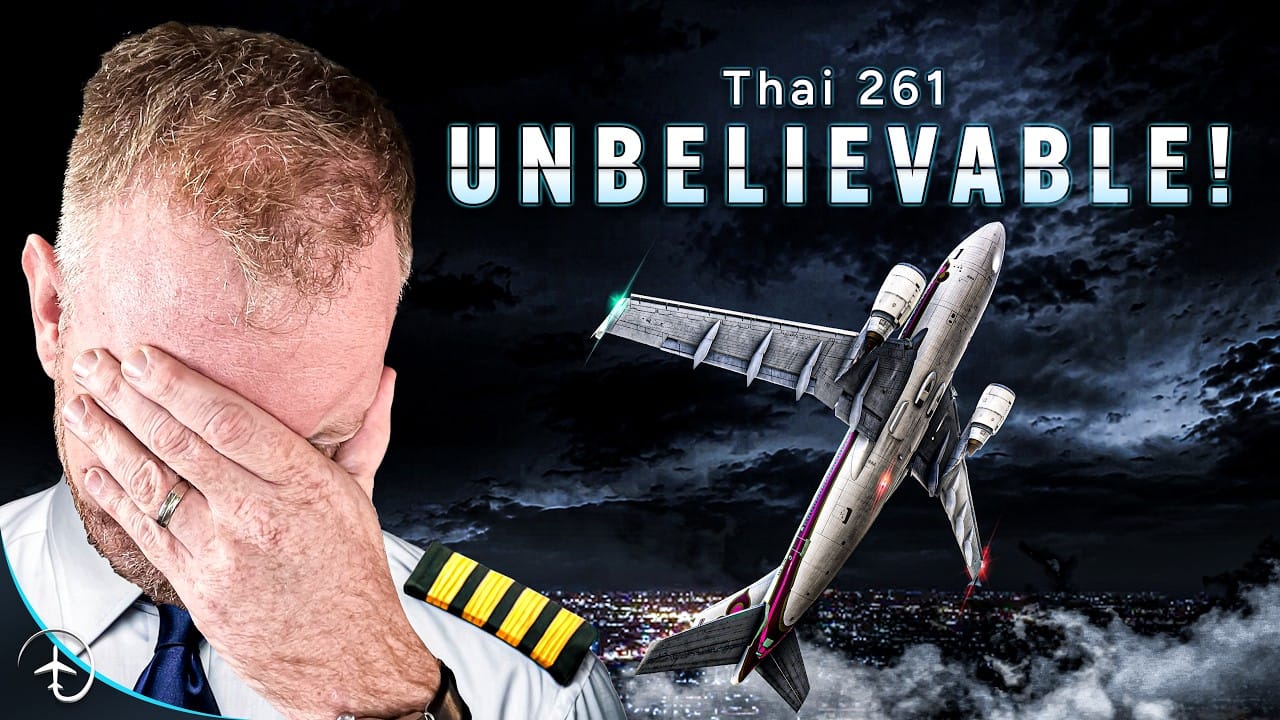
The third and final go-around attempt created a critically different set of circumstances from the previous two. While the autopilot was disconnected, the auto-throttle remained engaged, causing the engines to spool to maximum take-off/go-around (TO/GA) thrust in just eight seconds. This rapid power application generated a severe pitch-up moment.
What made this particularly dangerous was the absence of the autopilot, which had compensated for the aggressive pitch-up during the second go-around. Now, the full responsibility for countering this force fell to the captain, who was flying manually and was unprepared for the aircraft's swift and powerful reaction.
Thai Airways A310 Crash Mirrored Earlier China Airlines A300 Accident
The sequence of events leading to the crash of Thai Airways Flight 261 bears a striking resemblance to the accident involving China Airlines Flight 676 in February 1998. In that incident, the captain of an Airbus A300 also initiated a go-around moments after the autopilot had disconnected. Expecting the automation to manage the climb, he failed to intervene manually.
The result was a rapid, uncontrolled pitch-up that exceeded 40 degrees, leading to an aerodynamic stall from which the crew could not recover. The crash in Taipei, Taiwan, resulted in 202 fatalities and highlighted the same critical vulnerability: a pilot's failure to transition effectively to manual control during a high-thrust go-around.
"This sequence of events is eerily similar to another accident involving the very similar Airbus A300 which had happened earlier the same year."
Disorientation from 'Somatogravic Illusion' May Have Caused Pilot's Fatal Control Input
One hypothesis for the captain's catastrophic decision to pull back on the controls in response to the stall warning is a form of spatial disorientation known as a reverse somatogravic illusion. The combination of a steep pitch-up attitude and maximum engine thrust would have pressed the pilots back into their seats, creating powerful sensory cues.
It is possible the captain misinterpreted these intense physical sensations as extreme acceleration, believing the aircraft was about to overspeed. This disorientation may have prompted the fatal, instinctual reaction to pull the nose up to slow down, directly contradicting the required stall recovery procedure of pushing the nose down.
"It is possible that the captain therefore became disoriented and interpreted these cues to mean that the airplane was accelerating very rapidly and would overspeed unless he did something about it."
How a VOR/DME Non-Precision Approach Guides Aircraft Without Vertical Data
The crew was flying a VOR/DME approach, which is a type of non-precision instrument approach. This procedure relies on two ground-based radio beacons: a VOR (Very High Frequency Omnidirectional Range) for lateral guidance, and DME (Distance Measuring Equipment) for tracking the aircraft's distance from the beacon. The VOR transmits signals that allow pilots to fly along a specific magnetic bearing, or "radial," toward the airport.
Unlike more modern precision approaches, a VOR/DME approach provides no vertical guidance. Pilots must manage their own descent by cross-referencing their distance from the DME with predetermined altitudes specified on their approach chart, descending in steps rather than on a continuous glide path.
"A VOR/DME approach is what we call a non-precision approach, which means that while it does provide the pilots with lateral guidance to the runway, it doesn't provide any vertical guidance to help them descend."
Also mentioned in this video
- A scene of an Airbus A310 struggling in a stormy night over Surat Thani,… (0:01)
- On December 11th, 1998, a Thai Airways crew prepared to operate Flight 261, a… (0:25)
- The flight crew consisted of a highly experienced captain with over 10,000… (1:24)
- Pilots reviewed dispatch paperwork, finding the aircraft in good order, but… (2:42)
- The airport's degraded systems meant it no longer met ICAO's minimum equipment… (4:25)
- Despite the severe airport degradations, dispatching a flight at night was… (5:16)
- The forecast for Surat Thani showed generally good conditions but warned of… (6:07)
- The extra fuel brought the aircraft's takeoff weight to 108 tons, far below its… (7:18)
- Flight 261 took off at 17:54, climbed to 31,000 feet uneventfully, and at… (9:24)
- The VOR approach for Runway 22 at Surat Thani was unusual due to the VOR's… (11:20)
- The Thai Department of Aviation's VOR/DME approach chart for Runway 22 had a… (12:28)
- The Thai Airways chart specified a 215-degree approach course, closer to the… (13:14)
- Flight 261 pilots used the Thai Airways chart with a 215-degree inbound course,… (14:44)
- Despite an approach ban in most countries prohibiting continuation past the… (15:32)
- After passing the intermediate approach fix, the tower reminded pilots of… (16:31)
- The controller cleared them to land despite not having the aircraft in sight,… (17:57)
- The captain initiated a go-around, slowly increasing thrust, but despite the… (19:07)
- The final approach fix. (21:18)
- Rain, the captain chose to ask for visibility, then the first officer asked… (22:05)
- During the second approach, cleared to land again, the captain complained about… (23:50)
- Despite two failed approaches and the option to hold or divert, the captain,… (25:50)
- As Flight 261 prepared for its third approach, the captain expressed… (27:54)
- The captain decided to proceed with the third approach, seemingly swayed by the… (29:20)
- The captain, distracted by the reasons for failed approaches, failed to apply… (32:31)
- The captain pushed forward too gently, using less than 50% of available control… (35:49)
- Only 19 seconds after initiating the go-around, the stall warning activated,… (36:38)
- In a moment of panic, the captain pulled his control column back, increasing… (39:03)
- At 19:08:25, Flight 261 crashed into a flooded plantation, killing 51 on… (40:47)
- The pilots' decisions and loss of control. (41:43)
Summarised from Mentour Pilot · 44:27. All credit belongs to the original creators. Streamed.News summarises publicly available video content.