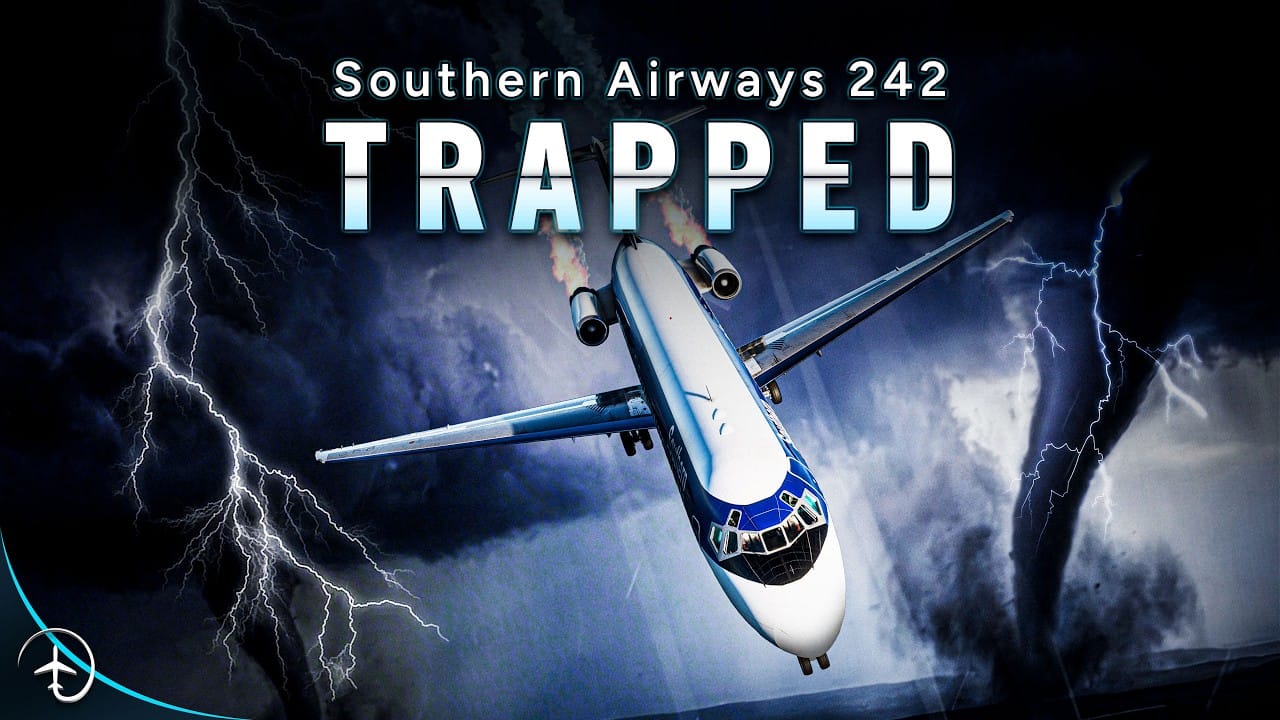
Original source: Mentour Pilot
This video from Mentour Pilot covered a lot of ground. Streamed.News selected 8 key moments and summarises them here. Everything below links directly to the timestamp in the original video.
Flying through a storm is dangerous, but the greatest threat to a jet engine isn't at full power—it's during descent at idle thrust. Here's the counterintuitive physics behind it.
How Heavy Rain and Hail Can Induce Jet Engine Flameout
The ingestion of large volumes of water or hail can cause a jet engine to lose thrust or flame out entirely by disrupting the delicate balance within its core. The water rapidly cools the combustion chamber and alters the fuel-to-air ratio, reducing the energy available to spin the turbine. This effect becomes catastrophic at lower power settings, such as during a descent, for two critical reasons.
First, the 'scoop factor' means that while the engine's core requires less air at idle, the inlet continues to ingest a large volume of water due to the aircraft's forward speed, dramatically increasing the water-to-air ratio. Second, a slower-spinning fan provides less of a shielding effect, allowing more water and hail to enter the core instead of being centrifugally forced into the bypass flow. This combination makes descending at idle thrust through severe precipitation a uniquely hazardous phase of flight.
"Even as air flow through the core decreases, the amount of water being ingested remains nearly the same, leading to a rapidly-rising water-to-air ratio."
Advancing Thrust on Surging Engines Caused Catastrophic Failure of Flight 242
The decision to advance the thrust levers while the engines were already in a state of compressor surge triggered a catastrophic and irreversible mechanical failure. The increased fuel flow and thrust demand on the unstable engines created powerful internal pressure spikes. These forces were strong enough to drive the low-pressure compressor blades forward into the adjacent stator vanes, causing the blades to disintegrate.
The resulting debris tumbled into the high-pressure compressor, causing the damage to multiply exponentially and leading to a complete structural failure of the compressor system. Within approximately one minute, this cascade of events, combined with catastrophic overheating from the excess fuel, had so severely damaged both engines that a restart was rendered impossible.
"Within roughly a minute, both engines completely failed, with internal damages so severe that restarting them would be impossible."
Southern Airways 242 Crash Led to Key Aviation Safety Advances
The investigation into the crash of Southern Airways Flight 242 sought to answer two primary questions: how a modern airliner could lose both engines, and why it was flying through the core of a severe thunderstorm. The NTSB's findings provided a harsh lesson on the unsuitability of highways for emergency landings and revealed critical gaps in technology, procedure, and training.
As a direct result of this tragedy, aviation safety was significantly enhanced. The industry developed vastly improved methods for providing pilots with real-time weather information, gained a deeper understanding of how jet engines behave in extreme precipitation, and, crucially, instituted formal training programs for the once-unthinkable scenario of a dual-engine failure.
"Today's pilots are unlikely to find themselves in the same situation thanks to vastly better knowledge of how engines behave in extreme precipitation, and training on how to actually deal with a dual-engine failure."
Unseen Danger: Flight 242's Engines Approached 'Surge Line' Before Final Failure
After a 36-second electrical blackout, power was restored to Flight 242's cockpit. As the first officer responded to an air traffic control instruction to climb, hail continued to shatter the outer pane of the windscreen. However, a far more insidious and invisible danger was developing within the engines: the massive water ingestion had pushed their delicate balance of internal pressures to the aerodynamic limit.
This limit is known as the surge line, the point at which the smooth airflow through the engine's compressor core collapses and violently reverses. Unbeknownst to the crew, the engines were operating perilously close to this boundary, creating a latent condition that set the stage for the final, catastrophic failure when thrust was advanced.
"What no one knew at this point was that the delicate balance of temperatures and pressures was now changing... The closer the engine will get to the surge line, which is the point at which the smooth airflow through the core collapses."
Outdated Radar Technology Gave Flight 242 Pilots a Distorted View of Storm
The DC-9 was equipped with a Bendix RDR-1E weather radar, a basic monochrome device that presented significant interpretation challenges for the crew. In its 'contour mode,' the system displayed the most intense areas of precipitation as black, empty voids. This meant the core of a dangerous thunderstorm could appear visually identical to a safe corridor of clear air.
Compounding this issue was the radar's susceptibility to 'attenuation.' When flying in heavy rain, the radar signal would be reflected back so strongly that it could not penetrate to detect even more intense weather further ahead, creating a radar 'shadow' that appeared clear. These technological limitations likely provided the pilots with a dangerously misleading picture of the storm's structure exactly when they needed accurate information most.
"A clear path through the weather and the strongest core of a storm could look, at a glance, almost identical."
Southern Flight 242 Breaks Apart on Highway Landing Attempt, Killing 72
The attempted emergency landing of Flight 242 on Georgia State Route 92 ended catastrophically at 18:18 local time. Just seconds after touching down, and with less than 100 feet of altitude remaining prior to impact, the DC-9's wings struck trees and utility poles lining the road. The impact tore the left wing off, causing the aircraft to veer violently and break apart as it slid for nearly 600 meters through a service station and wooded area.
The crash and subsequent fire resulted in 72 fatalities, including both pilots, 63 of the 81 passengers, and nine people on the ground. Twenty-two passengers survived the impact, though many suffered aggravated injuries from having removed their shoes in preparation for using the emergency slides on an unprepared surface.
Anatomy of a Jet Engine: How Water Ingestion Disrupts Thrust
A jet engine produces thrust through a self-sustaining cycle of compression, combustion, and expansion. The compressor stages squeeze incoming air, which is then mixed with fuel and ignited. The resulting high-energy exhaust gases spin a turbine, which in turn provides the mechanical power to drive the compressors, completing the loop.
While the large fan at the front generates most of the bypass thrust, the core is the engine's powerhouse. The entire system's efficiency, however, is predicated on the thermal energy released by burning fuel. When an engine ingests large quantities of water or hail, a significant portion of that energy is diverted to vaporizing the water into steam. This cools the combustion chamber, reduces the energy delivered to the turbine, and ultimately leads to a loss of thrust.
"It's the core that provides the energy that keeps the whole thing running."
The Dangers of Severe Thunderstorms for Aviation
Severe thunderstorms are not merely areas of heavy rain but are powerful, localized weather systems defined by violent vertical air movements. For an aircraft, these cells present multiple, concurrent hazards: extreme turbulence from updrafts and downdrafts, rapid and unpredictable airspeed changes that risk stalls or overspeeds, and large hail capable of shattering windscreens and damaging flight surfaces.
Because of this, standard aviation practice, both then and now, is not to attempt to fly through such weather. Pilots are taught to avoid convective cells by a wide margin, maintaining a lateral clearance of at least five to twenty nautical miles. This buffer is critical because a storm's dangers, including hail and turbulence, can extend far beyond its visible boundaries.
"Pilots are taught to not tempt fate and fly through convective cells, but instead give them at least 5 to 20 nautical miles of lateral clearance."
Also mentioned in this video
- On April 4th, 1977, Southern Airways Flight 242 was preparing for a short… (0:00)
- The flight was standard for Southern Airways' quick turnaround operations, with… (1:27)
- The aircraft, a McDonnell Douglas DC-9-31 with registration N1335U, was powered… (2:58)
- Severe weather was evolving rapidly across the region, with approximately 20… (4:08)
- In 1977, real-time severe weather information was limited in cockpits, and… (5:58)
- The limited turnaround time of 10 minutes meant there was little opportunity… (7:27)
- At 15:54 local time, the DC-9 departed Huntsville, climbing into the rain, with… (8:27)
- The pilots, relying on their primitive radar, struggled to find a clear path… (13:30)
- The weather escalated from a scattered nuisance to a continuous problem, and… (17:42)
- As Flight 242 reached 17,000 feet, the weather worsened, with rain turning into… (19:55)
- The first officer expressed uncertainty about a path through the storm, which… (21:01)
- Descending through the storm with engines at idle, Flight 242's engines… (28:08)
- With both engines failed, the captain declared an emergency and sought vectors… (34:06)
- Facing a dual-engine failure below 15,000 feet in a thunderstorm with a cracked… (35:25)
- Upon re-establishing communication, the captain declared an emergency and… (37:06)
- Investigators later discovered that Cornelius Moore Airport, a small general… (39:51)
- Route 92, a large two-lane highway, despite the captain's preference for a… (41:36)
Summarised from Mentour Pilot · 47:49. All credit belongs to the original creators. Streamed.News summarises publicly available video content.