Original source: Eze Martínez
This video from Eze Martínez covered a lot of ground. Streamed.News selected 8 key moments and summarises them here. Everything below links directly to the timestamp in the original video.
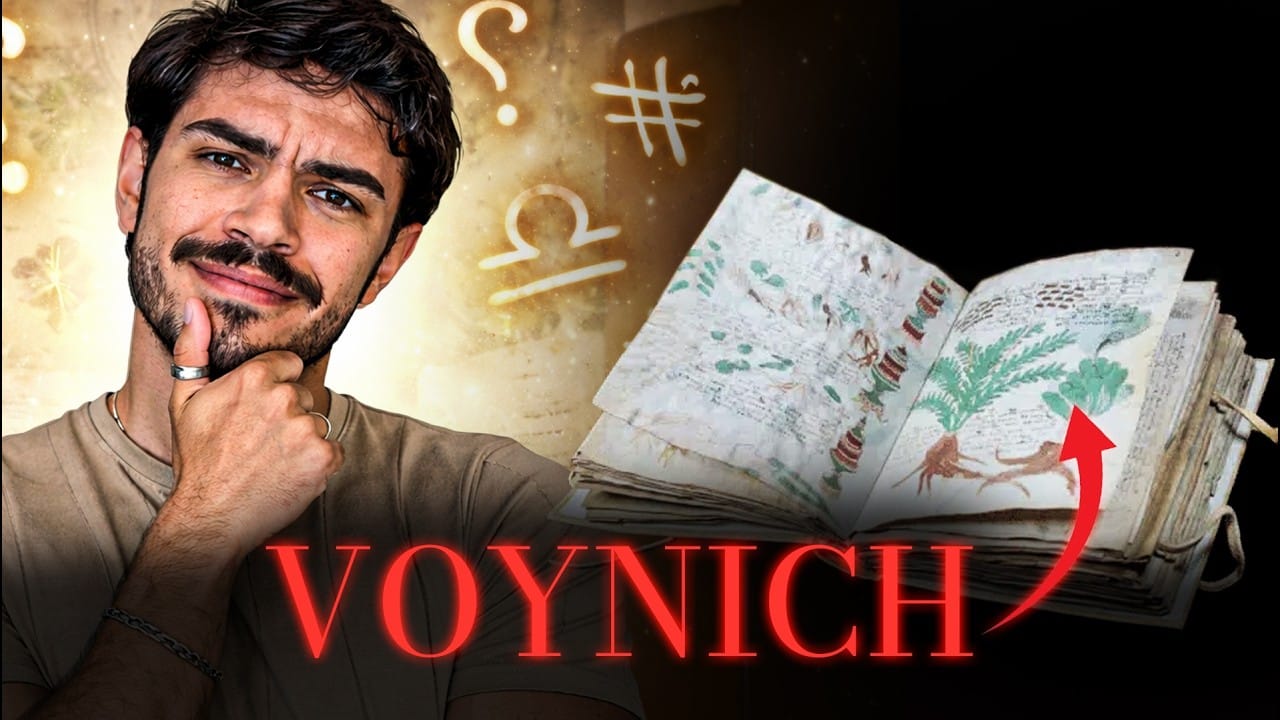
The key to unlocking the world's most mysterious book may lie not in its language, but in the physical order of its pages—an error persisting for 400 years.
AI Suggests Voynich Manuscript Studied in Wrong Order for 400 Years
Researcher Lisa Davis, a leading Voynich manuscript expert, observed non-consecutive pages within the same bifolio (double sheet) shared graphic elements, like pages 78 and 81. To investigate, she developed an AI to analyze symbol and word likenesses. The AI confirmed a high affinity between seemingly unconnected pages, such as 103 with 116 or 104 with 115. This suggests the manuscript has been studied in the wrong order for centuries. Its original structure may derive from individual bifolios rather than quires. This hypothesis could redefine future decipherment efforts by reordering the text into its logical sequence.
"She created an artificial intelligence that, without understanding the text or symbols, analyzes the similarity of symbols and words."
Frequency Analysis: The Statistical Technique That Deciphers Simple Substitution Ciphers
Frequency analysis can break texts encrypted with simple substitution ciphers, like the Caesar Cipher. The technique counts each symbol's repetition in the ciphertext. It then assumes the most frequent symbols correspond to common letters in the original language, such as 'e' or 'a' in Spanish. From these initial matches, analysts can progressively reconstruct words, validating hypotheses by forming meaningful fragments. This method demonstrates how a language's inherent statistical structure—its low entropy—becomes its primary cryptographic weakness. It allows deciphering a message without knowing the encryption key.
"We could venture to say that 's' would be an 'e,' 'o' is an 'a,' and 'd' is an 'o.'"
Zipf's Law Confirms Voynich Manuscript is a Real Language, Not a Hoax
The Voynich Manuscript text obeys Zipf's Law, a universal linguistic principle describing word frequency distribution in any language. This law states the most frequent word appears twice as often as the second, three times as often as the third, and so on, in an inversely proportional relationship. Analysis of the manuscript's 35,000 words found they precisely follow this pattern, just like Spanish, English, or Japanese. This statistical conformity is compelling proof the manuscript is not random symbols or an elaborate hoax. It contains a structured language with its own grammar and vocabulary.
"As you might imagine, when we apply this to the words in the Voynich Manuscript, it also follows Zipf's Law."
Language Entropy: How It Measures Predictability and Order
Language entropy measures a language's internal order and predictability, showing the likelihood of letter sequences. For instance, in Spanish, 'q' is almost always followed by 'u', indicating low entropy and high predictability. Conversely, 'e' can precede many letters, signaling higher uncertainty or entropy. This concept is crucial in cryptanalysis: languages with lower entropy are more structured, making their statistical patterns easier to exploit for decryption.
"No other letter can follow 'q' except 'u'. This means if we find a Spanish text with a missing word starting with 'q', we can say with total certainty that the next letter will definitely be a 'u'."
Voynich Manuscript's Exceptionally Low Entropy Rules Out Simple Ciphers
Frequency analysis fails to decipher the Voynich Manuscript due to a key statistical anomaly. While a simple substitution cipher like Caesar preserves original language entropy (around 2.9 for Spanish), the Voynich text shows an entropy of 2.3. This value is significantly lower than any known human language. This fundamental discrepancy proves the manuscript isn't merely a known language hidden by a monoalphabetic cipher, pushing researchers toward more complex explanations.
"If a Spanish message has entropy 2.9, and I encrypt it with a Caesar cipher, it will still have entropy 2.9. But the Voynich manuscript has entropy 2.3."
Voynich Manuscript Not Ciphered Text, But a Lost Language
Entropy analysis discredits the hypothesis that the Voynich Manuscript uses a polyalphabetic cipher. Complex ciphers like Vigenère increase disorder and, thus, a text's entropy. However, the manuscript's content shows exceptionally low entropy, even below that of known highly ordered Asian languages. Since encryption maintains or increases entropy but never decreases it, the most plausible conclusion is that the text is not ciphered. Instead, it's a genuine, unknown language, dubbed 'Voynichese,' possibly the last remnant of a lost tongue.
"Encrypting a message either keeps entropy the same (monoalphabetic ciphers) or increases it (polyalphabetic ciphers); it never decreases."
Polyalphabetic Ciphers: A Key to the Voynich Manuscript Mystery?
Polyalphabetic ciphers, an advanced encryption method for its era, might explain the Voynich Manuscript's mystery. Unlike simple substitution ciphers, these systems represent one original letter with multiple symbols, altering statistical frequency. Alberti and Vigenère ciphers exemplify this technique, breaking one-to-one letter correspondence. Engineer Giovanni Fontana's 1420 book confirms such cryptographic technology existed in the 15th century, when the manuscript was created.
"Now letters won't have a unique correspondence with another in the alphabet. For instance, if we encrypt this phrase with the Vigenère cipher, the letter 'i' appears three times, but is written with different letters."
Borta* 101 Alphabet Reveals Voynich Manuscript's Extremely Low Entropy
Researchers transcribe Voynich Manuscript symbols using the standardized Borta* 101 alphabet for statistical analysis. Once digitized, frequency analysis calculates its entropy, a measure of language order and predictability. The analysis is conclusive: the manuscript exhibits extremely low entropy. This finding confirms symbols aren't random; they follow predictable patterns, a fundamental characteristic of structured language, though unlike any other known.
"It's extremely low. That means these are not random symbols; they make sense, they are predictable."
Summarised from Eze Martínez · 21:58. All credit belongs to the original creators. Streamed.News summarises publicly available video content.