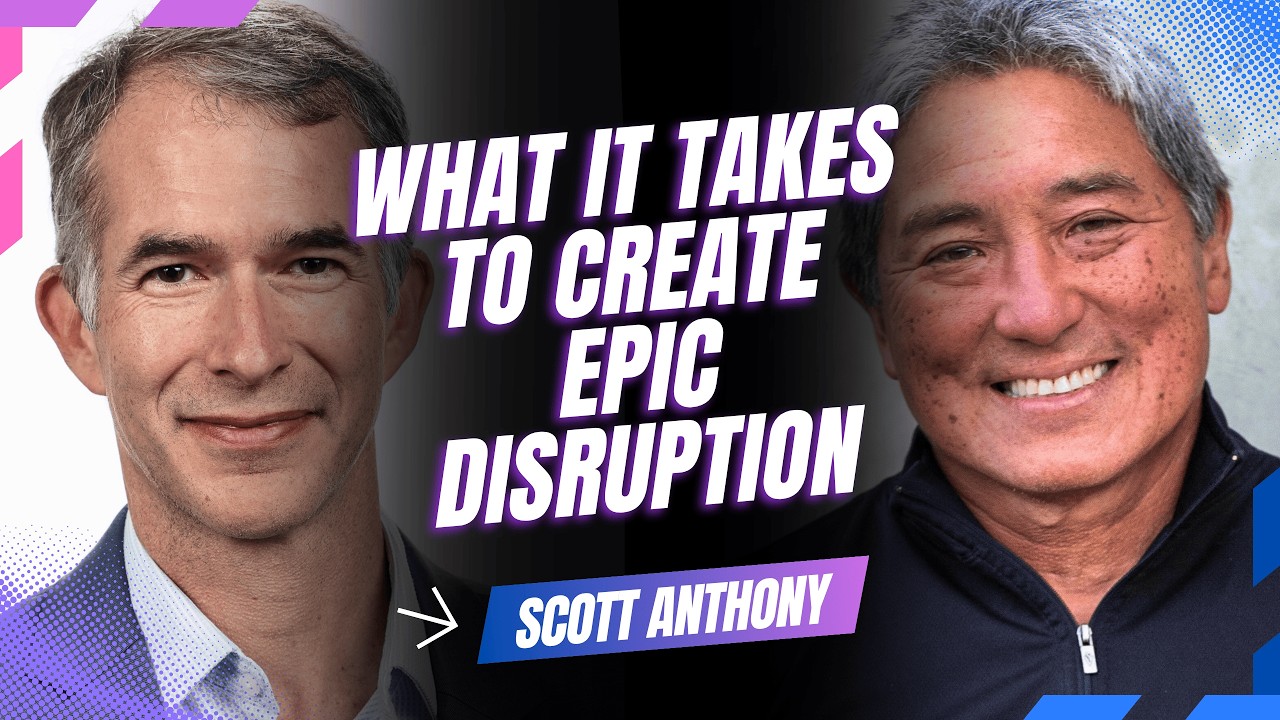
Original source: Guy Kawasaki
This video from Guy Kawasaki covered a lot of ground. Streamed.News selected 8 key moments and summarises them here. Everything below links directly to the timestamp in the original video.
When pursuing innovation, do you prioritize disruptive outcomes or fundamental customer needs? This distinction could redefine your strategy for success.
Disruption as a Means, Not an End: Focus on Simplicity and Affordability
True disruption is not an objective in itself but a byproduct of solving customer problems through simpler and more affordable means. Successful disruptors, such as Henry Ford with his obsession over making cars universally accessible, prioritize radical changes in cost and ease of use to serve a broader audience. Similarly, Taylor Swift's innovation stems from her consistent effort to deepen fan connection, not from a desire to be innovative for its own sake. This perspective reorients the entrepreneurial mindset from aiming for disruption to focusing on fundamental customer value. Innovation and disruption become tools and approaches, respectively, for achieving the ultimate goal of delighting customers and effectively meeting their needs.
"Innovation is a means. Disruption is an approach. The end goal is that connection with customers in different ways."
AI Regulation: Learning from 'Jaywalkers' and 'Fliverboobs' in the Automotive Age
Historical shifts, like the advent of automobiles, illustrate how societal norms and narratives are actively shaped rather than passively accepted. The contest between 'jaywalkers' (pedestrians seen as carelessly obstructing cars) and 'fliverboobs' (reckless early motorists) highlights a struggle for control over public perception and policy during disruptive periods. Ultimately, motorists prevailed, leading to structured regulations like traffic lights and speed limits. This historical parallel suggests that a hands-off approach to emerging technologies like AI, particularly concerning its impact on children, is ill-advised. Proactive regulation, envisioned as 'bounce ropes'—flexible yet firm boundaries—is essential to guide AI's development and integration, preventing chaotic or harmful outcomes by establishing necessary guardrails.
"History suggests that might not be the right answer. So at the very least, as a parent, at what they are able to do with AI, just makes you shiver in fear."
The 'Information Action Paradox' in Corporate Failure
Major corporations like Kodak and Research in Motion did not fail due to ignorance or denial of emerging threats. Instead, their downfall stemmed from an 'information action paradox': their core businesses continued to grow robustly, sending positive signals that masked the underlying disruptive forces. By the time data clearly indicated the necessity for radical change, it was too late to pivot effectively, trapping them in a cycle of gradual decline that eventually led to sudden collapse. This phenomenon highlights a critical challenge in strategic decision-making: the very success of an established model can blind leaders to existential threats. Effective leadership requires a theoretical framework to anticipate disruption, rather than relying solely on lagging indicators that confirm a crisis when actionable options have diminished.
"By the time the data are clear what you need to do, it's too late to do it."
Julia Child's Late Bloom Illustrates 'Disruption at 50'
Julia Child's career path challenges the conventional narrative of early success, as she embarked on her renowned culinary journey after the age of 50. Her diverse experiences, including a stint as a 'spook' during World War II, contributed to a winding path rather than a direct ascent to fame. This trajectory suggests that significant achievements, particularly in disruptive fields, are often the result of crystallized wisdom developed over a lifetime, not merely youthful exuberance. This phenomenon, dubbed 'disruption begins at 50,' underscores the value of accumulated experience and systemic understanding. While fluid intelligence may decline with age, crystallized intelligence—the ability to synthesize vast amounts of knowledge and rethink systems—continues to grow, positioning older individuals uniquely for profound innovations.
"Disruption begins at 50 because you have the crystallized wisdom that other people are missing."
Two Pillars of Serial Disruption: Optimistic Paranoia and Dedicated Space
Achieving serial disruption hinges on two critical organizational patterns. First, companies must cultivate an 'optimistic paranoia,' recognizing the finite nature of current success while simultaneously believing in their capacity to find new avenues for growth. This balance prevents the rigidity often associated with pure paranoia, enabling defensive maneuvers alongside proactive expansion. Second, successful disruptors consistently establish dedicated organizational units for new ventures, rather than burdening existing structures. This approach, exemplified by Procter & Gamble's early ventures, ensures that innovative ideas receive the necessary resources and protection to flourish, free from the inertia of core operations focused on incremental improvements.
"So there is this almost optimistic paranoia. That's one. Two, you recognize if you are serious about innovation, you have to do what Proctor and Gamble did."
The 'Great Unfreezing': An Era of Unprecedented Institutional Remaking
The contemporary world is undergoing a 'great unfreezing,' a period characterized by the breakdown of established structures and the emergence of extraordinary opportunities for institutional reinvention. While potentially unsettling, this phase allows for fundamental changes that were previously unimaginable, such as the transformative impact of ChatGPT on education and shifts in political landscapes affecting universities. This framework, adapted from Kurt Lewin's change management model, suggests that once fixed systems become fluid, making them ripe for profound alterations. For leaders and institutions, this era demands an ability to navigate uncertainty and embrace the unprecedented possibilities for radical transformation, rather than clinging to outdated paradigms.
"So we're in right now, the great unfreezing. Which is very disconcerting and can be, but it creates once in a lifetime possibilities."
The Unforeseen Consequences of Disruption: A 'Be Careful What You Wish For' Phenomenon
Disruption frequently carries unforeseen, negative consequences for its initial champions, embodying a 'be careful what you wish for' dynamic. The Catholic Church, for instance, initially welcomed the printing press to efficiently disseminate Bibles, only for the technology to inadvertently fuel the Reformation by enabling Martin Luther to spread dissenting theological views. This historical example illustrates how innovations can rapidly outgrow their intended uses. In contemporary business, consulting firms aiding clients with artificial intelligence adoption face a similar paradox. While profiting initially, they risk empowering clients to internalize AI capabilities, potentially eroding their own long-term market for advisory services. This highlights that disruptive forces rarely remain contained within their initial scope, often leading to systemic changes that impact even those who facilitated their rise.
"The problem is that Martin Luther can go and print out pamphlets that go and talk about different views of religion. The printing press led to the splintering of the Catholic Church."
Disruption as a Lens, Not the Objective: Prioritizing Customer Delight
Disruption serves as a means to an end, rather than an end in itself. The ultimate goal for any enterprise is to delight customers and solve their problems in unique, value-creating ways that justify their investment of time and money. Viewing disruption through this lens reframes it as a valuable strategic tool or approach, rather than the primary objective to be pursued in isolation. This perspective underscores that a focus on customer needs should always precede the pursuit of disruptive outcomes. When disruption is applied to solve genuine customer problems and generate clear value, it becomes a powerful catalyst for market transformation, but it must remain tethered to the fundamental purpose of serving the customer.
"Disruption is a lens that can help you understand the world. It's a tool that can help you then go and solve problems. The end is ultimately something that creates delight for your customer."
Summarised from Guy Kawasaki · 53:19. All credit belongs to the original creators. Remarkable People summarises publicly available video content.