Original source: Fullfunnel io
This video from Fullfunnel io covered a lot of ground. Streamed.News selected 8 key moments and summarises them here. Everything below links directly to the timestamp in the original video.
How do you turn virtual event attendees into actual customers? This company's step-by-step process shows how to use content to understand what your audience truly cares about after the event is over.
Post-Summit Content Strategy Generates 34 Sales Opportunities
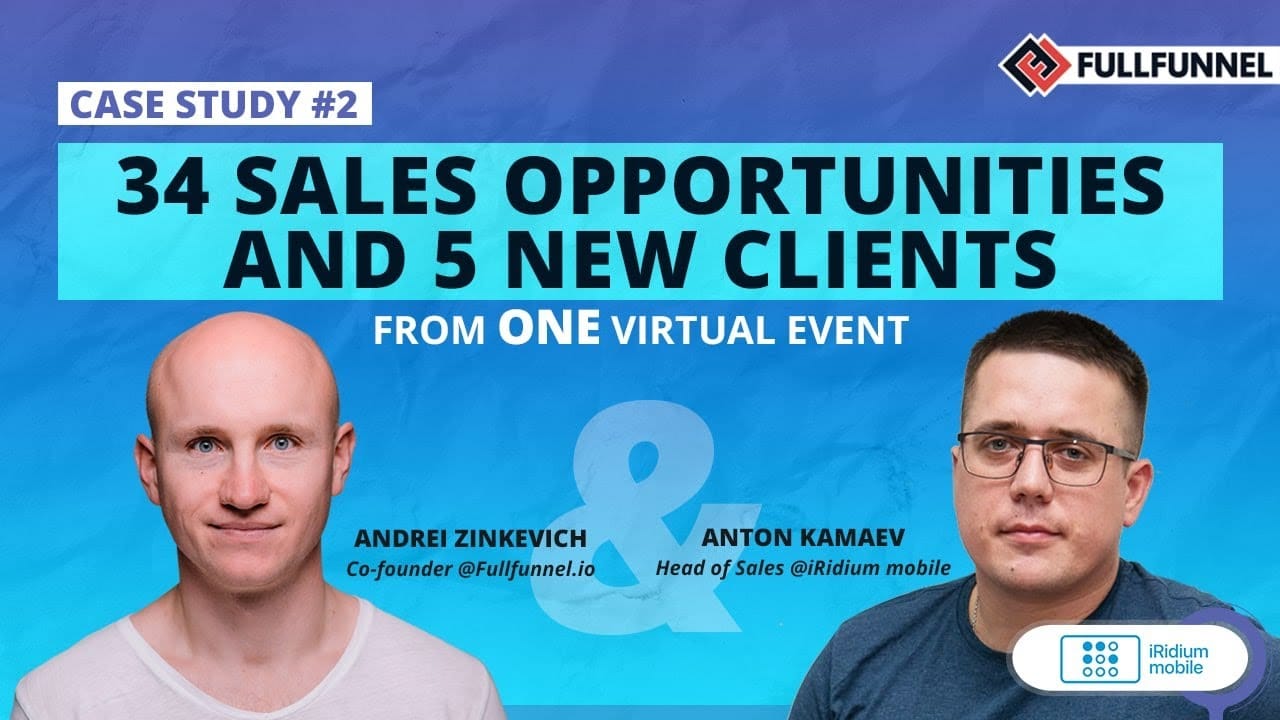
Following a major virtual summit, Iridium generated 34 sales-qualified opportunities by implementing a multi-stage, data-driven follow-up process. The company first contacted new attendees with emails and calls offering dealer status and product trials. They then hosted a dedicated webinar for this group and sent out a digital "content hub" containing product materials and case studies. This hub allowed the sales team to track which content each prospect consumed, providing precise insight into their interests.
This strategy marks a shift from generic post-event outreach to highly personalized engagement. By analysing content consumption, the sales team could initiate conversations based on a prospect's specific, demonstrated interests, such as a particular product or use case. This targeted approach not only created qualified leads but also generated enough revenue to cover all operational costs of the summit, primarily through the sale of 4K video recordings of the sessions.
"We sold some video records of the summit, so it covered all of our operational expenses."
Multi-Channel Promotion Strategy Secures 2,300 Registrations for Virtual Summit
A multi-channel promotion strategy launched a month and a half before a virtual summit successfully secured over 2,300 registrations. The campaign utilised a mix of email announcements, social media posts, and paid Facebook ads. A crucial element was leveraging informational partners and distributors, such as Aurix, who promoted the event through their own extensive customer databases. To generate early interest, organisers also conducted pre-summit podcast interviews with scheduled speakers to warm up the market.
This approach highlights the significant impact of partner marketing in reaching new audiences. Of the 2,300 sign-ups, approximately 900 were new contacts who came from partner channels, representing nearly 40% of the total registrants. This demonstrates that for B2B events, collaborative promotion through a trusted network can be a more powerful engine for audience acquisition than relying solely on direct advertising and internal marketing efforts.
"This network helped us to get so many registrations, more than 2,300. There were about 900 new attendees that we didn't know."
Organic Endorsements and Targeted Offers Drive Sales at Non-Promotional Tech Summit
Even though a virtual summit was designed as a non-promotional, educational event, it successfully generated sales-qualified opportunities through two key methods. First, the host company, Iridium, benefited from what it called "lucky" organic endorsements, as partner companies spontaneously recommended Iridium's platform during their own presentations. Second, organisers made a prepared, specific offer to attendees, providing an upgraded "silver dealer" status with better discounts to those who registered during the summit, along with easy access to product trials.
This success illustrates that direct sales pitches are not always necessary to generate business from events. By creating a high-value, collaborative environment, the company built trust that was amplified by authentic testimonials from partners. This soft-sell approach, combined with a timely and relevant offer, proved effective at converting attendee interest into tangible sales leads, underscoring the principle of always selling the underlying idea or solution, even in an informational setting.
"Never forget to sell yourself when it's possible and when it's appropriate."
Clear Rules and Audience Focus Are Key to Recruiting Corporate Speakers
To successfully recruit speakers for a new virtual summit, particularly from large corporations, organisers focused on four key principles. First, they communicated a clear message that the event's purpose was educational, not to poach customers. Second, they remained open to partners' ideas for the format and content. Third, they clearly defined the target audience as system integrators rather than end-customers, ensuring relevance for speakers. Finally, they established a highly professional and structured plan, with clear rules and timelines, to reassure partners about the event's quality.
This methodical approach addresses the primary concern of large corporations when participating in external events: reputational risk. By demonstrating professionalism, a clear value proposition, and a collaborative spirit, organisers can build the confidence needed to secure high-profile speakers. An organised, transparent process assures potential partners that the event will be managed effectively, making them more willing to lend their brand and expertise.
"If they are confident and they feel that you are able to manage it, they are going to be your best friends."
Free Event Uses 24-Hour Scarcity Model to Drive Live Attendance
A virtual summit boosted live participation by making the event free for all attendees and partners but restricting access to session recordings. Each day's video content was available for only 24 hours before disappearing, creating a sense of urgency and leveraging the "fear of missing out" (FOMO). This scarcity model successfully encouraged attendees to join the sessions live, leading to high levels of engagement, questions, and discussion. To further increase value, the organisers also invited marketing experts to speak, addressing a common pain point for their technical audience of system integrators.
This strategy offers a compelling solution to a common challenge for virtual events: low live attendance despite high registration numbers. By using basic human psychology, organisers can motivate people to prioritize the event in real-time rather than postponing it indefinitely. The inclusion of non-technical business content also demonstrates a deeper understanding of the audience's needs, transforming a standard tech event into a more holistic business development opportunity.
"If we said, 'You can see everything in records, we will send it to you,' we would have gotten ten times fewer attendees than it was."
Tech Summit Recruits Microsoft by Pitching Industry Education, Not Product Sales
To recruit major corporate speakers like Microsoft and MTS for its virtual summit, Iridium pitched the event as a collaborative effort to promote technologies across the market, rather than a sales opportunity for its own platform. The central idea was to create an open forum for knowledge sharing and to facilitate an exchange of customer contacts, allowing all participating companies to expand their reach. By positioning every speaker on a level playing field with equal time slots, the organisers fostered a sense of partnership and mutual benefit.
This approach marks a strategic shift from a company-centric marketing event to an ecosystem-building initiative. Instead of focusing on direct promotion, the event was framed as a platform for elevating the entire industry, which proved to be an attractive proposition for large companies that might otherwise decline a vendor-specific invitation. This model serves as a powerful tool for establishing thought leadership and cultivating relationships with key industry players.
"We said, 'Hey guys, we do not want to promote just Iridium as a platform. We want to promote technologies available in the market.'"
Partner Networks Outperform Facebook Ads for First-Time Virtual Event
In an analysis of their virtual summit's promotional activities, organisers found that partner networks and pre-event interviews with speakers were significantly more effective at generating buzz than paid advertisements on Facebook. Anton Kamaev noted that paid ads were "not so efficient" for their first event. The primary reason was a lack of social proof; without prior success stories or testimonials, it was difficult for paid ads to convince a cold audience of the event's value. In contrast, promotions from trusted partners and content featuring the speakers themselves provided inherent credibility.
This outcome offers a crucial lesson for marketing new initiatives: earned and partner media often trump paid media in the early stages. For a first-time event, building trust and demonstrating value are paramount. Ad spend is less effective without an established reputation or a bank of testimonials to leverage. The experience suggests that initial marketing efforts should focus on building a foundation of credibility through partnerships and content, with paid advertising becoming a more powerful tool for subsequent events once social proof is established.
"Advertisement on Facebook worked less; it was not so efficient comparing with an interview, for instance. That's true."
Iridium Summit's Success Paves Way for Paid Model and International Expansion
Following the success of its first virtual summit, Iridium is planning significant evolutions for its second edition, including the possibility of a paid attendance model and an expansion to a European, English-speaking audience. Anton Kamaev noted that while the impact on reputation is hard to measure, the company has received new business inquiries from attendees who learned of them through the event. The positive feedback has prompted discussions about featuring more use cases, inviting more system integrators as speakers, and eventually hosting a large-scale offline conference.
This trajectory from a free, local-language event to a paid, international one illustrates a typical maturation cycle for a successful marketing initiative. By first focusing on delivering high value and building social proof, a company can establish its event as a must-attend affair. Once that reputation is solidified, it can transition to a revenue-generating model and scale its reach. The long-term vision of an in-person stadium event highlights the ambition to transform a single virtual experiment into a flagship industry institution.
"Being a sales guy, I would say definitely it will be paid. But we will see."
Also mentioned in this video
- The unique challenge and success of Iridium Mobile, a company providing… (0:46)
- The goal of their virtual summit was to create market awareness and thought… (1:35)
- The event's preparation, including the target market (Russia), audience (system… (5:19)
- The initial three months were dedicated to agenda preparation, speaker… (6:04)
- The indirect benefits of the event, including increased brand awareness for… (41:22)
Summarised from Fullfunnel io · 51:21. All credit belongs to the original creators. Streamed.News summarises publicly available video content.