Original source: Garage Living
This video from Garage Living covered a lot of ground. Streamed.News selected 4 key moments and summarises them here. Everything below links directly to the timestamp in the original video.
Ever wondered how those durable, decorative garage floors are made? This explains a key step in their creation, detailing the careful balance of material application and curing time.
Polyaspartic Floor Coating Requires 60-Minute Cure After Flake Application
The application of a polyaspartic floor coating involves a two-person crew, with one member rolling the base coat while the other broadcasts vinyl flakes. To achieve full coverage, three times the standard amount of vinyl flakes is applied. Once the entire floor surface is coated and flaked, the material requires a 60-minute curing period.
This precise application and curing process is crucial for ensuring the durability and aesthetic quality of the finished floor, highlighting the material science involved in modern flooring solutions.
Polyaspartic Coating System Prioritizes Vertical Surfaces and Flake Coverage
Garage Living employs a two-component polyaspartic floor coating system, where a pigmented base coat, matched to the customer's chosen vinyl flakes, is prepared. Before applying the base coat to the main floor, crews first roll it onto all vertical surfaces, heavily applying flakes to ensure 100% coverage. Any excess material is vacuumed from the floor.
This initial focus on vertical surfaces and meticulous flake application is a critical step in achieving a seamless and aesthetically consistent finish across the entire coated area, underscoring the importance of preparatory stages in material application.
Concrete Hairline Cracks Repaired with Rapid-Cure Polyurea Filler
Hairline cracks in concrete pads are addressed by opening them with a diamond cutting wheel before filling them with either a polyurea filler or a cementitious mortar. This filler material hardens rapidly, curing within 25 minutes of application. After curing, any excess material is ground smooth, rendering the cracks invisible.
This quick-setting repair method is essential for maintaining the structural integrity and aesthetic appeal of concrete surfaces, demonstrating specialized techniques used in durable flooring solutions.
Clear Top Coat Applied with Squeegee and Back-Rolling for Uniform Finish
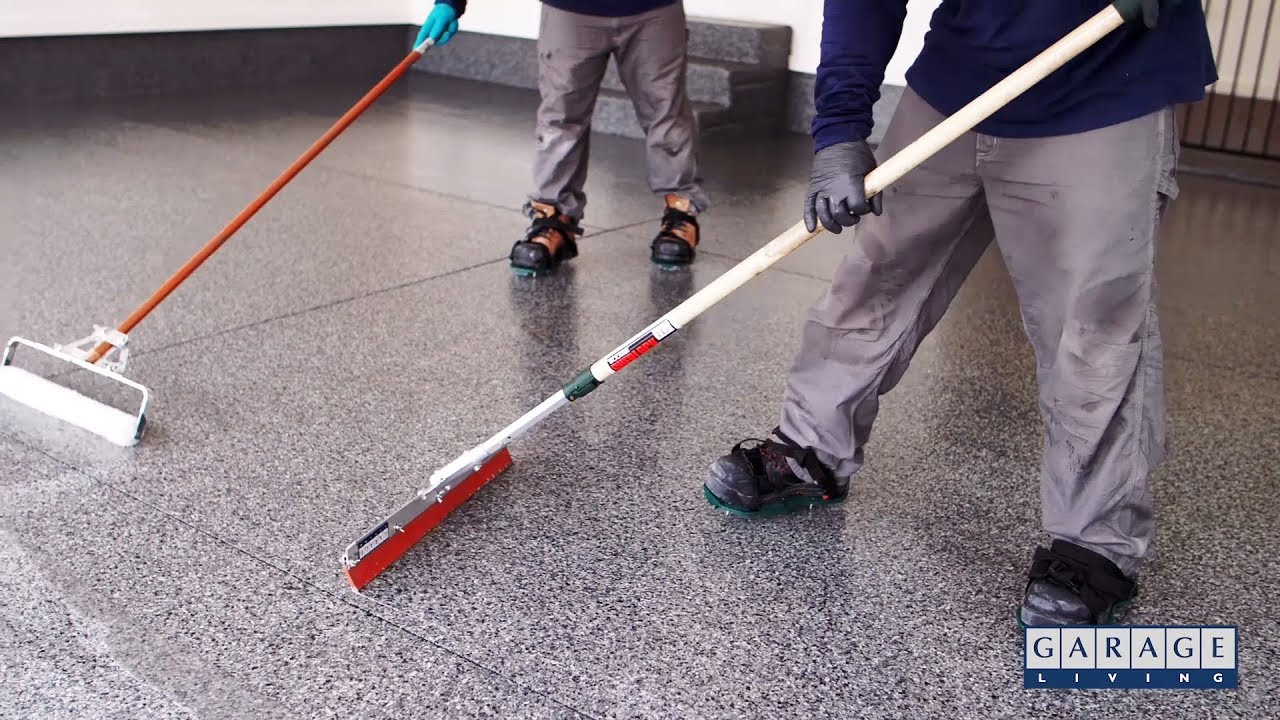
After the base layers and flakes have cured, the final step in the floor coating process involves applying a clear top coat. This two-component material is mixed on-site and then applied to the floor using a squeegee to create a thick, uniform layer. The surface is subsequently back-rolled to ensure an even and consistent finish.
This methodical application of the top coat is crucial for achieving the desired durability and aesthetic quality, protecting the underlying layers and providing a smooth, consistent surface.
Summarised from Garage Living · 4:39. All credit belongs to the original creators. Garage Living News summarises publicly available video content.