🌐 This article is also available in Spanish.
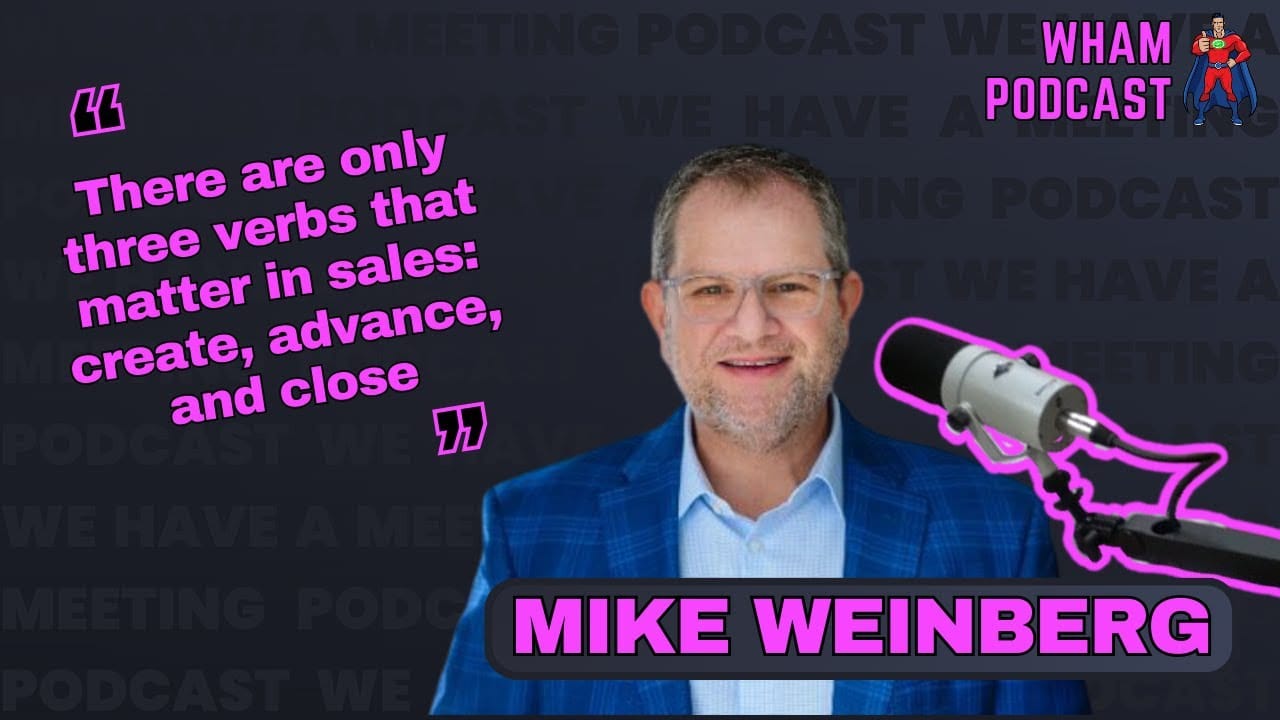
Original source: We Have a Meeting Podcast
This article is an editorial summary and interpretation of that content. The ideas belong to the original authors; the selection and writing are by Streamed.News.
This video from We Have a Meeting Podcast covered a lot of ground. 6 segments stood out as worth your time. Everything below links directly to the timestamp in the original video.
If your sales team is working hard but not growing revenue, the problem may be the system around them — not the people in it.
Sales Consultant Identifies Five Structural Reasons Sales Teams Fail to Win New Business
When executives complain that their teams aren't filling pipelines, sales consultant Mike Weinberg argues the problem rarely starts with selling skills. He identifies five distinct failure points: hiring people wired for relationship management rather than new-business hunting; compensation plans that technically offer variable commission but in practice don't reward the extra effort of landing new accounts; sales managers who skip pipeline reviews and accountability conversations; salespeople buried in service tasks — delivering parts, chasing invoices, sitting in onboarding meetings — instead of prospecting; and, lastly, weak selling skills. Weinberg stresses that the fifth category, skill gaps, is often the least urgent when the first four remain unaddressed.
The framework matters because it redirects blame away from the salesperson on the floor and toward the systems built around them. A compensation plan that doesn't move the needle for new wins, or a culture that lets salespeople substitute busyness for prospecting, will defeat even talented hunters. For any organisation wondering why its revenue growth has stalled, Weinberg's checklist is a diagnostic tool that starts at the top, not at the individual rep.
"I look at the compensation plan and there's no reason to hunt, because it doesn't move the needle on compensation enough."
The Sales Story, Not the Product, Is a Seller's Most Powerful Weapon, Weinberg Says
Mike Weinberg defines the sales story not as a formal pitch deck but as the living collection of language a salesperson reaches for in every interaction — voicemails, cold emails, opening lines in a meeting, slides in a proposal. The decisive quality of a strong sales story, he argues, is that it leads with the problems a prospect is trying to solve and the outcomes they want to achieve, rather than with the seller's own history, features, or credentials. Weinberg says he is confident enough in his own messaging to approach any CEO and, within ten to thirty seconds, make that executive think: "That's interesting — you help people like me."
The principle has direct commercial consequences. Weinberg links a compelling, customer-outcome-focused message to a seller's ability to justify a premium price, secure more meetings, and dissolve the instinctive resistance that prospects display when they feel they are being pitched at rather than understood. In his framing, weak messaging isn't just an aesthetic problem — it is the structural reason many sellers lose on price and struggle to get in the door at all.
"If your story, your messaging, is awful, you're screwed — I don't know how you could sell, and I definitely don't know how you could prospect and get meetings if you're not confident in what you're saying."
Weinberg: Salespeople Who See Themselves as Problem-Solvers, Not Pests, Consistently Outperform
Mike Weinberg traces his foundational sales philosophy to a single piece of advice his father gave him thirty years ago when he entered the profession: your goal is to help your customer win, and as long as that is your motivation, you will always win too. That reframe, he says, is the antidote to the hesitation most salespeople feel before making a cold call or pushing past initial resistance. Instead of worrying about being intrusive, a salesperson who genuinely believes the prospect has a problem and that they carry a real solution sees each call not as an interruption but as a rescue. Integrity, proactivity, and likability, Weinberg argues, all flow naturally from that belief.
The insight cuts against a persistent cultural anxiety in sales — the fear of becoming the pushy, manipulative stereotype that gives the profession a bad reputation. Weinberg's argument is that the stereotype and the top performer are separated not by technique but by intent. When the motivation is genuinely the customer's outcome, the entire emotional dynamic of a sales conversation shifts: customers sense authentic interest, lower their defenses, and engage differently. That shift, he contends, is worth more than any individual tactical skill.
"You're not calling to bug them — you're calling to rescue them. You believe they're better off with you than with somebody else."
Top Salespeople Own Their Results Even When the Territory Works Against Them, Weinberg Argues
Mike Weinberg acknowledges that external headwinds are real — economic downturns, depressed sectors, unfairly carved territories. He describes mentoring a young salesperson handed a list of largely dormant accounts while colleagues in neighbouring territories work richer ground. The frustration, Weinberg says, is legitimate. But the response of the highest performers is not to wait for conditions to improve. He recalls his own mentor, Donnie Williams, who would listen to his explanations about a slow advertising market in particular cities, remove his glasses, and ask a single deflating question: "What are you going to do about it?" That posture — acknowledging difficulty while insisting on personal agency — is what Weinberg calls an internal locus of control.
The tension Weinberg is navigating is one that any professional faces when structural disadvantage meets individual accountability. His answer is not to deny the unfairness but to refuse to let it become an excuse that stops action. The goal, he suggests, is to work hard enough within a bad situation to earn the right to a better one — which requires distinguishing between circumstances that deserve acknowledgment and circumstances that become a permanent alibi.
"It's not my fault, but it is my problem — I've got to deal with it."
Weinberg Describes the Perfect Sales Pitch — One Guaranteed to Fail
Asked to construct a sales story engineered to fail, Mike Weinberg answers without hesitation: open with slides of the company's buildings, follow with org charts, show a photograph of the founder alongside a timeline of acquisitions, and then walk through detailed flowcharts of internal processes. Every element, he says, would be self-focused — a monument to how long the company has existed and how clever its engineers are. He notes that the exercise is uncomfortable precisely because it describes how a surprising number of real sales pitches are actually structured, from company websites to SaaS demos where a salesperson wins a meeting and then immediately starts clicking through features without ever establishing what problem the product exists to solve.
The point lands hardest as a mirror. Weinberg is not describing a hypothetical failure mode — he is describing the default setting that many organisations revert to when they let product pride override customer empathy. The antidote, in his framework, is to begin with the outcome the client is trying to reach and work backward to the solution, rather than presenting capabilities and hoping the prospect will do the connective work themselves.
"It would be self-focused garbage — we've been in business this long, here's our history, here's why we're so smart. That's if I wanted to write a really bad story."
Weinberg Warns Against the 'Sales Voice' — and the Overcorrection That Sends Prospects to Sleep
Mike Weinberg argues that the inauthentic, over-enthusiastic vocal tone some salespeople adopt — what he calls the sales voice — actively destroys trust, because it signals to prospects that something performative rather than genuine is happening. His prescription is straightforward: sound like an adult having a normal business conversation with another adult. Neither cheerleading nor grovelling, neither hyper-casual nor obsequiously deferential. He is critical of at least one large training firm with offices in the UK and the United States whose methodology, in his view, teaches salespeople to act in ways designed to manipulate a customer's emotional state — an approach he finds both ineffective and ethically uncomfortable. The most reliable cure for a bad tone, he says, is recording the salesperson without warning, then playing it back.
Weinberg also flags the equal and opposite failure: salespeople who dial down the energy so aggressively in pursuit of calm that they sound listless on the phone, losing the call before they have made their point. The sweet spot he describes is confident composure — someone who sounds unhurried because they genuinely believe the prospect has a problem and they carry a real solution, not because they are following a script. That internal conviction, he suggests, is what tone training alone can never manufacture.
"Normal people — good salespeople — don't sound like they're a salesperson. They sound like a normal person having an adult business conversation with another adult business person."
Also mentioned in this video
- Mike explica que las empresas que buscan su ayuda suelen tener problemas para… (1:17)
- Mike distingue entre la "generación de nuevos negocios" y el "vender",… (2:31)
- Mike explica el concepto de ser el "CEO de tu propio negocio" en ventas,… (13:13)
- Mike compara la importancia de contarse una mejor historia interna para los… (19:57)
- Mike explica que los vendedores con un tono demasiado apagado deben ser… (35:04)
- Mike discute el equilibrio entre la persistencia en la búsqueda de reuniones y… (37:03)
- Mike aconseja a los nuevos vendedores que entiendan la nobleza de las ventas,… (44:51)
Summarised from We Have a Meeting Podcast · 48:16. All credit belongs to the original creators. Streamed.News summarises publicly available video content.
Streamed.News
This publication is generated automatically from YouTube.
Convert your full video library into a digital newspaper.
Get this for your newsroom →