Original source: Barry's Economics
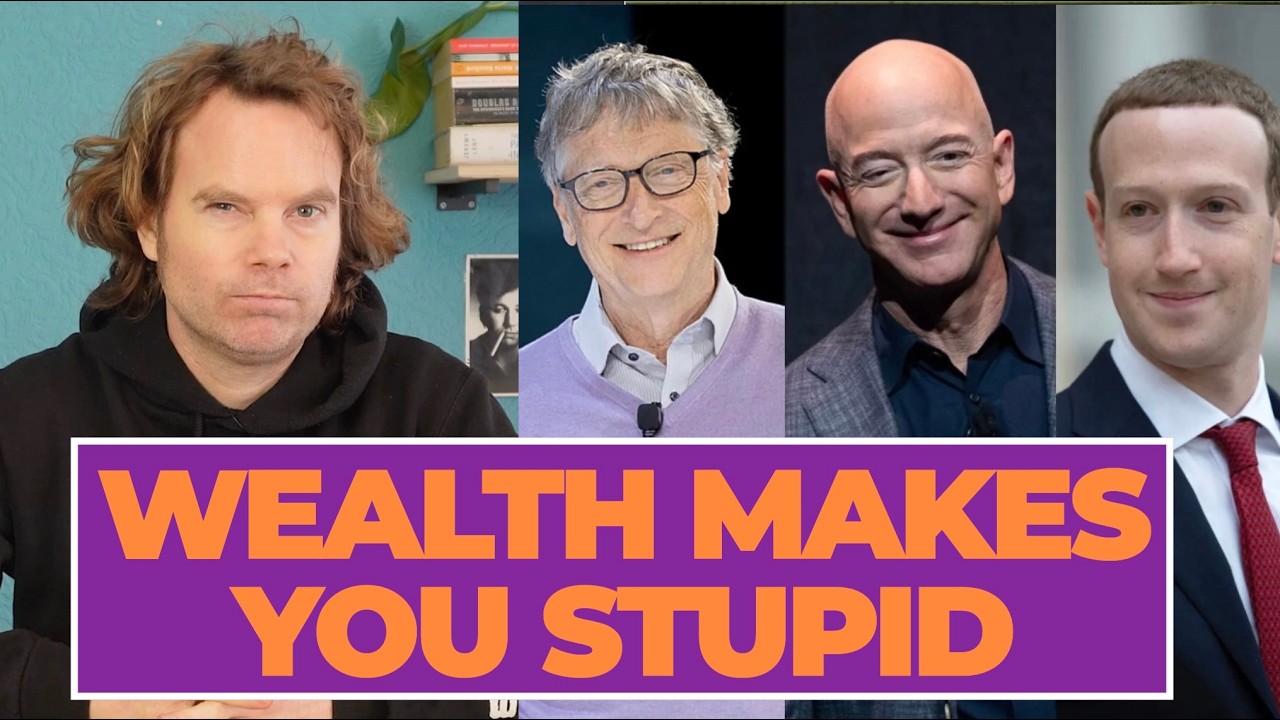
This video from Barry's Economics covered a lot of ground. Streamed.News selected 5 key moments and summarises them here. Everything below links directly to the timestamp in the original video.
Why do the rich so often advise the poor to just "work harder"? Research suggests their own life experiences have neurologically wired them to see meritocracy everywhere, even where it doesn't exist.
Sociologist Finds Wealthy Attribute Success to Merit, Poor to Circumstance
Research from sociologist Michael Kraus reveals a stark "attribution bias" dividing the rich and poor. Wealthier individuals overwhelmingly explain outcomes through personal traits like talent and hard work, whereas those with fewer resources are far more likely to point to contextual factors—structural barriers, timing, and luck.
This isn't just a difference of opinion; it is a worldview forged by lived experience. When your life is a series of automatically opening doors, your brain concludes the world is a meritocracy, fundamentally misreading the systemic forces and constraints that shape the lives of others.
"Wealthier people are far more likely to explain outcomes in terms of personal traits, hard work, talent... Whereas poorer people... are far more likely to explain outcomes in terms of context, good or bad timing, structural help, barriers."
Berkeley Study Finds Power Degrades Social Intelligence and Empathy
Does power corrupt? According to decades of research by social psychologist Dacher Keltner at Berkeley, the answer is a resounding yes. Dozens of experiments, from cookie-eating habits to traffic behavior, show that when people feel powerful they become worse at reading emotions, less able to see others' perspectives, and more prone to unethical actions.
The core mechanism is social distance. Power insulates individuals from consequences, so they simply stop needing to pay attention to others, causing the human feedback loops that maintain social cohesion and empathy to break down.
"If I have a little dose of power, I'm more likely to touch people inappropriately, swear, lie, cheat, steal... most of the unethical tendencies come out of feeling too much power."
The Paradox of Power: Social Skills Win It, but Power Destroys Them
Humans typically gain power through what is best in our nature—social intelligence, empathy, and collaboration. Yet, as social psychologist Dacher Keltner's research demonstrates, the experience of having power actively diminishes these very qualities. The higher one climbs, the less real the people below become.
This creates a dangerous paradox where the skills required to lead are eroded by the act of leading itself. The result is a class of powerful but "untethered" individuals who lose the perspective necessary for effective and humane governance.
"We gain power through what is good in human nature, but regrettably, power decreases our social intelligence, and really releases, very often, what is problematic in human behavior."
Nobel-Winning Theory Explains How Billionaires Develop a Warped View of Reality
The "availability heuristic," a concept from Nobel laureates Daniel Kahneman and Amos Tversky, explains how easily recalled examples shape our worldview. Because billionaires' own efforts are consistently rewarded with success, their brains conclude this is a universal rule, making failure seem like a personal error rather than a common outcome.
This isn't arrogance; it is a statistical distortion. Their personal data set lacks failure, leading them to dramatically underestimate how often effort fails for others and to fundamentally misinterpret the basic mechanics of social mobility.
"When people repeatedly see their effort followed by success in their own lives, they dramatically underestimate how often effort fails for others."
Power and Wealth Combine to Create a Neurological Inability to Grasp Reality, Researchers Argue
The persistent disconnect of the billionaire class is not a moral failing but a predictable psychological outcome. The combination of power-induced social distance and a wealth-driven overestimation of meritocracy creates a profound cognitive gap. They become, in effect, neurologically unable to comprehend the daily realities of most people.
This explains why advice like "pull yourself up by your bootstraps" is offered with genuine conviction. They are not consulting experts on the world; they are describing a reality that only exists inside their own gilded bubble.
"Listening to a billionaire explain success is like listening to somebody describe a recipe when they've never had to grow, hunt, or pay for a single ingredient."
Summarised from Barry's Economics · 14:30. All credit belongs to the original creators. Barry's Economics Press summarises publicly available video content.