🌐 Also available in: 🇪🇸 Español
Original source: Nate Hagens
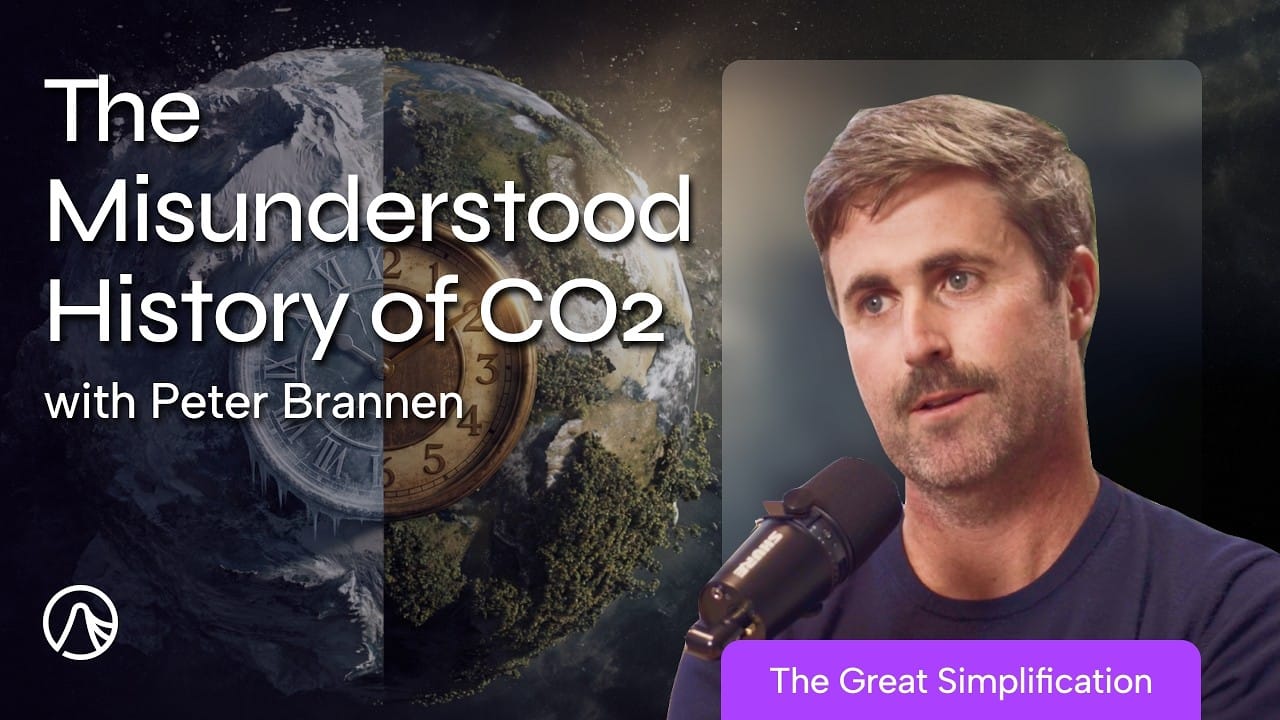
This video from Nate Hagens covered a lot of ground. Streamed.News selected 8 key moments and summarises them here. Everything below links directly to the timestamp in the original video.
Understanding Earth's deep history of climate catastrophes, particularly the Permian extinction, provides crucial context for evaluating the scale and speed of current human-induced climate change. What does an 'unprecedented rate' of planetary alteration mean for the habitability of Earth, and what are the long-term implications for human civilization?
Permian Extinction Parallels Human-Driven Warming, Raising Concerns About Unprecedented Rate of Change
The Permian mass extinction, which saw global temperatures rise by 10°C over 30,000 years due to the injection of thousands of gigatons of CO2 from Siberian volcanic eruptions, offers a stark parallel to contemporary anthropogenic climate change. This ancient catastrophe, along with the Paleocene-Eocene Thermal Maximum (PETM), which caused a 5-8°C warming, demonstrates Earth's system response to massive carbon inputs, including widespread ocean acidification and coral reef collapse. While the total volume of current human CO2 emissions has not yet matched these prehistoric events, the rate at which fossil fuels are being released is significantly faster, pushing the planet into an unknown and potentially chaotic state.
Geological records from events like the PETM reveal long-lasting legacies in sediment cores, characterized by shifts from calcareous ooze to red clay, indicative of severe ocean acidification. Scientists project that current human activity will leave a similar, if not more extreme, geological signature. The Earth's natural processes would require hundreds of thousands of years to re-equilibrate and scrub the excess carbon dioxide from the atmosphere, even if emissions ceased immediately. The unprecedented speed of current warming implies that feedbacks within the carbon cycle, such as permafrost melt or forest dieback, could be triggered in ways not fully understood, exacerbating the long-term planetary trajectory.
"While we aren't emitting as much CO2 as the Permian mass extinction or the PETM, we're doing it much faster. It's much more intense."
Global Food Systems Vulnerable to Collapse in 3°C Warming Scenario
A global average temperature increase of 3°C or more poses an existential threat to the intricate, fossil-fuel-dependent global food supply chains, according to Peter Brannen. Such warming would profoundly disrupt established "bread baskets" by altering drought patterns and reliable precipitation, jeopardizing food production for a population that currently relies on supply chains extending an average of 1,300 miles. These complex systems, fueled by bunker fuel for shipping and fossil-powered irrigation, are ill-equipped to accommodate rapid climate shifts.
The unparalleled stability of the Holocene, the interglacial period in which human civilization developed, has created an institutional memory of climate conditions that are now rapidly changing. Brannen suggests that industrial society, functioning as an incredibly complex and energy-intensive "superorganism," faces the risk of network collapse, akin to how ecosystems unravel when too many interconnected nodes are lost. The stress points within this global system are unknown, but pushing beyond the 3°C threshold could trigger cascading failures across interdependent systems.
"We've built up this incredibly complex, unbelievably energetic global industrial civilization… and I don't know where the stress points are or whether that could, you know, collapse like a network."
Ice Age Volatility Shaped Human Evolution, Fostering Brain Growth and Culture
The extreme climate volatility of the ice ages, which began approximately 2.5 million years ago as atmospheric CO2 levels fell below 300 parts per million (ppm), profoundly influenced human evolution. This period, characterized by dramatic swings between 40,000-year and 100,000-year ice ages and brief interglacial warm periods, is thought to have selected for adaptive traits such as the use of fire. Fire, in turn, transformed human anatomy, supporting the development of large, energy-intensive brains and fostering the emergence of culture, language, and technology.
Despite the cognitive advancements, early agriculture proved challenging during these volatile times due to rapid climate shifts and critically low CO2 concentrations, sometimes reaching 180 ppm. Many foundational crops rely on an older photosynthetic pathway that thrives in higher CO2 environments, making sedentary farming difficult or impossible until the more stable conditions of the Holocene began about 11,000 years ago. This long history underscores the deep, reciprocal relationship between climate dynamics and the trajectory of human life.
"That incredibly volatile environment...is thought to have shaped humanity because it was an incredibly difficult and volatile world."
Scientists Predict 3°C+ Warming with Unpredictable Consequences for Human Society
Current scientific consensus points towards a likely future scenario of 3°C or more global warming, though projections carry significant "error bars" due to poorly understood carbon cycle feedbacks. Phenomena like permafrost release and widespread forest dieback could accelerate warming trajectories beyond current models. Human societies, characterized as complex, dynamic, and far-from-equilibrium systems, are inherently ill-equipped to manage such rapid and extreme planetary alterations, particularly given that all of recorded human history has unfolded within the unusually stable climate of the Holocene interglacial period.
The increasing complexity of Earth's response to anthropogenic forcing means that even minor additional pushes on the system can lead to unpredictable outcomes. A target of 3°C warming, for example, could easily translate into 4°C due to unforeseen feedbacks. Such a profound shift would occur on a planet that has experienced ice ages for the past 3 million years, rendering historical precedents inadequate. The collective humility and caution of human societies are essential when engaging with these complex systems whose ultimate behavior remains beyond complete comprehension.
"The most common numbers I see are like a little over three with these huge error bars depending on whether the carbon cycle complies with our…"
Fossil Fuel Formation Explains Earth's Oxygenated Atmosphere
Earth's oxygenated atmosphere, critical for animal life, is a surprising byproduct of the geological processes that formed fossil fuels. While photosynthesis is necessary to produce oxygen, it is not sufficient; the decomposition of organic matter typically consumes the oxygen produced. The key lies in the burial of organic material—plants, upon death, are quickly covered by sediment, shielding them from oxygen and preventing their decomposition. This sequestration of carbon over geological timescales allowed the surplus oxygen they generated to accumulate in the atmosphere.
This "infinite decimal leak" of carbon into the Earth's crust over hundreds of millions of years is what charged the atmosphere with abundant oxygen. The Industrial Revolution represents a monumental reversal of this process, reuniting these long-separated reservoirs of ancient organic carbon and atmospheric oxygen. The rapid combustion of fossil fuels releases vast amounts of stored energy, essentially bringing two highly reactive components, held out of equilibrium for eons, back together in a dramatic, energy-releasing event.
"The charging up of the Earth's crust with fossil fuels is the reason why there's a lot of oxygen in the air today."
Snowball Earth Catastrophe Preceded Cambrian Explosion, Triggered by CO2 Decline
Approximately 700 million years ago, Earth experienced a profound climate catastrophe known as "Snowball Earth," a period predating complex animal life. Declining atmospheric CO2 levels, exacerbated by an acceleration of rock weathering processes, caused ice sheets to expand from the poles, eventually covering the entire planet, including the tropics, for tens of millions of years. This extreme glaciation rendered the planet a frigid, nearly lifeless sphere, trapping volcanic CO2 emissions until they reached immense concentrations.
The eventual thaw of Snowball Earth was abrupt and extreme, leading to a "super greenhouse" climate due to the accumulated CO2. Paradoxically, this period of immense environmental stress and subsequent rapid warming is thought to have played a crucial role in paving the way for the Cambrian explosion, the rapid diversification of animal life that followed. This ancient event serves as a powerful reminder of Earth's profound climate volatility and the long-term, bidirectional control exerted by atmospheric carbon dioxide.
"The greatest climate catastrophe in Earth history happens in the leadup to animal life... You have this crazy climate catastrophe and then sort of the champagne cork of animal life explodes in its aftermath."
CO2 Acts as Earth's Planetary Thermostat, Regulating Habitable Temperatures for Animals
Carbon dioxide functions as Earth's planetary thermostat, maintaining the relatively narrow temperature range essential for animal life over geological timescales. This regulation is primarily achieved through the rock weathering cycle, a long-term geological process occurring over hundreds of thousands of years. In this cycle, volcanic CO2, released at a slow, manageable rate (about 1/100th of current human emissions), reacts with rainwater, making it slightly acidic. This acidic rain weathers rocks, dissolving minerals that are carried to the oceans as bicarbonate.
Oceanic life utilizes this dissolved carbon to form shells, which, upon death, sink to the seafloor, forming calcareous ooze that eventually becomes limestone. This limestone subducts back into the Earth's mantle, where the carbon can be re-released through volcanic activity, completing the cycle. This elegant, self-regulating mechanism ensures that CO2 levels remain within bounds: too little CO2 would plunge the planet into deep cold (e.g., 0.01% CO2 and vast ice sheets 20,000 years ago), while too much would create a super-greenhouse (e.g., 0.1% CO2 and crocodiles in the Arctic 50 million years ago), neither of which would be hospitable for complex animal life.
"The primary knob governing Earth's temperature, as a classic paper puts it, is CO2."
Human Activity Releases 500 Million Years of Stored Carbon at Unprecedented Rates
The Earth's normal carbon cycle involves a delicate balance where a thin trickle of CO2 from volcanoes is offset by natural sequestration, maintaining equilibrium. Simultaneously, carbon rapidly cycles between oceans, atmosphere, and biosphere, with plant life drawing in CO2 and other organisms releasing it. This dynamic interplay is crucial for life, as unchecked photosynthesis could deplete atmospheric CO2 within seven years, ending life on Earth. However, human activity is introducing a new, disruptive element: the rapid release of geological carbon stores.
These fossil fuels, representing 500 million years of accumulated organic matter, are being combusted and released into the atmosphere over a mere matter of centuries. This rate is exponentially faster than any natural volcanic emissions or past climate events, fundamentally disrupting the planet's long-term carbon balance. The physical principles of CO2's greenhouse effect, understood since the 19th century, confirm its role as the climate's control knob, dictating temperature changes. Unlike water vapor, which cycles rapidly, anthropogenic CO2 persists indefinitely, trapping heat and creating a positive feedback loop with the water cycle, intensifying both droughts and precipitation.
"This took 500 million years to build up this battery of fossil fuels in the crust, and releasing it in a matter of centuries on the surface of the planet and expecting that not to be chaotic and disruptive is just not realistic."
Also mentioned in this video
- The Permian mass extinction, caused by volcanic eruptions injecting gigatons of… (0:00)
- His new book, "The Story of CO2 is the Story of Everything," evolved from his… (2:10)
- The common misconception that CO2 is merely "plant food" by emphasizing its… (4:11)
- The carbon cycle, which operates on microscopic and planetary scales,… (5:53)
- Projections that in 500 million years, the sun's expansion will accelerate rock… (10:30)
- Peter Brannen delves into the origin of life, favoring the hypothesis that life… (16:16)
- Peter Brannen expresses frustration with the public's lack of understanding… (36:20)
- Oceans have absorbed about 30% of human CO2 emissions, leading to 30% more… (38:07)
- Peter Brannen expresses hope that a deep-time understanding of Earth's CO2… (46:27)
- Geoscientists are converging on the understanding that simply building solar… (49:04)
- The intriguing, though debated, idea that early human land clearance for… (55:13)
- Peter Brannen expresses frustration with the naive assumption that more… (56:37)
- Key research questions in geoscience, including understanding the specific… (59:00)
- Human societies have been organized around diverse value systems throughout… (1:01:15)
- Peter Brannen reflects on his worldview shift, stating that his deeper dive… (1:03:11)
- Peter Brannen, after completing a challenging book, is now focusing on the… (1:05:03)
Summarised from Nate Hagens · 1:09:01. All credit belongs to the original creators. Streamed.News summarises publicly available video content.