Original source: Patrick Mouratoglou
This video from Patrick Mouratoglou covered a lot of ground. Streamed.News selected 8 key moments and summarises them here. Everything below links directly to the timestamp in the original video.
What's the difference between a good shot and a great one? Often, it comes down to a few milliseconds and one aggressive step forward.
Mouratoglou's Key Advice: Move Forward and Attack the Ball on the Rise
Following a high-quality debut UTS match, Patrick Mouratoglou identified two critical adjustments for both players to reach the next level. The first is to consistently move forward to meet the ball rather than waiting for it. The second is to run around the backhand not just to reach the ball, but to sprint forward and strike it on the rise.
This aggressive court positioning is designed to rob the opponent of time. Taking the ball early, especially with a forehand, makes the shot exponentially more dangerous and prevents the opponent from organizing a counter-attack. Failing to do so allows the opponent time to recover and exploit the open court.
"If you're able to take it on its way up, you can even lean on it. I mean, your shots would be 10 times more dangerous."
Mouratoglou Cites Jannik Sinner as Model for Aggressive Court Positioning
The difference between good and great players often lies in small, consistent habits. Mouratoglou advises that taking even one step inside the baseline whenever possible immediately elevates a player's level. He points to Jannik Sinner as the ultimate example of a player who relentlessly takes any space given to him, always moving forward to meet the ball.
This habit must be forged in practice, because practice makes permanent, not perfect. If a player waits for the ball in training, they will instinctively wait for it in a match. The goal is to make aggressive forward movement an automatic, unconscious action.
"Everybody says practice makes perfect, which is not true because practice makes permanent. So, everything you do at practice, you'll do it in a match, for sure."
Mouratoglou Praises Charles's Aggression Despite Abandoning Game Plan
In a mid-match analysis, Charles admitted his original plan to play high, passive balls had been completely abandoned. Instead, he found himself playing aggressively and forcing the points. Mouratoglou expressed approval for this change, noting that the original strategy was too passive and that the aggressive play created numerous opportunities.
The advice was to maintain the aggression but refine the tactics. Rather than rushing to open up the court, Charles should patiently work his opponent's backhand with his forehand. This builds the point logically, forcing a short ball that can then be attacked decisively.
"I didn't like your plan because it was a bit passive. The way you played was not passive at all, so that's what I think you played really, really good."
To Compete at the Top, Players Must Get Used to Less Time
By forcing players to constantly move forward and never wait for the ball, Mouratoglou aims to simulate the pressure of elite tennis. This drill makes the court feel smaller and forces much faster decision-making, which is initially uncomfortable for the players. They have less time to prepare and must execute with greater urgency.
This discomfort is a necessary part of development. The top players in the world play at an extremely fast pace, and it is better to get accustomed to that feeling in training rather than being overwhelmed by it in a high-stakes match.
"At the highest level, anyway you will be, they will make you feel uncomfortable, so it's better to get used to it now than later."
Mouratoglou Questions Maxime's Contradictory Game Plan
In a pre-match strategy session, Maxime laid out a plan to beat his brother by making him miss. He intended to take control on his own serve but play high, heavy balls on the return. Mouratoglou immediately identified this as a contradictory strategy that would likely fail.
Playing with height gives an aggressive opponent time to set up and dictate the rally, which works against the goal of taking control. The plan was refined: take control on serve, and on return, use high balls only to push the opponent back before stepping in to attack any short reply.
"It's a little bit contradictory because you said you need to take control, and then you said I need to play high, so you give him the time."
Charles Plans to Disrupt Rhythm With Variety and Early Ball-Striking
Charles outlined his strategy to defeat his brother Maxime by preventing him from finding a comfortable rhythm. His plan is to constantly vary the pace and spin, using a mix of slices and high balls to the backhand to ensure his opponent never sees the same shot twice in a row.
The foundation of this plan is to take control by striking the ball early. By stepping inside the baseline on any shorter ball, as practiced in the warm-up, he aims to take time away from Maxime and dictate the flow of the rallies himself.
"I need to change a lot the rhythm to make him never play the same ball."
Tennis Twins Define Their Styles: 'The Marathoner' vs. 'The Sprinter'
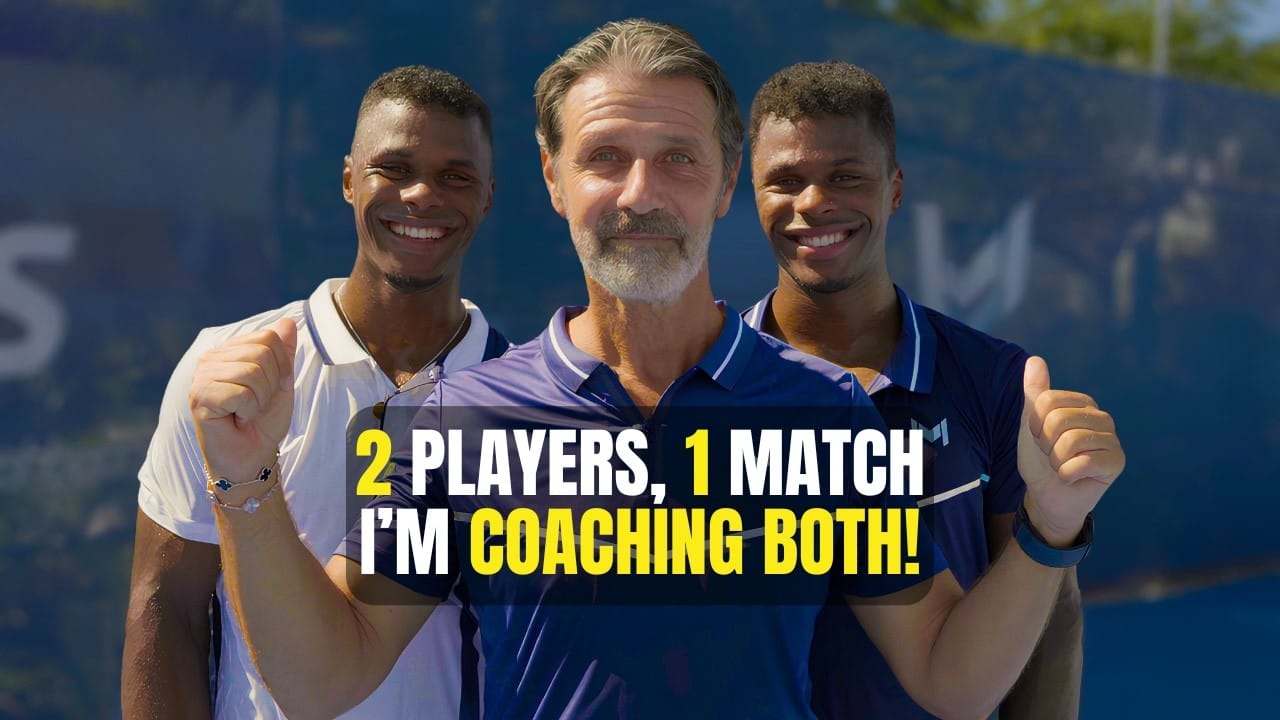
The twin players, Maxime and Charles, detailed the key differences in their playing styles. Maxime describes his game as looser and more intuitive, with a greater variety of shots. In contrast, Charles defines his approach by its discipline, particularly in his footwork.
This divergence extends to their physical profiles on the court. Charles is characterised as a "marathon" player, with the endurance to last for three hours. Maxime, conversely, is "the sprinter," excelling at rapid, explosive side-to-side movements over shorter periods.
"Charles can last 3 hours on the court. He's more like a marathon, and I'm more... the sprinter."
A Guide to the UTS Format: Timed Quarters, No Second Serves, and a 'Bonus Card'
Patrick Mouratoglou outlined the rules for the Ultimate Tennis Showdown (UTS), a format designed for fast-paced, compressed action. Matches are comprised of four 8-minute quarters, with the first player to win three quarters claiming victory. Scoring is sequential, like a tie-break, not traditional games and sets.
Several key rules distinguish UTS from the traditional tour. Players only get one serve per point, forcing a blend of power and consistency. A 15-second shot clock speeds up play, and each player can use a "bonus card" once per quarter to make the next point worth three.
"It's only one serve, so there is no first serve. And you have to find a good combination between a first and a second."
Also mentioned in this video
- Twin tennis players Charles and Maxime, discussing their current rankings,… (0:01)
- Patrick Mouratoglou draws a comparison between the twins' similar career paths… (0:45)
- The twins discuss the next stage of their improvement, aiming to play more… (2:41)
- Patrick Mouratoglou prepares the twins for a UTS match, a format with unique… (6:30)
- The first quarter of the UTS match is played, resulting in a narrow win for… (10:32)
- Maxime reflects on the first quarter, noting too many faults on his serve and… (12:51)
- The second quarter of the UTS match is played between the twins, with continued… (15:23)
- Changing his strategy in the second quarter to be more aggressive, noting he… (17:31)
Summarised from Patrick Mouratoglou · 20:56. All credit belongs to the original creators. Streamed.News summarises publicly available video content.