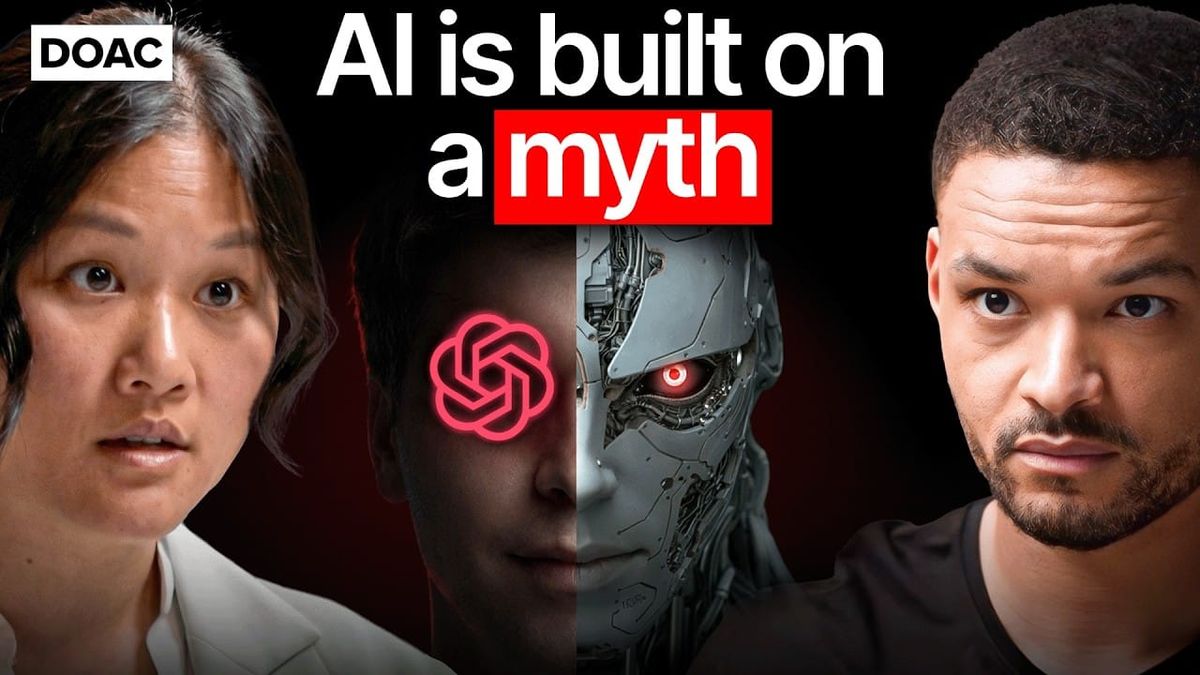
Original source: The Diary Of A CEO
This article is an editorial summary and interpretation of that content. The ideas belong to the original authors; the selection and writing are by Streamed.News.
This video from The Diary Of A CEO covered a lot of ground. 6 segments stood out as worth your time. Everything below links directly to the timestamp in the original video.
Have you ever considered the hidden human and environmental costs behind the AI tools you use daily? This perspective challenges the narrative that AI universally enhances human life.
AI Dehumanizes Working Class While Empowering Elite, Karen Hao Argues
While some business owners find AI allows them to offload tasks and become "more human," investigative journalist Karen Hao argues that the working class faces dehumanization through the AI industry. She points to data annotation jobs, now among LinkedIn's fastest-growing positions, which are often low-paying, high-anxiety, and atomized. Hao cited a New York Magazine piece detailing how even highly educated individuals, displaced by AI-driven economic restructuring, are forced into these roles, leading to severe personal stress, such as a mother screaming at her child due to work pressure.
This trend exacerbates societal inequality, creating a stark divide between those who benefit from AI and those who bear its costs. Beyond job displacement and diminished dignity, vulnerable communities face environmental and public health crises from AI's infrastructure. Hao highlighted OpenAI's massive data center project in Abilene, Texas, which is projected to consume over 20% of New York City's power. She also cited Elon Musk's Grok supercomputer in Memphis, Tennessee, which used 35 methane gas turbines, polluting a working-class community and contributing to existing environmental racism by pumping thousands of tons of toxins into their air.
"This industry that is absorbing more and more of the workers that are being laid off, is mechanizing my life, atomizing my work, devaluing my expertise, and then harvesting it for the perpetuation of this machine."
▶ Watch this segment — 1:40:37
Karen Hao Calls for 'Bicycles of AI' and Public Resistance Against 'AI Empires'
Karen Hao advocates for a shift away from resource-intensive "rockets of AI" towards more sustainable "bicycles of AI," citing DeepMind's AlphaFold as an example. AlphaFold, which predicts protein folding, uses small, curated datasets, significantly less computational power, and fewer resources while providing immense benefits for drug discovery and understanding human disease. In contrast, current AI models from major companies exact an extraordinary cost on a large swath of people and the environment.
Hao urges the public to resist the current trajectory of AI development by withholding data, protesting data centers, and engaging in public discourse about ethical AI adoption. She notes that the AI industry's appetite for data and labor is expanding, not shrinking, despite claims that AI would reduce these needs. Hao calls for breaking up AI "empires" that exploit labor and resources without fair value exchange, highlighting growing public sentiment, with 80% of Americans favoring AI regulation, and grassroots movements successfully stalling or banning data center projects globally.
"Let's not make it go flawlessly if we don't agree with what they are doing. And then let's build alternatives."
▶ Watch this segment — 1:55:56
Ilya Sutskever Initiated Sam Altman's Ouster from OpenAI Over Chaotic Leadership
Ilya Sutskever, then chief scientist and co-founder of OpenAI, became deeply concerned by Sam Altman's chaotic leadership and poor decision-making, which he believed compromised research outcomes. Sutskever covertly approached independent board member Helen Toner, carefully revealing his worries about Altman's instability. The board structure, designed to balance financial interests with public benefit, gave independent members the crucial role of oversight. Sutskever and CTO Mira Murati subsequently presented evidence, including emails and Slack messages, to independent board members, asserting that Altman was the root of the company's internal divisions and lack of trust.
The independent board members, wrestling with the immense stakes of developing artificial general intelligence (AGI), concluded that Altman's behavior, which included inconsistencies in his portrayal of company activities such as the "OpenAI startup fund" actually being "Altman's startup fund," was unacceptable for a technology they believed could "make or break the world." Fearing Altman's persuasive abilities, they fired him without informing key stakeholders like Microsoft. This decision, however, sparked immediate outrage from unconsulted parties, leading to a swift campaign that reinstated Altman as CEO days later.
"I don't think Sam is the guy who should have the finger on the button for AGI."
OpenAI Subpoenaed Critics During Nonprofit-to-For-Profit Conversion
During its critical transition from a nonprofit to a for-profit entity, OpenAI initiated a campaign of intimidation by subpoenaing its critics, including a small watchdog nonprofit called MIDAS. The subpoenas sought to map out the network of critical voices and uncover any connections to Elon Musk, reflecting what Karen Hao described as a "strange paranoia" within OpenAI that Musk was funding opposition to the conversion. The requested communications, primarily emails and text messages related to Musk, ultimately yielded no documents as the critics were not financially tied to him.
Hao characterizes such actions as typical of an "AI empire," which not only engages in "land grabs" and "labor exploitation" but also controls knowledge production and narrative. OpenAI, like other tech giants, employed a "good empire" narrative, presenting itself as a benevolent force needing to accumulate resources and power to deliver progress, while warning against the dangers posed by "evil empires" like Google in its early days, and later China.
"OpenAI started subpoenaing some of its critics... as part of a what's what appears to be a campaign of intimidation, but also what appeared to be a campaign of fishing for more information to figure out to map out the network of critics further."
OpenAI Co-Founders Depart to Form Rival AI Companies Amid Clashes with Sam Altman
Following Sam Altman's temporary ouster and subsequent reinstatement as CEO of OpenAI, many of the company's original co-founders and early executives, including Ilya Sutskever and Mira Murati, departed due to irreconcilable clashes with Altman. Sutskever, who told the board, "I don't think Sam is the guy who should have the finger on the button for AGI," left to launch Safe Superintelligence – a name that, Karen Hao observes, implicitly critiques OpenAI's approach. This pattern of high-profile departures highlights a fundamental tension within the AI industry.
From Elon Musk creating xAI, to Dario Amodei founding Anthropic, and Mira Murati establishing Thinking Machines Lab, these tech leaders share a common thread: a desire to create AI in their own image and gain control over their distinct visions for the technology. Hao notes that rather than collaborating, these rivalries often lead to intense personal animosity and the proliferation of competing companies, each vying to develop their version of world-altering artificial intelligence.
"They want to create AI in their own image and that's why they keep not getting along. And in fact, it's not just don't get along, they end up hating each other after working together."
Sam Altman Allegedly Manipulated Elon Musk to Co-Found OpenAI, Then Ousted Him
Karen Hao alleges that Sam Altman strategically manipulated Elon Musk into co-founding OpenAI by mirroring Musk's language about AI posing the "greatest existential risk to humanity." While Altman initially focused on threats like engineered viruses, he pivoted to align with Musk's central fear, as articulated in speeches where Musk famously compared AI development to "summoning the demon." Musk, who donated a significant sum, later felt tricked and harbored an intense personal vendetta against Altman, believing he was engineered into becoming a partner.
Altman then maneuvered to "muscle Musk out" of leadership during OpenAI's transition to a for-profit entity. Although chief scientist Ilya Sutskever and CTO Greg Brockman initially chose Musk to be the CEO of the new for-profit company, Altman personally appealed to Brockman. He argued that Musk's fame, pressures, and potential for erratic behavior made him a dangerous choice to lead a company developing such powerful future technology. Convinced, Brockman and Sutskever switched their allegiance to Altman, leading Musk to declare, "If I'm not CEO, I'm out," and subsequently depart.
"Don't you think that it would be a little bit dangerous to have Musk be the CEO of this company... He could act erratically. He could be unpredictable. And do we really want a technology that could be super powerful in the future to end up in the hands of this man?"
Also mentioned in this video
- The AI industry is inhumane, with companies profiting enormously by exploiting… (0:00)
- Karen Hao, author of "Empire of AI," shares her background in mechanical… (2:46)
- Her extensive research for her book, which included over 300 interviews with… (5:08)
- AI as a field began in 1956, and the term "artificial intelligence" was coined… (6:22)
- Karen Hao observes that Sam Altman is a highly polarizing figure, with opinions… (15:06)
- Ilya Sutskever, a co-founder of OpenAI, became instrumental in trying to fire… (18:48)
- Understanding the mechanism behind AI is crucial because companies' actions,… (23:18)
- AI companies as 'empires' due to their imperial agenda, characterized by… (25:33)
- AI leaders like Sam Altman use a dual narrative of both potential catastrophe… (32:09)
- Sam Altman's tweet, which she believes was a subtle jab at her book, "Empire of… (33:16)
- The AI industry purposefully uses the 'summoning the demon' narrative as a… (59:00)
- Karen Hao refutes the argument that the US must accelerate AI research to… (1:06:48)
- The social and legal challenges of trust and responsibility in AI-driven… (1:18:47)
- The significant impact of AI on employment, with job displacement driven by… (1:23:47)
- AI has significantly reduced his company's headcount by automating 70% of… (1:31:16)
Summarised from The Diary Of A CEO · 2:09:12. All credit belongs to the original creators. Streamed.News summarises publicly available video content.
Streamed.News
This publication is generated automatically from YouTube.
Convert your full video library into a digital newspaper.
Get this for your newsroom →