Original source: Guy Kawasaki
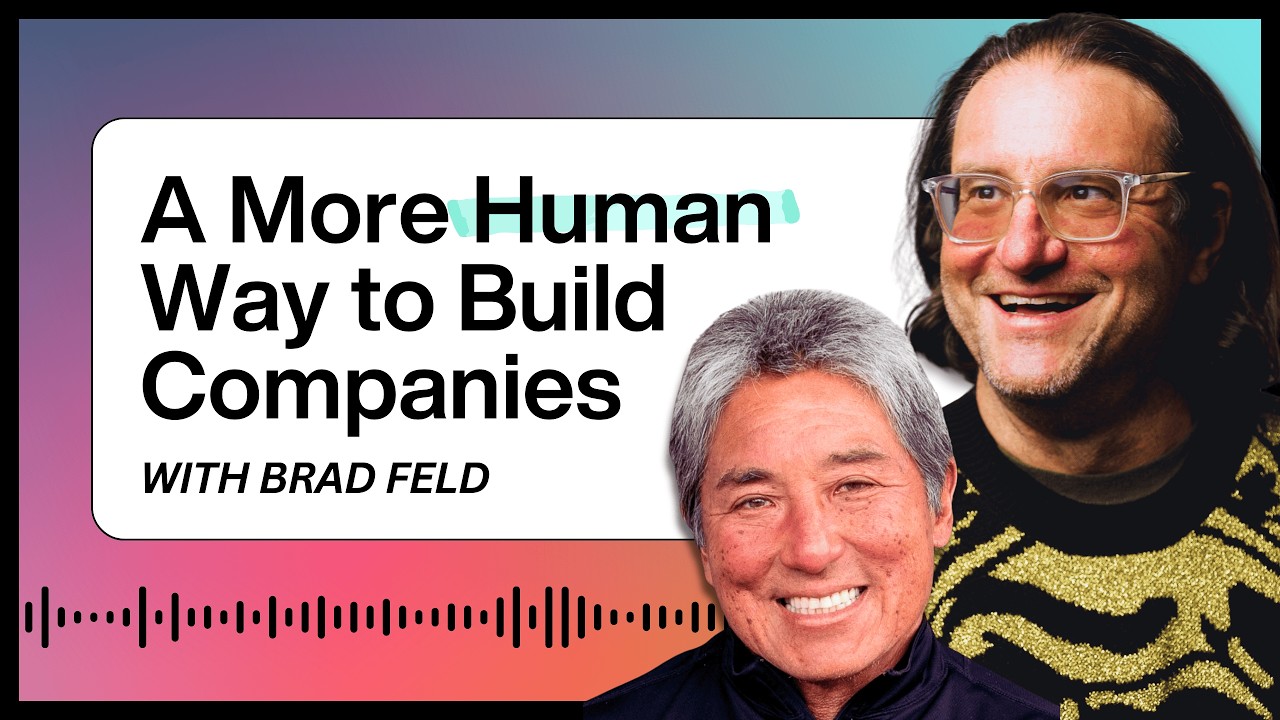
This video from Guy Kawasaki covered a lot of ground. Streamed.News selected 8 key moments and summarises them here. Everything below links directly to the timestamp in the original video.
Ever feel overwhelmed by requests for your time and expertise? Discover how a renowned venture capitalist manages to stay accessible and impactful without succumbing to the endless demands.
Brad Feld Adopts 'Default Yes' with Structured Boundaries for Mentorship
Brad Feld implements a "default yes" approach to initial engagement requests for mentorship, acknowledging his desire to be responsive while establishing clear boundaries to manage his time effectively. This strategy involves assigning specific tasks to those seeking his guidance, often requiring them to articulate their needs more precisely via email before deeper engagement.
He further refines this with a 'Random Day' initiative, dedicating specific blocks for 15-minute meetings. The dual objectives for these interactions are to learn one new thing and to offer helpful assistance, transforming potential distractions into opportunities for mutual growth and maintaining accessibility without being overwhelmed.
"The next 15 minutes of my life belongs to you. Go. And, you know, the timer would go off, I'd say, look, the timer went off. It was 15 minutes or up, it's over."
Brad Feld Dismisses 'Pattern Matching,' Advocates for Entrepreneurship as Endless Experimentation
Brad Feld critically views "pattern matching" in entrepreneurship as a limiting concept, instead defining the process as an "endless series of experiments." He contends that over-reliance on past successes can blind founders and investors to the unique dynamics of new ventures, emphasizing continuous hypothesis testing and adaptation.
Feld identifies three core characteristics of a successful founder: singular dedication to their problem, a genuine affinity for the work, and a desire for the investor to be a true partner. These traits, he argues, are crucial for navigating the inevitable challenges and near-death experiences every company faces, fostering resilient, engaged leadership.
"I view entrepreneurship as an endless series of experiments. You have a hypothesis, you run an experiment. Most of the experiments fail. You learn from the experiment, you formulate a new hypothesis, run a new experiment."
Brad Feld Endorses 'Five Whys' to Uncover Root Problems in Business and Mentorship
Brad Feld advocates for the "Five Whys" technique, a method of repeatedly asking "why" to drill down to the fundamental cause of a problem, rather than addressing superficial symptoms. He notes that initial problem statements are rarely the actual issue, drawing a parallel to understanding customer pain points in sales.
This method is crucial for effective mentorship, as it enables mentors to guide founders to the core of their challenges, such as financial distress stemming from a lack of product-market fit, rather than simply offering solutions to immediate cash flow issues. It transforms mentorship from reactive advice to strategic problem-solving.
"Ineffective mentorship is, uh, the founder comes to you and says, we're outta money in a month. And the mentor immediately says, here's what you do. But that's not the problem."
Brad Feld Defines Effective Mentorship as Evolving Peer Relationships
Brad Feld posits that identifying a truly effective mentor is difficult in advance; the most valuable mentorship relationships evolve into peer-to-peer exchanges. In these dynamic interactions, both the mentor and mentee learn from each other, driven by the mentor's genuine humility and curiosity.
This reciprocal learning model ensures longevity and depth, transforming a traditional, one-sided guidance role into a mutually enriching partnership. The essence of such a relationship lies in the mentor's openness to learn from diverse experiences, fostering a long-term connection beyond immediate transactional needs.
"The powerful, best, most amazing mentorship that is sustainable over time, uh, is when the mentor is learning as much as the mentee learns from the mentor."
Brad Feld Navigates Founder Disagreements with Openness and Hypothesis Testing
Brad Feld approaches disagreements with founders by maintaining an open mind, recognizing that he has frequently been proven wrong in the past. His strategy involves allowing founders to test their hypotheses, provided they are willing to acknowledge when an approach is not yielding results.
As an investor, Feld's primary role is to support the company leader, stepping back only if there's a fundamental divergence in values or approach. He values direct communication, engaging in clear discussions to realign expectations, and is prepared to exit a board if a core philosophical conflict remains unresolved.
"The only thing I'm not comfortable with is when the leader is unable to acknowledge that it's not working."
Brad Feld Differentiates 'Give First' from 'Pay It Forward' as Non-Transactional Philosophy
Brad Feld distinguishes "Give First" from "Pay It Forward" by defining the former as a non-transactional philosophy, a way of life that involves generosity without specific expectations of return. Unlike "Pay It Forward," which implies an obligation to reciprocate, "Give First" is an intrinsic approach to interaction.
This philosophy emphasizes giving without knowing when, from whom, or in what form a benefit might return. It is neither altruistic nor monkish sacrifice, but a fundamental stance that integrates generosity into one's being, fostering a positive ecosystem where value is created and shared freely.
"Give First is just a philosophy. It's a way of being, it's a way of living. It's not a set of rules that you follow. You just incorporate the ideas into the way that you are."
Brad Feld Critiques Silicon Valley's 'Shtick' and Superficial Optimism
Brad Feld expresses his weariness with the "shtick" and superficial optimism prevalent in Silicon Valley. Having spent significant time in the Bay Area, he finds the clichés and vague declarations of "changing the world" often lack substantive meaning.
He contrasts this with his own approach, suggesting a preference for authenticity over performative enthusiasm. This perspective highlights a desire for more grounded, tangible impact in the entrepreneurial ecosystem, rather than rhetoric that can often feel hollow.
"I'm, uh, I'm, I'm exhausted by the shtick of Silicon Valley. Uh, I've never been of Silicon Valley."
Guy Kawasaki Implements Charitable Donation for Pitch Reviews to Filter Serious Entrepreneurs
Guy Kawasaki employs a unique strategy to manage the influx of pitch review requests: he requires a $500 donation to charity for his time. This approach not only provides a tangible filter, ensuring that only those who genuinely value his expertise engage, but also directs funds to meaningful causes.
Kawasaki notes that this method significantly reduces the volume of requests, as many potential clients are unwilling to make the charitable contribution, indicating they do not sufficiently value the expert's time. This creates an effective boundary, allowing him to dedicate his energy to founders who are truly committed.
"I came up with this practice that I would ask people to make a $500 donation to various organizations like my son's high school, you know, hockey club or whatever."
Summarised from Guy Kawasaki · 1:05:40. All credit belongs to the original creators. Remarkable People summarises publicly available video content.