Original source: Piano Lessons On The Web
This video from Piano Lessons On The Web covered a lot of ground. Streamed.News selected 6 key moments and summarises them here. Everything below links directly to the timestamp in the original video.
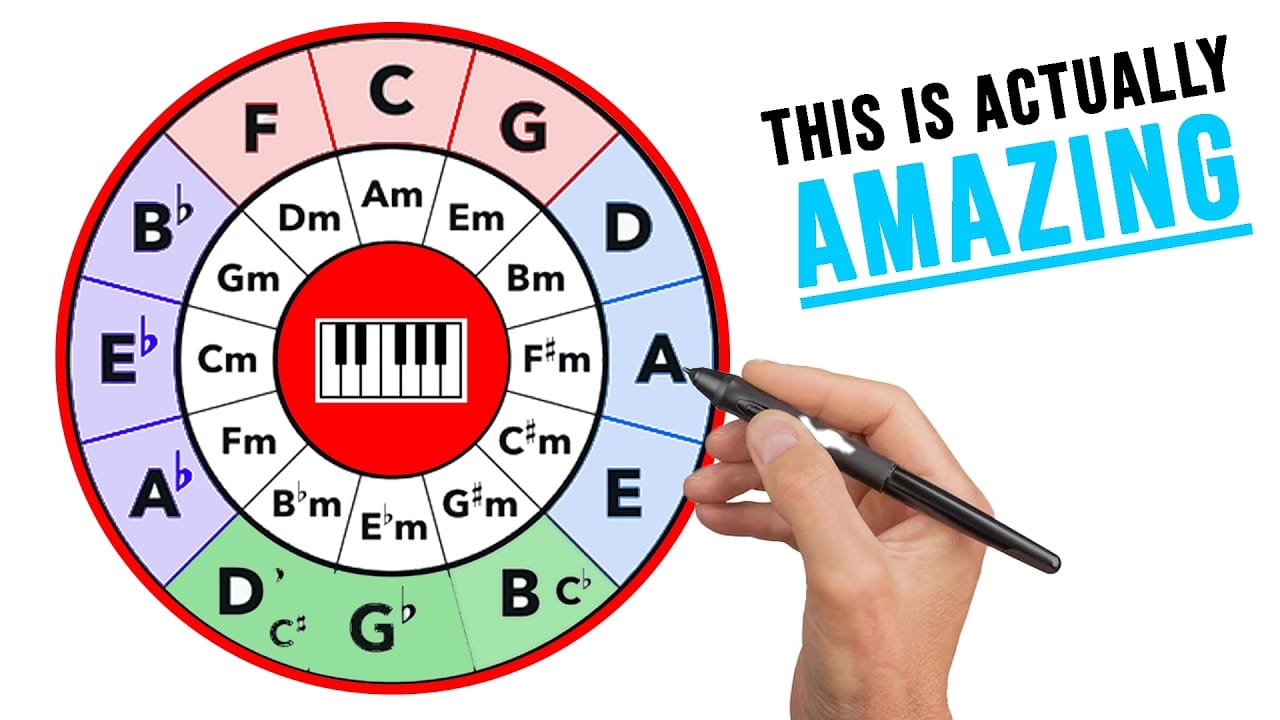
The circle of fifths isn't just a diagram to memorize. Here’s a step-by-step method to use it as a predictive tool for analyzing the songs you want to play.
How to Analyze a Piece of Sheet Music Using the Circle of Fifths
The circle of fifths can be used to deconstruct a piece of music before playing it. By examining the key signature—in this case, one sharp in "Minuet in G"—a musician can use the circle to identify the key as G major. This immediately reveals that F notes will be sharp and that the G major chord (G-B-D) will be central to the piece.
Furthermore, the circle predicts the most common chords that will appear, known as the primary chords (G, C, and D major in this example). This framework gives musicians a predictive map of the song's harmonic structure, turning abstract music theory into a practical performance tool.
"The circle of fifths is actually super valuable. You can actually apply it to real pieces. A lot of students don't know that."
The Circle of Fifths Reveals a Song's Primary Chords at a Glance
The circle of fifths offers a visual shortcut to find the most common chords in any musical key. These three "primary chords"—built on the first, fourth, and fifth notes of the scale—form the harmonic foundation of most popular music. To find them, simply locate the song's key on the circle; its two immediate neighbors are the other two primary chords.
For example, in the key of C, the adjacent notes are F and G, making C, F, and G the primary chords. This simple grouping provides a powerful predictive tool for musicians learning new songs or composing their own.
"If you're in the key of G, the primary chords are G major, C major, and D major."
How to Determine Exactly Which Notes Are Sharp or Flat in Any Key
To use a key signature effectively, a musician must know not just how many sharps or flats there are, but which specific notes are altered. This is determined by a fixed sequence known as the "order of sharps" (F-C-G-D-A-E-B) and its reverse for flats. For a key with two sharps, like D major, the notes affected are always the first two in the order: F-sharp and C-sharp.
Similarly, a key with four flats, such as A-flat major, will always have B-flat, E-flat, A-flat, and D-flat. Memorizing this order is the essential link between a key signature and the notes played.
"Say we have four sharps... the name of the key is E. Now let's figure out what four sharps exist... It's very easy. It's F C G D."
A Visual Trick on the Circle of Fifths Spells Any Major Chord
The circle of fifths can serve as a quick visual calculator for spelling any major chord. To construct a chord, start with the root note on the outer circle. The second note of the chord is found by moving one position to the right on the inner circle, and the third note is one position to the right of the root on the outer circle.
For example, to find a G major chord, you start at G, move right on the inner circle to B, and right on the outer circle to D, correctly spelling G-B-D. This offers a simple alternative to counting half-steps.
"Let's say we're trying to figure out a G major chord... we're starting at the letter... and then we're going on the inside of the circle, but over one. So, we got the notes G B D."
How to Find the Relative Minor for Any Major Key
Every major key shares its key signature—its set of sharps and flats—with a "relative minor" key. To identify this minor equivalent, simply locate the root note of the major key and count down three half-steps. For example, three half-steps down from C is A, meaning C major and A minor both have zero sharps or flats.
This principle explains why different songs can be written with the same key signature yet evoke contrasting moods. The inner circle of the diagram typically shows the minor keys corresponding to the major keys on the outer ring.
"To find the minor equivalent, the minor key with the same key signature, you count down... three half steps."
A Simple Mnemonic Unlocks the Order of Sharps and Flats in Music
The sharps and flats in musical key signatures are always added in a fixed sequence. The "order of sharps" is F-C-G-D-A-E-B, which can be memorized with the mnemonic "Fat Children Gather At Every Breakfast." The "order of flats" is simply that sequence in reverse: B-E-A-D-G-C-F.
This seemingly arbitrary sequence is actually embedded within the circle of fifths itself. Starting at F and moving clockwise reveals the order of sharps, making the circle a tool not just for counting accidentals but for identifying them.
"To come up with a saying for it is fat children gather at every breakfast. F C G D A E B."
Also mentioned in this video
- In fifths clockwise (G, D, A, E, B, F#), explaining that each note is five… (0:09)
- The presenter adds labels for sharps and flats to the circle of fifths, with… (1:05)
- The other half of the circle of fifths is filled in counterclockwise with flats… (2:00)
- Correspond to five scale notes up or down, emphasizing the zero to six… (3:07)
- The first practical use of the circle of fifths is demonstrated (4:15)
- The circle of fifths also guides the order in which to learn scales and key… (5:03)
- (the third) is lowered by a half step, providing a quick way to deduce minor… (17:44)
- The best way to practice is by learning scales in the order suggested by the… (18:09)
- Are played in fourths (C, F, Bb, Eb), but the presenter advises focusing on… (20:15)
Summarised from Piano Lessons On The Web · 26:32. All credit belongs to the original creators. Streamed.News summarises publicly available video content.