Original source: Barry's Economics
With: Barry's Economics
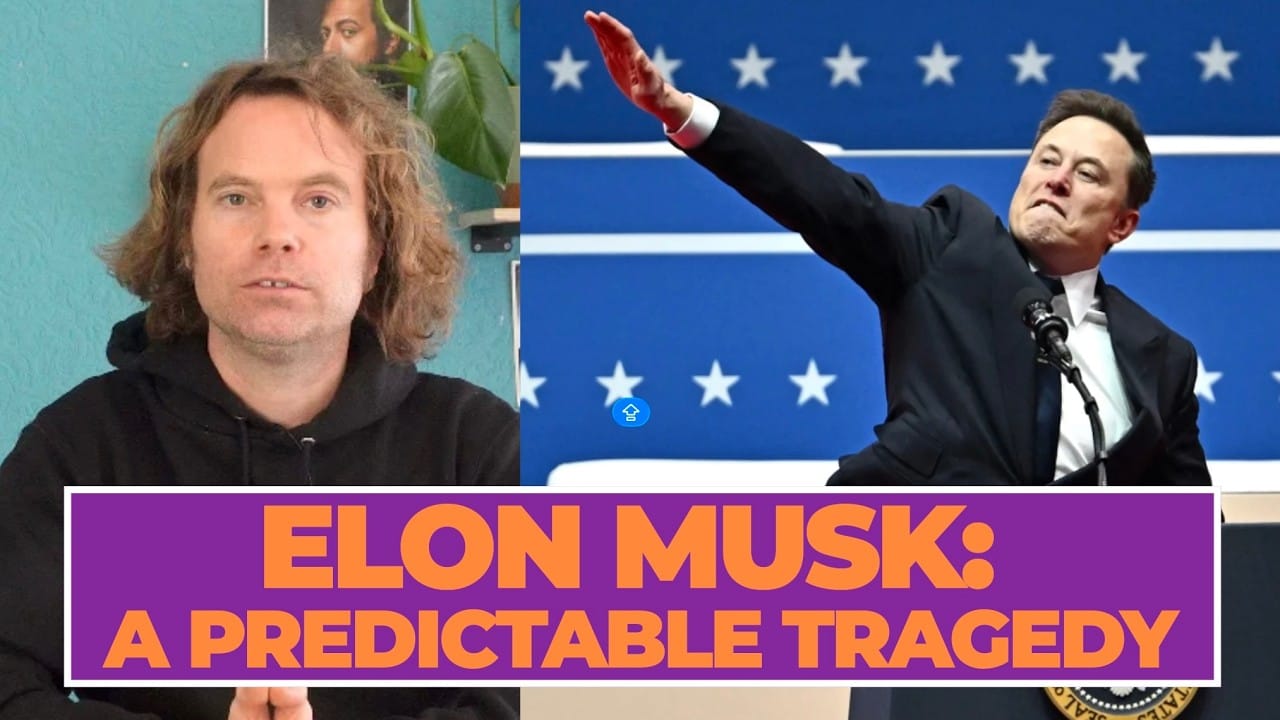
This video from Barry's Economics covered a lot of ground. Streamed.News selected 8 key moments and summarises them here. Everything below links directly to the timestamp in the original video.
Democratic systems were designed with safeguards against the corrupting influence of power. But what happens when the most powerful individuals operate completely outside of that system?
Democratic Founders' 'Radiation Shields' Against Power Absent for Today's Tech Billionaires
The architects of modern democracy, observing centuries of history, understood power not as a personal failing but as an institutional problem. They designed systems like term limits and the separation of powers as "radiation shields" to limit the corrosive dose of authority on any single individual. The U.S. Constitution, for example, doesn't just limit a president's power, but the duration of that power—a mandatory exit from the corridors of influence.
Yet, where are these shields for the new sovereigns of the digital age? A billionaire who simultaneously owns the satellites, the social media platform, and the government contracts faces no term limits. This vertical integration creates a feedback loop where the tools of power are also the platforms for dissent, a structure even the creators of Monopoly failed to imagine.
"Where's the term limit on a man who owns the satellites, the cars, the social media platform, and the government contracts at the same time? I've looked, I can't find it."
Elon Musk's Thai Cave Rescue Response Cited as Example of Power-Induced Empathy Collapse
In 2018, during the tense international effort to rescue 12 boys from a flooded cave in Thailand, Elon Musk arrived with a custom-built mini-submarine. When a lead diver, Vernon Unsworth, later dismissed the device on CNN as a "PR stunt" that was unfit for the cave's terrain, Musk didn't just disagree. He launched a public attack, branding the heroic rescuer a "pedo guy" in a tweet and later hiring a private investigator to dig up dirt on him.
The disproportionality of the reaction is the entire point. For a person who has just risked their life, a billionaire's bruised ego should be irrelevant; instead, it became the trigger for a campaign of character assassination. This isn't just a personal failing; it's a clinical demonstration of what happens when power insulates an individual from consequences and the feelings of others.
"Sorry pedo guy, you really did ask for it."
The 'Nuclear Button Hack': A Radical Proposal to Reconnect Power with Consequence
How do you force a leader to feel the weight of a decision that could kill millions? Harvard negotiator Roger Fisher proposed a chillingly direct solution to the abstract nature of modern warfare. He suggested the nuclear launch codes be placed in a capsule surgically implanted near the heart of a volunteer who accompanies the president daily. To launch the missiles, the president would first have to take a butcher's knife and personally kill this individual.
The proposal's genius was revealed not in its application, but in the Pentagon's objection: that having to commit a personal act of violence would "distort the president's judgment." The objection wasn't to the killing, but to the feeling of the killing. It exposes the core desire of institutional power—to make monumental decisions with the emotional detachment of an administrative act.
"My god, that's terrible. Having to kill someone would distort the president's judgment. He might never push the button."
From 'Don't Be Evil' to Global Conflict: Power's Corrosive Effect on Institutions and Leaders
The quiet shelving of Google's famous motto, "Don't be evil," serves as a perfect corporate case study for how power anesthetizes an organisation's founding principles. A rule like "don't be evil" only needs to exist if evil is, in fact, on the table as a strategic option. As the company's power grew and the original founders left the decision-making rooms, the commitment gave way to the calculus of growth.
This isn't just a corporate story; it's a dose-response relationship playing out on the world stage. From Vladimir Putin's 25 years in power to Xi Jinping making himself president-for-life, the science isn't surprised by current global conflicts. It simply observes a predictable outcome when individuals accumulate vast power over long periods, their capacity for empathy diminishing at a civilizational scale.
"You don't go to a bakery whose motto is 'don't put glass in the bread.'"
Rigged Monopoly Game Reveals How Unearned Power Breeds Entitlement and Blinds Winners to Reality
In an experiment by psychologist Paul Piff, a simple game of Monopoly was rigged. One randomly assigned player received twice the money, rolled two dice, and collected double the salary for passing "Go." Despite knowing the game was unfair from the start, these "rich" players quickly changed their behaviour. They slammed their pieces on the board, taunted their opponents, and ate more snacks from a communal bowl.
The most telling finding came after the game. When asked why they won, not a single advantaged player credited the rigged rules or luck. Instead, they told stories of their own strategic brilliance. Power, it seems, doesn't just anesthetize empathy for others; it simultaneously rewrites the story of your own success, attributing to merit what was simply given by chance.
"When the game ended, researchers asked the winners, 'How did you win?' ... Not one rich player said that [the game was rigged]. Instead, they told stories about how smart they had played."
Jeff Bezos's Amazon Allegedly Demonstrates How Power Turns Human Insight into a 'Weapon'
The argument that power erodes empathy extends beyond any single billionaire. Consider Jeff Bezos, who built Amazon from a garage and intimately understands uncertainty and vulnerability. Yet, Amazon's warehouses are reportedly models of engineered fear, where workers are tracked by GPS, penalised for taking too long in the bathroom, and face being "released"—fired—for failing to meet relentless productivity rates.
This isn't a case of forgetting what hardship feels like. On the contrary, it appears to be a conscious weaponization of that knowledge. The memory of fear is not used to protect workers, but is instead filed away under "tools" for maximising output. This strategic shift demonstrates a mind that can no longer place itself in another's shoes, seeing people only as variables to be managed.
"He didn't forget what fear felt like. He remembers exactly what fear felt like. He's just switched it from 'I don't want people to feel this' to 'hmm, this is useful.'"
Feeling Powerful 'Anesthetizes' Brain's Empathy Circuits, Neuroscience Study Finds
The observation that power corrupts sympathy is not just poetry; it's neurology. Research by neuroscientist Sukhvinder Obhi at McMaster University used brain scans to measure "mirroring," the process where our brain simulates the experience of others, which forms the biological basis for empathy. His key finding was that after simply asking student participants to recall a time they felt in charge, their mirroring response dropped significantly.
The feeling of power, even when temporary and imagined, acted as an anesthetic on the very neural pathways that allow us to feel what others feel. If a 20-minute exercise can measurably dampen empathy in a student, one can only imagine the neurological effect of two decades of being untouchable. It suggests the changes we see in the powerful are not a moral choice, but a predictable biological outcome.
"The neural pathway responsible for feeling what others feel, in his words, became anesthetized. Not broken, but anesthetized by power."
The 'Power Paradox': Why Good Leaders Go Bad Once in Office
It’s a common political story: a candidate seems connected and engaged on the campaign trail, only to become a disconnected "maniac" once in office. This isn't a simple betrayal, but a phenomenon known as the "power paradox." Groups naturally elevate socially intelligent individuals to leadership—people who are good at empathising and connecting. We gain power through what is best in our nature.
The paradox is that the experience of holding power systematically erodes the very skills that got them there. Power decreases social intelligence and releases the more problematic aspects of human behaviour. The change we perceive in leaders isn't them revealing their "true" selves; it's a predictable transformation caused by the neurological effects of sustained authority.
"We gain power through what is good in human nature, but regrettably power decreases our social intelligence and really releases very often what is problematic in human behavior."
Also mentioned in this video
- The presenter recalls a time when Elon Musk was widely admired as a visionary… (0:00)
- A psychological experiment where people are asked to draw the letter 'E' on… (0:53)
- Power is a 'toxin' that erodes sympathy, citing historical observations and… (2:48)
- The video delves into Elon Musk's 'before' period, highlighting his humble… (4:26)
- The presenter reiterates that as wealth and power increase, empathy and… (11:10)
- Elon Musk's early career (2012-2016) as a period where he was still… (13:15)
- The presenter asserts that a person with a functioning mirroring system and… (17:43)
- The presenter includes a clip of Elon Musk's comment about George Soros hating… (19:46)
- The presenter humorously redefines Batman as a supervillain whose billionaire… (31:36)
Summarised from Barry's Economics · 34:14. All credit belongs to the original creators. Streamed.News summarises publicly available video content.