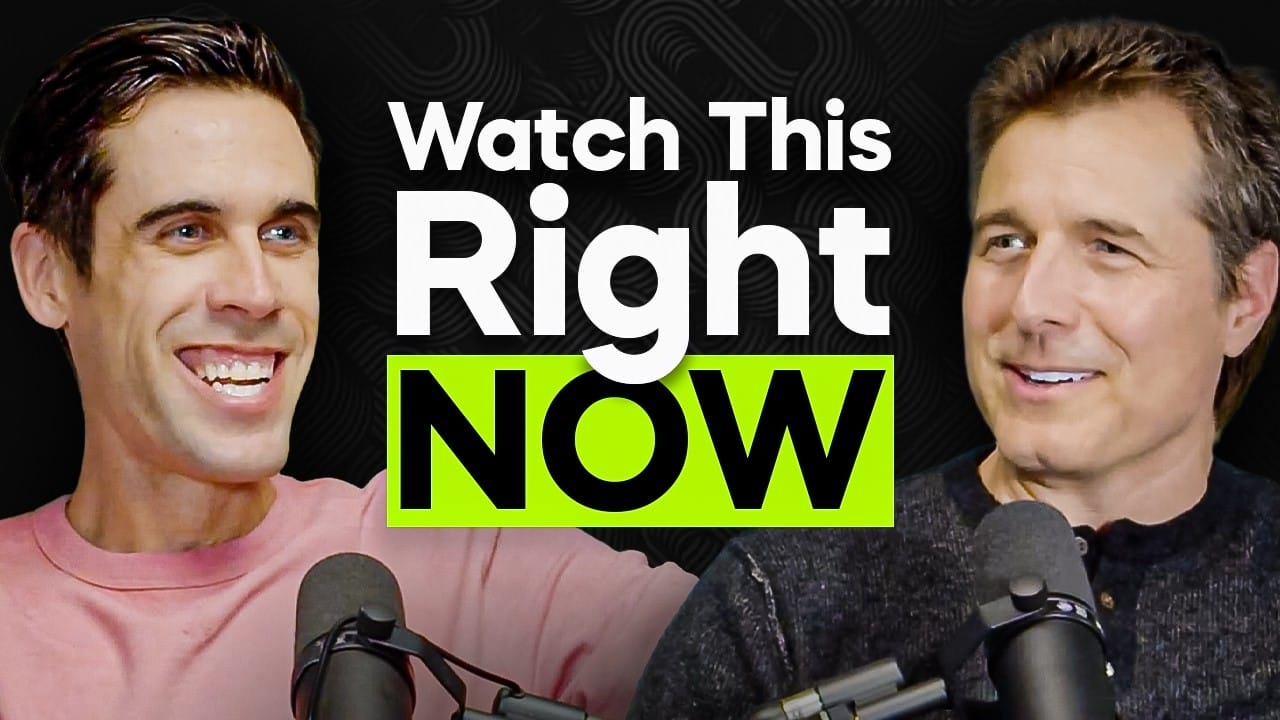
Original source: Finding Mastery
This article is an editorial summary and interpretation of that content. The ideas belong to the original authors; the selection and writing are by Streamed.News.
This video from Finding Mastery covered a lot of ground. 6 segments stood out as worth your time. Everything below links directly to the timestamp in the original video.
A firsthand account of being barred from a military institution for defending intellectual freedom raises pointed questions about what the US is choosing to teach — and hide from — its next generation of officers.
Ryan Holiday Disinvited from US Naval Academy After Refusing to Drop Book-Banning Criticism
Author Ryan Holiday was turned away from the US Naval Academy roughly an hour before a scheduled lecture after refusing to remove a passage criticising the removal of around 300 books from the institution's library — a purge carried out under orders from the president and secretary of defense. Holiday had planned to use the story of Admiral James Stockdale, who credited his Stanford education in Marxist theory with helping him resist re-education efforts as a prisoner of war in North Vietnam, to argue that engaging dangerous ideas is itself a form of preparation and strength.
Holiday reserved his sharpest criticism not for the political officials who ordered the book removal, but for the three-star admiral overseeing the Academy — whose role, he argued, is to model exactly the kind of principled decision-making being demanded of cadets. He noted the bitter irony that the admiral complied with the order and was subsequently dismissed anyway, framing the episode as a case study in why the expedient choice rarely delivers the protection people believe it will.
"You shouldn't want to keep a job that you could lose by doing the right thing."
▶ Watch this segment — 1:15:26
AI Amplifies Competence but Cannot Substitute for It, Author Ryan Holiday Argues
AI tools are widely misunderstood as a shortcut to knowledge, but author Ryan Holiday contends the opposite is true: they demand more foundational judgment than almost any technology that preceded them. Without the ability to recognise a good answer from a bad one, users are left unable to detect the confidently wrong responses these systems regularly produce. Holiday's argument is that prompt quality determines output quality, and crafting a good prompt requires exactly the kind of broad, accumulated understanding that AI is supposed to replace.
The implications extend well beyond individual users. Holiday and his interlocutor converged on the concept of discernment — the capacity to evaluate information against a rich set of internal and external reference points — as the skill AI is simultaneously demanding and, for many users, quietly eroding. As AI-generated content proliferates, the gap between those with the foundational knowledge to interrogate outputs and those without is likely to widen considerably.
"I can't imagine a technology that would require more wisdom than this."
Holiday Calls Trump a 'Classic Demagogue' and Links Political Dysfunction to a Deficit of Collective Wisdom
Author Ryan Holiday offered an unambiguous assessment of the current American political moment, describing Donald Trump as a textbook demagogue and con artist who exploits real public grievances while offering manipulative and unworkable solutions. He argued that the failure to recognise this was not primarily a partisan failing but a wisdom deficit — the same inability to distinguish good arguments from bad ones that leaves people vulnerable to AI misinformation or satirical news sites. He pointed to the human capacity for self-deception as a central mechanism, noting that some supporters have since admitted the reality of Trump's presidency surprised them, despite explicit prior warnings.
Holiday connected this political diagnosis to a broader pattern of collective failures — from pandemic deaths to the inadequacy of responses to climate change — arguing that insufficient wisdom at scale produces catastrophic outcomes. He found some consolation in Stoic history, noting that figures like Cicero and Seneca navigated similarly chaotic political environments, but was candid that managing his own equanimity in the current climate tests his philosophy daily.
"Our endless capacity for self-deception is one of the most incredible and terrifying things about the human condition."
▶ Watch this segment — 1:01:57
Stoicism's Founding Insight: Wisdom Is a Conversation Across Centuries, Not a Solo Journey
Ryan Holiday traces the intellectual origin of Stoic philosophy to a moment of revelation by its founder, Zeno, who reportedly understood the Oracle of Delphi's cryptic instruction — that wisdom comes from conversing with the dead — only after encountering a bookseller reading aloud from a Socratic text in an Athenian marketplace. The episode reframes what books are: not repositories of information but a mechanism for inheriting the distilled understanding of everyone who came before. Holiday's point is that wisdom is cumulative and collective, not something each person must reconstruct from scratch through personal experience alone.
The argument has a practical edge. If every generation treats itself as starting from zero, it wastes the accumulated insight of centuries. The Stoic tradition, as Holiday describes it, is explicitly built around the transfer of hard-won understanding across time — with each generation expected to receive that inheritance, test it against lived experience, and add to it before passing it on.
"Wisdom is starting from everything up until now and then adding to it."
Experience Alone Does Not Produce Wisdom — Reflection Is the Missing Step
Ryan Holiday challenges the widespread assumption that wisdom accumulates automatically with age and experience, arguing that most people move through life constantly encountering lessons they never absorb. Drawing on Winston Churchill's description of Neville Chamberlain as a man who repeatedly stumbled over the truth and walked away unaffected, Holiday frames wisdom not as a passive byproduct of living but as the product of a deliberate cycle: learning, application, reflection, and repetition. Without the reflection step, experience simply washes over people and leaves nothing behind.
The practical framing — learn, apply, reflect, repeat — maps closely onto how elite coaches structure athletic development: practice, performance, and then rigorous film review that distinguishes failures of execution from failures of strategy. Holiday's argument is that most people skip the equivalent of film review in their own lives, which is why years of experience can coexist with a persistent lack of growth.
"Occasionally stumbled over the truth and when he did he picked himself up and dusted himself off and carried on as if nothing had happened."
Social Media Is Structurally Anti-Wisdom, but the Underlying Problem Is Ancient
Ryan Holiday acknowledges that social media is genuinely corrosive to wisdom — hostile to patience, empathy, nuance, and collaborative thinking — but resists the nostalgia that treats this as a new crisis. Humans have always struggled with distraction, restlessness, and the avoidance of stillness. He cites Blaise Pascal's seventeenth-century observation that virtually all of humanity's problems flow from the inability to sit quietly in a room alone, arguing that smartphones have intensified a pre-existing condition rather than invented it. The oldest surviving complaint about youthful behaviour, he notes, is carved in stone roughly four thousand years old.
The more productive frame, Holiday suggests, is not a collective lament about declining wisdom but an individual question: are you, right now, actually translating what you encounter into deeper understanding? He expresses particular admiration for older people who retain genuine social concern and openness rather than drifting toward cynicism — treating that combination of experience and continued curiosity as the closest visible model of what wisdom in practice actually looks like.
"All of humanity's problems stem from our inability to sit quietly in a room alone."
Summarised from Finding Mastery · 1:23:45. All credit belongs to the original creators. Streamed.News summarises publicly available video content.
Streamed.News
This publication is generated automatically from YouTube.
Convert your full video library into a digital newspaper.
Get this for your newsroom →