Original source: The Diary Of A CEO
This article is an editorial summary and interpretation of that content. The ideas belong to the original authors; the selection and writing are by Streamed.News.
This video from The Diary Of A CEO covered a lot of ground. 6 segments stood out as worth your time. Everything below links directly to the timestamp in the original video.
Consider how essential everyday items like food depend on fragile global supply chains, and how geopolitical tensions could reshape the dinner table for billions.
Strait of Hormuz Conflict Threatens Global Famine Through Fertilizer Shortages
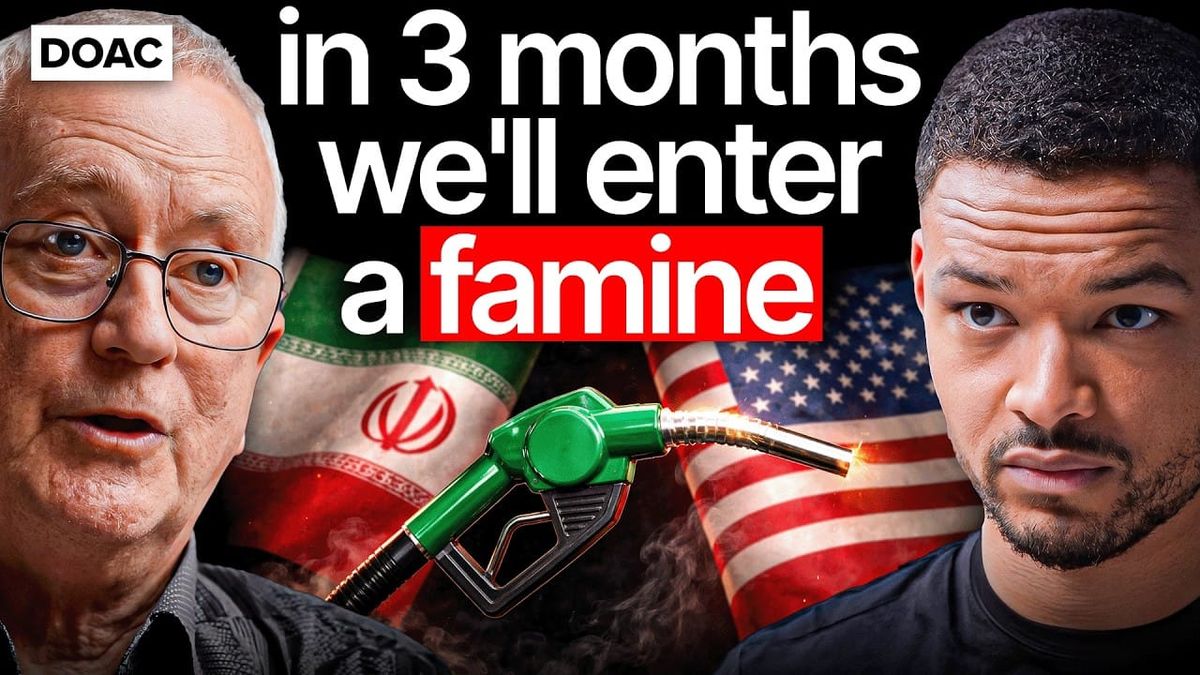
Professor Steve warns that the ongoing conflict in the Strait of Hormuz is jeopardizing more than just oil supplies, specifically highlighting a critical shortage of fertilizer. With 20 to 30% of the world's fertilizer supply originating from this region and passing through the strait, its disruption could lead to a global famine. He explains that fertilizer is indispensable for growing most food crops, supporting a global population that could shrink dramatically without it.
The potential loss of even 20% of the world's fertilizer supply is projected to cause a corresponding 20% reduction in global food production, triggering an unprecedented worldwide famine. Unlike historical localized famines, this scenario poses a direct threat to the global food system, impacting billions and demonstrating the cascading, systemic risks beyond immediate energy concerns.
"If we lost 20% of the world's fertilizer, we'd lose roughly 20% of the world's food. And it'd cause a global famine. We've never had this experience before."
Global Famine Looms as War Threatens Food Supply, Even Wealthy Nations Vulnerable
Professor Steve reiterates that a prolonged conflict will result in a global famine due to severe fertilizer shortages, projecting a potential 10 to 25% drop in planetary food production within months. This dire scenario would leave insufficient food for the global population, raising questions about who would face starvation. India, for example, could experience famine within two to three months from fertilizer depletion.
The professor emphasizes that even affluent countries are highly vulnerable; Australia, for instance, possesses only a 30-day oil supply, which would cripple its ability to transport food from farms to cities. This stark reality underscores how the war in the Strait of Hormuz poses a universal threat, exposing the fragility of interconnected global systems and national self-sufficiency in the face of widespread resource disruption.
"Food production on the planet could fall 10-25%. And therefore there simply won't be enough food for everyone on the planet and then it's a question of who's going to starve."
Strait of Hormuz Blockade Threatens Global Semiconductor Supply with Helium Shortage
Professor Steve details how the Strait of Hormuz conflict is severely disrupting the global semiconductor industry due to a critical helium shortage. Approximately 30% of the world's helium, essential for manufacturing all electronic components, originates from a gas field spanning Saudi Arabia and Iran. With Iran blocking the strait, this vital supply chain is now severely compromised, leading to a projected loss of 30% of the world's helium.
Helium, which cannot be stockpiled due to its tendency to leak, is indispensable for semiconductors, found in everything from iPhones to tablets. Phil Cornblutch, a leading helium expert, predicted a two-to-three-month shutdown of production, extending up to six months for supply to normalize. This disruption directly impacts countries like South Korea, which sources 65% of its helium from the region and produces two-thirds of the world's memory chips, prompting their government to launch an emergency investigation into the looming shortage.
"If you cut off 30% of the world's helium supply, you cut off the capacity to produce 30% of the world's semiconductors."
US President Holds Sole Authority for Nuclear Launch, Congressional Report Confirms
Author Annie Jacobson explains that the United States president possesses sole authority to initiate nuclear war without requiring permission from Congress, military leaders, or the Joint Chiefs of Staff. This unique power means the president can unilaterally make the decision to launch nuclear weapons, a fact that can be unsettling upon recognition.
This aspect of presidential power gained significant attention and concern within Congress during the Trump administration. Lawmakers, alarmed by the implications, launched an inquiry into the matter, which culminated in an official report. The report confirmed that, as Commander-in-Chief, the president indeed holds this sole authority, not needing external approval for a nuclear strike.
"The United States president has sole presidential authority to launch a nuclear war... He doesn't have to ask anyone for permission."
Strait of Hormuz: A Critical Global Chokepoint for Key Resources
Professor Steve describes the Strait of Hormuz as a critically narrow chokepoint in the Persian Gulf, measuring only 21 kilometers wide. This strategic waterway is essential for global trade, as it serves as the sole passage for a vast array of resources, including oil, fertilizer, and helium, emanating from the surrounding region.
Due to its constricted geography, the Strait of Hormuz falls well within the reach of Iranian weaponry, granting Iran significant control over global supply chains. This strategic position allows Iran to dictate whether ships carrying these vital commodities can pass, thereby exercising considerable influence over international markets and the political stances of other nations.
"All these critical elements for the production system all have to pass through this point. And obviously that's well within reach of any weapons from Iran."
Global Energy Losses Threaten 5-10% Drop in World Economic Output
Professor Steve highlights a direct and tight correlation between global energy supply and Gross World Product (GWP), explaining that a significant reduction in energy availability directly translates to a proportional decline in economic output. He presented a graph illustrating that over the past 40 years, annual percentage changes in GWP and gross energy consumption have moved in virtual lockstep, with similar magnitudes.
Given current global circumstances, where the world is losing 20% of its liquefied natural gas supply along with a substantial portion of its oil, Professor Steve predicts a potential 5 to 10% fall in overall energy. This reduction is expected to trigger a corresponding 5 to 10% decrease in global economic output, demonstrating the profound and immediate impact of energy supply disruptions on the world economy.
"We're losing 20% of the world's liquefied natural gas, a substantial proportion of its oil as well. We could see a 5 or 10% fall in energy. We will certainly see a 5 or 10% fall in global world gross world product."
Also mentioned in this video
- Five scenarios for how the war could end, including Iran destroying Gulf power… (0:00)
- Trump's actions in the war are a 'pump and dump' scheme to drive up oil prices… (0:29)
- Professor Steve believes Trump will send ground troops to Iran, calling it a… (1:03)
- His specialisms as the history of economic thought, financial instability, and… (2:35)
- Professor Steve attributes the current global confusion to the election of a… (3:01)
- Of Iran having nuclear weapons as an imminent threat is questionable, noting… (4:12)
- Professor Steve observes a significant disconnect between politicians'… (4:55)
- The war started because Israel, driven by a Zionist, expansionist ambition,… (7:16)
- Iran's preparedness for conflict, detailing how they have broken their military… (8:34)
- Professor Steve reiterates his belief that Trump is engaging in a 'pump and… (10:25)
- The 'pump and dump' theory, suggesting Trump's actions might be predictable,… (11:42)
- Oil from the Middle East, particularly from Iran, Saudi Arabia, and Iraq, is… (19:37)
- The host shares a personal anecdote about meeting an Uber driver working three… (22:12)
- Trump benefits from rising oil prices, highlighting Trump's lack of ethics and… (23:56)
- Wars are often created when inequality is severe, citing the Great Depression… (25:36)
- Initial assumptions about an easy victory over Iran were misguided due to… (27:45)
- Five scenarios for the war's end, with scenario one being Iran's destruction,… (29:58)
- Scenario two (32:34)
- Iran's strategy of attacking neighboring partners' energy infrastructure, like… (35:26)
- The terrifying 'Samson doctrine' (scenario three), where Israel, facing… (37:51)
- The historical threats from Iran to Israel and the concerning rhetoric from… (39:53)
- Scenario four, hoping that Iran disables Israel's nuclear weapons to prevent… (45:00)
- Israel could lose the war against Iran due to Iran's much larger population,… (47:26)
- Iran's strategy of preparing for decapitation attacks by decentralizing its… (48:49)
- Professor Steve suggests Trump is trying to 'build his golden bridge' to exit… (51:01)
- Professor Steve predicts that Trump will send ground troops into Iran, calling… (53:32)
- The best-case scenario as America realizing its defeat and withdrawing, leading… (56:29)
- Professor Steve identifies the most probable outcome as Iran disabling Israel's… (59:23)
- Trump will inevitably claim victory regardless of the outcome, attributing this… (1:00:10)
- Professor Steve advises individuals to invest in solar energy for… (1:01:12)
- 90% of AI startups fail, significantly higher than general technology, and… (1:05:59)
- The need for a universal basic income (UBI) to address the massive job… (1:07:56)
- Professor Steve agrees that AI and robotics could wipe out up to 50% of… (1:12:44)
- The availability of physical minerals to support widespread robot production. (1:19:18)
- Professor Steve predicts Bitcoin will go to zero due to its enormous energy… (1:21:16)
- Professor Steve concludes that our system is far more fragile than we realize… (1:25:12)
- He is focused on creating a sustainable economic system rather than personal… (1:27:25)
Summarised from The Diary Of A CEO · 1:33:49. All credit belongs to the original creators. Streamed.News summarises publicly available video content.
Streamed.News
This publication is generated automatically from YouTube.
Convert your full video library into a digital newspaper.
Get this for your newsroom →