Original source: The Diary Of A CEO
This article is an editorial summary and interpretation of that content. The ideas belong to the original authors; the selection and writing are by Streamed.News.
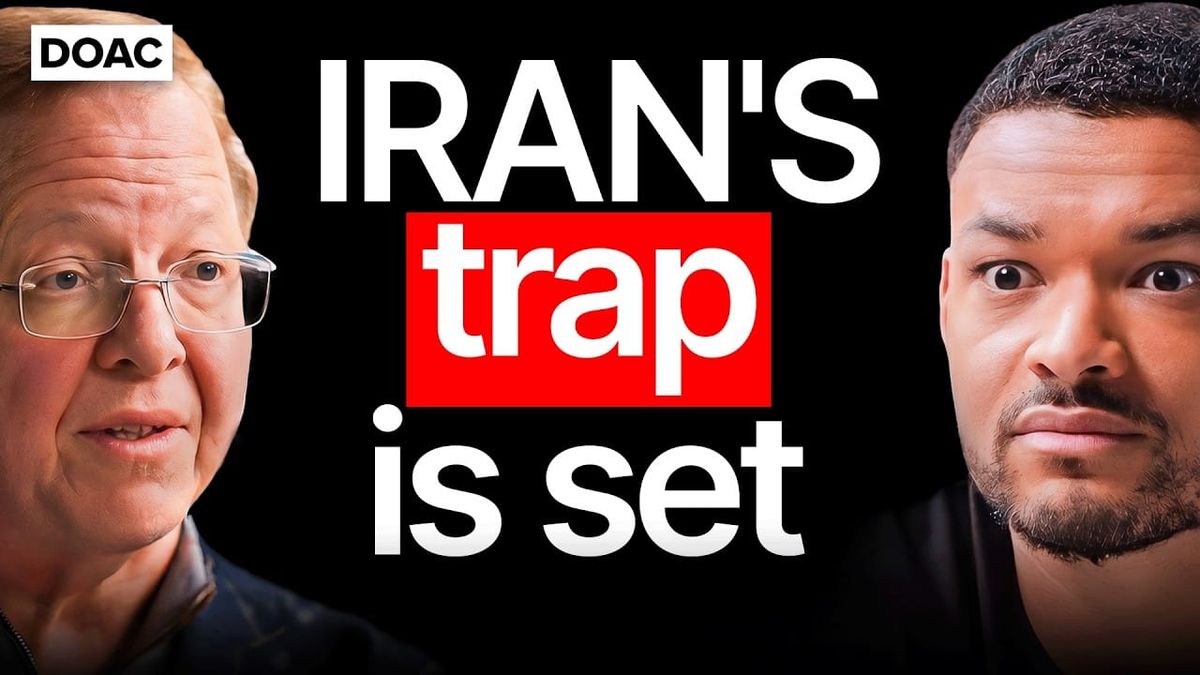
This video from The Diary Of A CEO covered a lot of ground. 6 segments stood out as worth your time. Everything below links directly to the timestamp in the original video.
Consider how a leader's rhetoric, particularly when backed by immense power, can inadvertently unite a populace against a perceived threat, reshaping national resolve and strategic priorities.
Trump's 'End Civilization' Threat Unifies Iranians, Fuels Nuclear Ambitions, Says Professor
Former President Donald Trump's statement threatening to "end an entire civilization" is an unprecedented declaration of genocidal intent from a leader with nuclear capabilities, according to Professor Robert Pape. Pape highlights the gravity of this rhetoric, noting that the US possesses 500 Minuteman III missiles, each with warheads multiple times more powerful than those used on Hiroshima and Nagasaki, capable of being retargeted and deployed to Iran within minutes.
Pape argues that such a threat, unlike previous presidential statements, profoundly persuades all 92 million Iranians of their imminent danger. Far from destabilizing the Iranian regime, this rhetoric is actively bonding society and the government closer together, even among pro-democracy movements. Pape predicts this will significantly hasten and increase support within Iran for developing nuclear weapons, as citizens seek protection from a perceived existential threat.
"That is the most declared statement of genocidal intent we've ever seen from an American president. No American president has threatened to end a civilization before."
US Pullback Could See Iran Develop Nuclear Weapons, Form Oil Alliance with Russia and China, Warns Analyst
Should the United States withdraw its presence, Iran's power will grow significantly within a year, enabling it to develop nuclear weapons and increase its oil revenues by $75-100 billion, according to Professor Robert Pape. He notes that Iran, possessing 20% of the world's oil, is already strengthening its capacity to fashion nuclear weapons in deeply buried facilities, making them difficult to halt.
Pape warns that this internal growth will foster closer alliances between Iran, Russia, and China, dramatically shifting the global energy landscape. With Iran controlling 20% and Russia 11% of the world's oil, their cooperation could enable them to collectively take 30% of global oil off the market. Such a move would trigger severe economic consequences for the United States and Europe, creating what Pape calls "mega economic consequences."
"Within a year Iran could have nuclear weapons and we can't stop it."
Iran's Oil Dominance Creates Fourth Global Power Center, Threatens US and European Economies
Professor Robert Pape argues that Iran's emergence as a fourth center of world power, primarily driven by its control over 20% of the world's oil, is fundamentally reshaping the global balance. This shift, combined with Russia's 11% share of global oil, grants these nations the potential to collectively control 30% of the world's oil supply, giving them unprecedented economic leverage alongside China.
Pape stresses that oil is a critical commodity underlying economic growth, and losing access to even a fraction of global supply can trigger dramatic "cliff effects" on economies within weeks. He asserts that a collective restriction of supply by an Iran-Russia alliance could lead to severe economic consequences for the United States and Europe, far surpassing the impact of disruptions in other vital resources like semiconductors or pharmaceuticals.
"If we start to add Iran as a center of world power, now we're starting to change this in a much different way."
US-Backed Gulf Coalition Fractures Amid Vulnerable Bases and Shifting Alliances
The US-backed counterbalancing coalition in the Persian Gulf, designed to contain Iran, is rapidly disintegrating, according to Professor Robert Pape. American military bases in Qatar, Bahrain, and Kuwait are proving to be vulnerable "big, fat targets" for Iranian precision drones, and US aircraft carriers are positioned a thousand miles away, providing minimal deterrence.
Pape explains that this perceived withdrawal of US security guarantees is causing Gulf states to reconsider their alignments. Iraq is distancing itself from American military presence, Oman is reportedly moving closer to Iran, and Qatar is striving for neutrality. Crucially, Saudi Arabia and the UAE are now seeking security deals with other nations, such as Pakistan, indicating a profound fragmentation of the former alliance and a significant weakening of American influence in the region.
"All of this coalition, it's not all siding with Iran right now. It's fragmenting. And that's weakening America."
Targeting Iran's Electric Grid Would Cause Mass Hunger and Disease, warns Professor
A potential US military strike targeting Iran's electric power grid, specifically its generating hulls, would have catastrophic humanitarian consequences for ordinary Iranians, according to Professor Robert Pape. Drawing on his experience studying power grid vulnerabilities, Pape explains that destroying just ten of Iran's major power plants could cripple the entire network for six to eighteen months, as the giant turbines cannot be easily replaced.
Such a prolonged outage would halt all essential medical services, including dialysis and life-saving surgeries, and eliminate food refrigeration nationwide. Pape warns this would lead to widespread spoilage, enormous hunger, and a surge in disease among an already vulnerable population. Ultimately, he predicts this action would measurably lower the life expectancy across Iran, impacting millions of civilians regardless of their political alignment.
"You will end up lowering the life expectancy in a measurable way of that population."
Iran-Russia Oil Alliance Could Trigger US Inflation, Force Social Security Cuts
An alliance between Iran and Russia that collectively controls 30% of global oil could have severe economic repercussions for American consumers, even though the U.S. does not directly import oil from the Strait of Hormuz, warns Professor Robert Pape. He explains that oil is a global, fungible commodity, meaning any shortage drives up prices universally, impacting the cost of gas at the pump across America.
Pape highlights that rising global oil prices would fuel inflation and increase interest rates on U.S. government bonds. These higher borrowing costs would exacerbate the national debt, making interest payments the largest budget item for the US government. Ultimately, Pape concludes, this economic pressure would necessitate cuts to critical social programs such as Social Security and Medicaid, directly affecting millions of American citizens.
"Iran and Russia together could have a tremendous impact on America's economy. This this is the real thing."
▶ Watch this segment — 1:01:14
Also mentioned in this video
- The discussion begins with an assessment of the current geopolitical situation,… (0:00)
- Israel is playing two roles that complicate the assessment of the situation,… (0:32)
- Modeling hypothetical bombing campaigns of Iran for 21 years and notes that… (0:46)
- Consistent findings from bombing models that America could destroy targets and… (1:04)
- The host welcomes Professor Robert Pape and asks him to address the current… (2:13)
- Himself as a professor at the University of Chicago and former US Air Force… (3:08)
- "air campaigns" involve sustained military aircraft operations over extended… (3:30)
- Professor Pape details his hypothetical bombing campaign against Iran, focusing… (4:38)
- His models consistently showed that while bombers could destroy Iranian nuclear… (6:24)
- The US is not weakening Iran but strengthening it, emphasizing that political… (7:53)
- Professor Pape asserts that Iran has realized the US cannot defeat them, as… (10:25)
- The feasibility of negotiating a ceasefire if various factions operate… (12:17)
- Professor Pape clarifies that while Iran's military structure may be… (13:02)
- Professor Pape reiterates that the situation is at a fork in the road, having… (15:00)
- Iran's control of the Strait of Hormuz is generating significant political… (17:31)
- Professor Pape attributes the US's fundamental flawed assumption to… (26:25)
- Israel's role as a "diplomatic spoiler," citing instances where Israeli… (27:43)
- Prime Minister Netanyahu's public rhetoric consistently painted Iran as a weak… (31:19)
- Professor Pape elaborates on "stage three" of the war, which involves ground… (32:05)
- President Trump's desire to seize Iran's oil fields, explaining that while… (37:27)
- The recent ceasefire and Trump's 10-point plan represent a collision of stages… (52:32)
- Historical precedent shows countries rarely surrender power, especially when… (53:49)
- Setting global system rules. (55:56)
- Leading to abrupt shifts in the world balance of power. (1:03:32)
- Professor Pape proposes a solution where the US offers Iran a deal involving… (1:05:07)
- Professor Pape predicts that the US will likely oscillate between ground war… (1:09:56)
- If Trump pulls out, Iran will likely develop and demonstrate nuclear weapons by… (1:15:46)
- Trump made a significant mistake by ripping up the Obama nuclear deal, leaving… (1:19:51)
- Professor Pape declares NATO "for all practical purposes dead" because European… (1:21:26)
- Professor Pape suggests that European leaders refusing to support Trump's war… (1:26:23)
- The need for the public to support strong, stable policies and centrist… (1:28:27)
- The speaker expresses empathy for the mental health and psychology of ordinary… (1:31:54)
- Professor Pape reiterates that the situation is a worsening trap, emphasizing… (1:35:19)
Summarised from The Diary Of A CEO · 1:36:48. All credit belongs to the original creators. Streamed.News summarises publicly available video content.
Streamed.News
This publication is generated automatically from YouTube.
Convert your full video library into a digital newspaper.
Get this for your newsroom →