🌐 Also available in: 🇪🇸 Español
Original source: DECODE con DaniNovarama
This video from DECODE con DaniNovarama covered a lot of ground. Streamed.News selected 8 key moments and summarises them here. Everything below links directly to the timestamp in the original video.
The greatest irony of Trump's foreign policy is that his trade war against China produced the opposite of its intent: a more autonomous, harder-to-pressure technological power.
Trump's Trade War Accelerated Chinese Tech Self-Sufficiency: Nine Years That Flipped the Dependency
When Trump visited China in 2017, the West saw it as a cheap manufacturing hub incapable of competing technologically with the United States. Today China leads or contests the top position in electric vehicles, batteries, solar panels, artificial intelligence, robotics, drones — with DJI as the dominant global manufacturer — and telecommunications. The paradox: Trump's own trade restrictions, by cutting China off from American chips and supply chains, forced Beijing to pour trillions into technological self-sufficiency.
The result is a structural reversal of dependency. Where Washington in 2017 could pressure China by threatening to cut off access to iPhones or Nvidia chips, by 2026 it is Xi Jinping who can ask whether the United States wants Chinese cars, minerals, or diplomatic leverage over conflicts Washington cannot manage alone.
"When the United States started cutting off China's access to its chips, China got the message immediately. It said: 'We cannot depend on these people.'"
Trump Arrives in Beijing With Three Urgent Needs: A Visible Win, Trade Deals, and an Exit on Iran or Ukraine
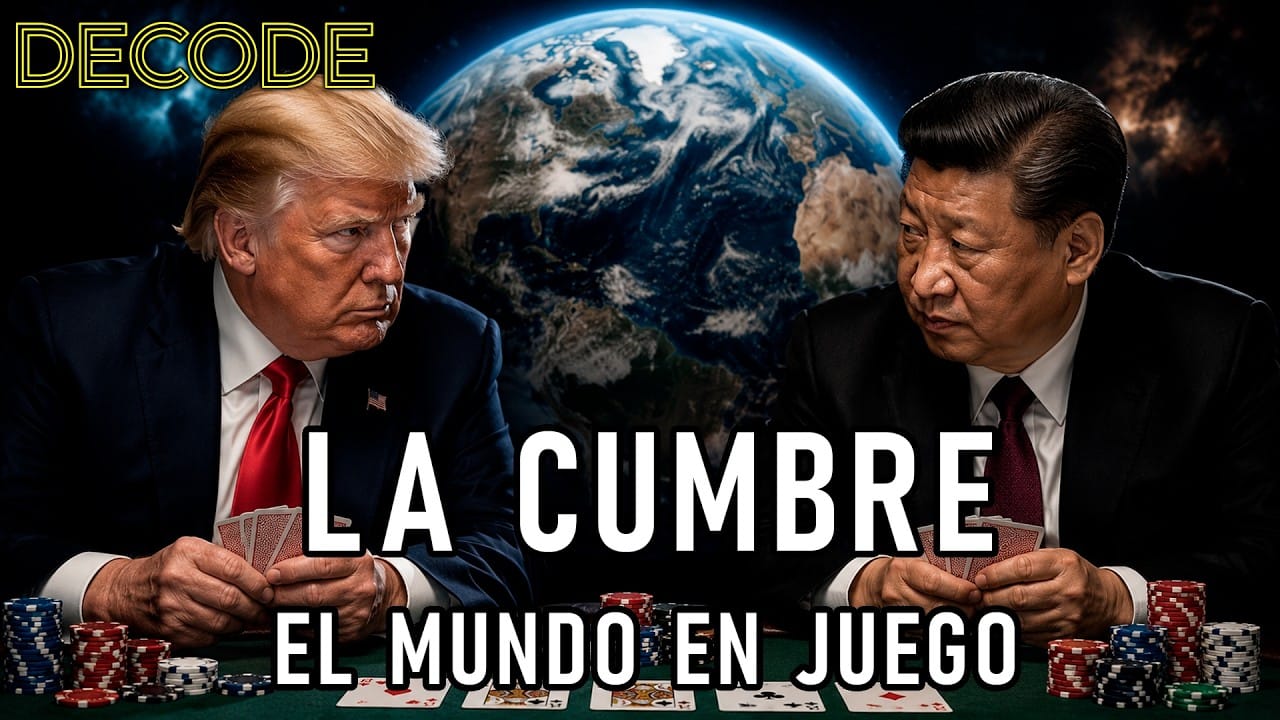
Trump enters the summit from a position of domestic weakness — his authority challenged at home and November elections he needs to capitalize on. According to the agenda reported by Reuters, the negotiating framework covers trade, energy, agriculture, aviation, investment, and artificial intelligence, as well as nuclear security and Iran. His logic is transactional: tariffs for soybean purchases, concessions for Boeing jets, a victory photo for whatever he can get.
The deeper problem is that Trump cannot settle for an airplane deal. He needs to return to Washington with geopolitical weight — progress on Iran or Ukraine — and that kind of win depends entirely on Xi Jinping's willingness to deliver it, which reverses Trump's negotiating position from the outset.
"Trump is a transactional guy. I squeeze you here, you buy my soybeans, I lower a tariff, you buy Boeing jets. I say we're friends and everyone's happy."
China is the only actor that can pressure the ayatollahs: Trump needs Xi to escape the Iran maze
Trump cannot pressure the Iranian regime directly — the ayatollahs have shown they can ignore him — but Xi Jinping holds that lever. China buys a substantial share of Iranian oil and maintains a strategic alliance with Tehran that gives Beijing influence Washington simply lacks. According to Reuters, Trump has scheduled a dedicated Iran session at the summit. The Strait of Hormuz — whose blockade would shatter global energy markets — also threatens China, whose industry depends on crude imports, along with Japan and South Korea, which source more than 80% of their oil from that region.
The paradox: Xi has no clear incentive to solve the problem. In game-theory terms, a United States bogged down in the Middle East is a United States less able to contain China in Asia. If Xi intervenes, he will name his price.
"The ayatollahs cannot laugh at Xi Jinping, because China has real leverage over Iran: it buys enormous volumes of its oil, and it holds a strategic alliance with Tehran."
China will offer rare earths in exchange for lifting the tech restrictions choking its industry
The real core of the US-China conflict is not tariffs or soybeans: it is control over the technological platforms that will define the next industrial revolution. Washington has imposed sweeping export restrictions on chips, semiconductors, manufacturing equipment, and AI, and maintains blacklists of Chinese firms. Xi Jinping will push to ease that pressure at the summit, and his main bargaining chip is rare earths — lithium, gallium, and other critical minerals essential for making chips and batteries — of which China holds vast reserves while the United States has almost none.
It is no coincidence that America's ambition to annex Greenland was driven precisely by that island's rare earth deposits. A bilateral deal exchanging strategic minerals for the lifting of restrictions on Chinese firms is exactly the kind of transaction both leaders could sell as a win.
"The deep root of the competition between the United States and China is who controls the fundamental technological platforms of the planet's next technological revolution."
Taiwan on the table: Xi pushes for diplomatic concessions and Trump may trade them for Iran or Ukraine
Taiwan hosts much of the world's chip manufacturing through TSMC, Taiwan Semiconductor Manufacturing Corporation, making the island the most sensitive node in global tech balance. Xi Jinping has spent decades waiting to consolidate sovereignty over it — much as China reclaimed Hong Kong from Britain — and this week he will seek to extract a shift in diplomatic language from Trump. No explicit concession is needed; if Trump replaces the traditional 'we will defend Taiwan' with vague talk of 'pathways to agreement,' Beijing will count it as a win.
The risk is that Trump, who operates on pure transactional logic, may accept that trade if China delivers on Iran or Ukraine. Any shift in Taiwan's status would affect global chip supply, undermine U.S. security guarantees across the region — Japan, South Korea, the Philippines — and open a new phase of Chinese expansion in the Pacific.
"Trump is an enormously transactional guy — he'd sell his own mother for a deal. If he thinks he can fix Ukraine or fix Iran by sacrificing Taiwan, watch out, because he will seriously consider it."
The Iran war exposes U.S. military limits and strengthens China's hand
The conflict with Iran has produced an outcome Washington did not anticipate: it has eroded U.S. military authority by showing that a nation of 90 million people armed with drones and light vessels can hold out for months against the world's largest war machine. That burns attention, budget, ammunition, and diplomatic capital that America can no longer direct toward Asia — the region it had identified as the century's strategic center. China reads that diversion as an opening to cement regional dominance without direct friction.
The paradox is that the Iran conflict also hurts China, which sources half its oil from the Persian Gulf. That creates a shared interest in ending the crisis — but also hands Xi Jinping leverage to demand a price for his mediation. If China can compel Iran to stand down when the United States cannot, it resets the global balance of power.
"To the extent that the United States has been unable to stop Iran — a far smaller country — the objective conclusion is that we are stronger than the United States."
China bankrolls Russia and can end the Ukraine war — Xi sets his price for Trump
Russia survives economically because of China. Beijing buys Russian oil across their shared land border, and when the West cut Russia off from global finance, Chinese payment networks — UnionPay — replaced Visa and Mastercard in the Russian market. Without that lifeline, Russia would collapse. That makes Xi Jinping the only actor capable of pressuring Putin to end a war that has claimed over a million lives on both sides. Trump tried — the Alaska summit was his first test — and got nothing.
The deeper problem is that Trump wants to claim credit for ending the Ukraine war before November, and Xi knows it. That knowledge turns Chinese mediation into a high-priced commodity. In exchange for leaning on Putin, Beijing will demand trade concessions, the lifting of restrictions on Chinese firms, or potentially moves on Taiwan. The question that will go unanswered in public this week: how much is Trump willing to pay?
"Xi Jinping picks up the phone and I guarantee you Putin stops the Ukraine war the next day. China is the one financing Russia."
Three scenarios for the Beijing summit: from cosmetic deal to the grand bargain that would reshape the world
The most likely outcome, per the analysis, is cosmetic: photos, banquets, grandiose declarations of cooperation, a minor agricultural deal — and none of the major conflicts resolved. The second scenario — the most ambitious and the hardest to reach — is the grand bargain: coordinated resolutions on Iran and Ukraine, market access, tariff cuts, and some linguistic concession on Taiwan. If that materializes, Beijing's narrative would be unambiguous: China fixed what the United States could not. The third scenario is open failure, possible if Trump pushes his demands too far or if Taiwan poisons the room.
All three scenarios share the same backdrop: we are watching in real time the collapse of the post-World War II order that America built on the dollar, sea lanes, and technology. That hegemony is fracturing — and this summit is the first major stage where the fracture becomes visible.
"What we are watching, you and I, is the shift in the world order — the balance of power between the two most powerful nations on earth, live."
Also mentioned in this video
- The US-China bilateral summit described as a… (0:01)
- US position as 20th century dominant power contrasted… (1:39)
- Key summit topics outlined: Iran, trade, and more… (2:44)
- Summit analyzed as matter of hierarchy, not trade… (4:06)
- Trump's third objective explained (15:29)
- Xi Jinping's three objectives outlined (19:29)
- Trump's interests recap: victory, curbing China, assistance… (31:37)
- Trump's personality compared: theatrical, impulsive, transactional… (42:25)
Summarised from DECODE con DaniNovarama · 57:05. All credit belongs to the original creators. Streamed.News summarises publicly available video content.