🌐 Also available in: 🇪🇸 Español
Original source: DECODE con DaniNovarama
This video from DECODE con DaniNovarama covered a lot of ground. Streamed.News selected 8 key moments and summarises them here. Everything below links directly to the timestamp in the original video.
Global energy markets — and the broader economy — hang on this single narrow strait. Do you grasp how dependent the world is on this chokepoint, and what that means for your energy bills?
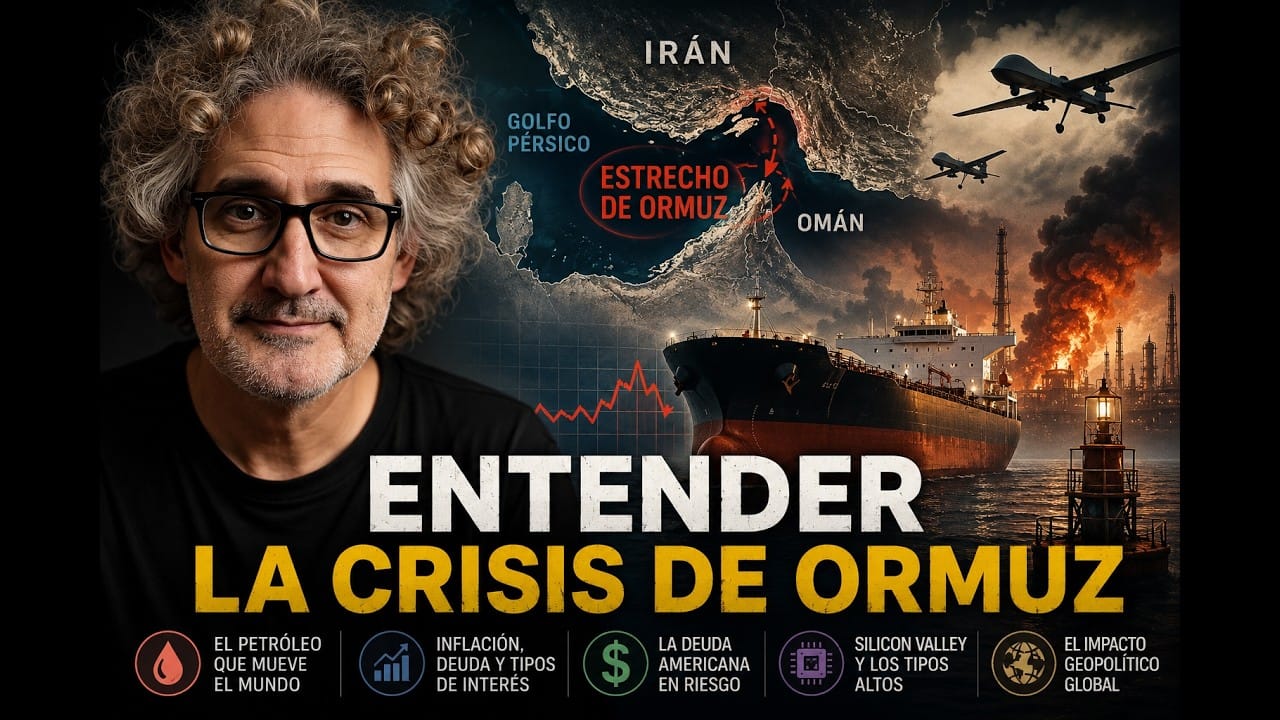
The Strait of Hormuz: The World's Most Critical Energy Chokepoint
The Strait of Hormuz has cemented its status as the planet's top energy bottleneck, carrying roughly 20% of global oil and 20% of liquefied natural gas. The waterway narrows to a dangerously thin navigable corridor with no viable geographic alternatives, making it a lifeline for industrial civilization — some 20 million barrels of crude pass through it daily.
Hormuz is far more than a trade route. Whoever controls it wields enormous geopolitical leverage. A blockade or disruption would send shockwaves through the global economy, hitting every market and nation dependent on energy imports.
Aviation Is the First Casualty of the Energy Crisis — and Europe Is Most Exposed
Aviation is shaping up as the first sector to crack under the energy crisis. Jet fuel has no viable substitute, and the cost has doubled in weeks — gutting the thin-margin business models airlines depend on. Spirit Airlines has already filed for bankruptcy; Lufthansa has been forced to cancel thousands of flights.
Europe faces a sharper shock than the United States. While the US produces much of its own oil, Europe relies heavily on imports, amplifying the impact of surging kerosene prices. Combined with energy stress carried over from the Ukraine conflict, the crisis threatens to push the continent into an economic downturn far worse than inflation alone.
"When the aviation industry starts struggling, watch out — it's a warning. What's coming is serious and it's big."
Iran Is Rewriting Modern Warfare With Cheap Drones in Hormuz
Iran has proved the power of asymmetric saturation warfare in the Strait of Hormuz. Its Shahid drones cost between $25,000 and $50,000 each; the US Patriot missiles used to intercept them top $4 million a unit. That 100-to-1 cost ratio creates unsustainable pressure on American stockpiles, which deplete within months while replacement takes years. Iran, meanwhile, can manufacture hundreds of drones a day.
This strategy rewrites the rules of modern conflict. Victory no longer belongs to the side with superior individual technology — it goes to the side that can bleed its opponent dry through relentless, low-cost attrition. The US is unprepared for this model, and Iran is pressing its advantage, forcing a fundamental rethink of military doctrine and defense spending.
"One lesson Iran has taken from this war: it wants a nuclear weapon."
Iran Sets Hormuz Conditions and Presses Ahead on Nuclear Program After Conflict
After the conflict, Iran is expected to force a deal giving it control over the Strait of Hormuz — likely through toll collection — framed domestically as a reconstruction victory. A uranium enrichment moratorium is also anticipated as part of any agreement, aimed at easing U.S. and Israeli nuclear concerns. Yet Iran's program had already reached weapons-grade levels, with 400 kg of uranium enriched to 60%.
The core lesson Iran draws from this conflict is that nuclear weapons guarantee security and deter future aggression. Despite any moratorium, Iran is expected to resume enrichment once the deadline passes, mirroring North Korea's strategy of using nuclear capability as a shield against attack. The outlook is one of sustained diplomatic hypocrisy and a persistent nuclear threat in the region.
"If Iran has learned anything from this war, it's that it wants a nuclear weapon. Let's not kid ourselves."
Airlines, the Canary in the Oil Crisis: Ticket Prices Triple
Airlines have become the fastest and most visible gauge of the energy crisis, with fares tripling on some routes — including flights to Tokyo. The reason is structural: carriers operate on razor-thin margins of 3% to 7%, leaving them unable to absorb a sharp spike in jet fuel costs.
Supply chain disruption and surging fuel prices threaten airline viability outright, hitting low-cost carriers hardest. Soaring ticket prices are already signaling a broader economic crisis — one that will ripple through global trade and mobility.
"The moment you get to the airline counter and they're charging you nearly triple for your flight, you realize this is a very real problem — and it's going to get worse."
Hormuz Blockade Threatens Asia's and Europe's Energy Security
A blockade of the Strait of Hormuz would hit key Asian economies hard and fast. China sources half its oil imports through Hormuz; Japan, 90%. That dependence is generating intense pressure on Washington to resolve the conflict. Europe relies on the strait less directly, but a global price shock would strike it all the same.
The global energy system's interconnection means removing 20 million barrels per day from supply would send crude prices soaring worldwide. The blockade doesn't only strangle oil importers — it squeezes Iran's Persian Gulf neighbors, including Saudi Arabia and Qatar, making Hormuz a lever against the entire global energy order.
Oil as the 'Blood' of Industrial Civilization and the Threat of Global Collapse
Oil is the backbone of modern industrial civilization — not just as fuel for maritime, air, and ground transport, but as a critical input for industrial agriculture, plastics, chemicals, and supply chains. Its low-cost availability is essential to the global economy. Any disruption or price spike — such as a closure of the Strait of Hormuz — threatens to seize the world's productive and logistical systems, triggering economic collapse.
The metaphor of oil as the 'blood' of the global economy and Hormuz as the 'aorta' captures the system's fragility. A blockage in that vital artery would not merely raise gas prices — it would trigger a systemic 'heart attack,' paralyzing production and trade worldwide with devastating consequences for every interconnected nation. The current war in the region poses an existential threat to global economic stability.
"Oil is the blood of the global economic system — literally. And Hormuz is the aorta."
Iran Gains the Upper Hand at Hormuz, Forcing the U.S. to the Table
Iran has secured a decisive advantage in the Strait of Hormuz standoff, demonstrating it can blockade the vital waterway indefinitely using low-cost weapons — drones and fast attack boats. That strategy has put the U.S. in a militarily untenable position: deploying a carrier strike group risks catastrophic losses, and a sunken carrier would be a humiliation with global consequences.
Faced with that reality, Washington is being pushed toward a diplomatic deal that offers an honorable exit without a real military victory. Leaked details of a possible memorandum of understanding suggest the U.S. wants a quick ceasefire to calm markets, deferring the harder questions — Iran's nuclear program and Persian Gulf access — to later. The dynamic exposes Iran's strategic superiority in this confrontation.
"Iran has won this war."
Also mentioned in this video
- US faces a new form of warfare in the Strait of Hormuz (0:00)
- Anticipating the outcome of the war in the Strait of Hormuz (0:49)
- Apparent economic normalcy driven by strategic reserves and other factors (9:05)
- A brutal surge in oil costs expected in June (12:54)
- Countries push for a Iran-US deal as tensions escalate (23:08)
- US has built its military machine with advanced technology (24:22)
- US military imbalance is pushing many countries to reconsider alliances (32:52)
- China, Japan, and Saudi Arabia pressure the US amid the conflict (34:21)
- Trump is eager to end the war due to mounting economic damage (40:21)
- The historical and geopolitical complexity of the Middle East (43:46)
- Key lesson from Hormuz: modern wars are won through economic means (56:15)
Summarised from DECODE con DaniNovarama · 59:56. All credit belongs to the original creators. Streamed.News summarises publicly available video content.