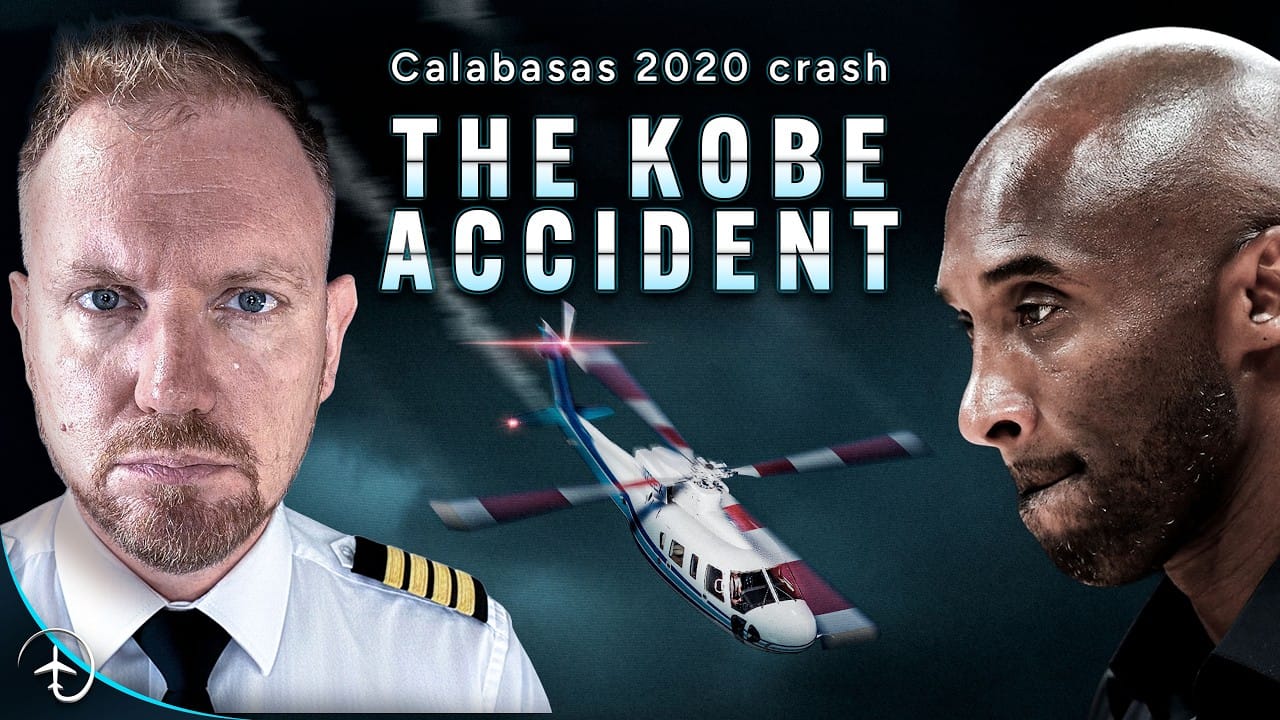
Original source: Mentour Pilot
This video from Mentour Pilot covered a lot of ground. Streamed.News selected 8 key moments and summarises them here. Everything below links directly to the timestamp in the original video.
Understanding the physiological traps of flying without visual references explains why seemingly minor weather changes can become fatal in seconds. This is a core danger in aviation.
Flight Into Clouds Gives Untrained Pilots 178 Seconds Before Losing Control, Studies Show
Flying under Visual Flight Rules (VFR) and inadvertently entering clouds, known as Instrument Meteorological Conditions (IMC), is an exceptionally dangerous event for an unprepared pilot. Without external visual references, the human body’s internal sense of balance becomes unreliable, leading to profound spatial disorientation. Studies have shown that for a pilot not proficient in instrument flight, the average time from entering clouds to losing control of the aircraft is a mere 178 seconds.
This phenomenon of VFR into IMC is a leading cause of fatalities among private pilots worldwide. The danger is not confined to reckless flying; it often arises when weather conditions deteriorate more rapidly than forecasted, catching a pilot by surprise and leaving them with only minutes, or even seconds, to avert disaster.
"Studies have even shown that the average time between entering IMC and losing control or striking terrain is just 178 seconds, which is truly terrifying."
NTSB Cites Pilot's 'Plan Continuation Bias' as Cause of Kobe Bryant Helicopter Crash
The National Transportation Safety Board (NTSB) determined that the probable cause of the accident was the pilot's decision to continue the flight under visual rules into deteriorating weather, which resulted in spatial disorientation and a loss of control. Investigators specifically cited the pilot's susceptibility to "plan continuation bias" and self-induced pressure as critical factors that shaped his flawed decision-making.
Furthermore, the NTSB found that the operator, Island Express, had not fully implemented its own safety management system, failing to mitigate the risks of flying in marginal weather. The accident underscores a persistent and deadly problem that extends beyond this single event to affect many private and small charter operations.
"The National Transportation Safety Board determined that the cause of the accident was the pilot's decision to continue flight under VFR into an area of instrument meteorological conditions until he lost visual references and control of the helicopter."
Instrument Rating No Guarantee Against Disorientation Without 'Instrument Mindset,' Analysis Shows
Even pilots holding an instrument rating can become victims of spatial disorientation when unexpectedly flying into clouds, a factor in nearly a third of such accidents. The key vulnerabilities are a lack of an "instrument mindset" and insufficient recent experience flying solely by instruments. The pilot in this crash had not flown in actual instrument conditions outside of training, likely leaving his skills rusty.
When a pilot is operating in a visual mindset—focused on looking outside to avoid clouds—their attention becomes consumed by that task as weather worsens. They can fail to make the crucial mental shift to trusting their instruments until after they have already lost visual references, by which point it is often too late.
"The last thing that you want to do is to try and establish yourself on instruments after you've already lost visual references in a VFR flight, because by that point you have seconds before you start to lose your bearings."
Pilots Can Counter 'Self-Induced Pressure' With Hard Minimums and a Plan B
To combat the hazardous effects of self-induced pressure, pilots should follow a clear, pre-defined procedure. 1. Set hard minimums: Establish non-negotiable weather conditions, such as for visibility and cloud ceilings, below which a flight will not be initiated or continued. 2. Always have a Plan B: Draft an alternative course of action, such as a diversion to another airport or a route to return, before every flight. The accident pilot did not fully complete a company risk analysis form that would have forced the creation of such a plan, a failure that increased the psychological cost of deviating from his original intention.
"The way you combat this pressure is by drawing up quantifiable minimums for yourself. You need to tell yourself, if the weather is worse than X... then I just won't go."
Lack of 'Plan B' Led to 'Get-There-Itis' in Bryant Helicopter Crash, NTSB Found
The pilot's failure to establish an alternate plan before takeoff made it psychologically more difficult for him to abort or reroute the mission when conditions deteriorated. This cognitive trap, known in aviation as "plan continuation bias" or "get-there-itis," makes pilots more likely to press on into known danger rather than accept the perceived failure of changing course.
Compounding this human factor, the NTSB found that the operator's risk management system was inadequately enforced. This failure rendered the required pre-flight risk assessment forms a mere paperwork exercise instead of an effective tool to force consideration of alternatives.
"Without that plan B, he increased the mental cost of taking a less direct route or landing the helicopter early, and therefore, also increasing the risk of making an ill-advised decision."
Controller's 'Squawk Ident' Request May Have Triggered Final Disorientation in Crash Sequence
A critical moment in the accident sequence occurred when a new air traffic controller, who was unfamiliar with the helicopter's situation, asked the pilot to "squawk ident" to locate him on radar. This routine request required the pilot, already under immense stress from entering clouds, to divert his attention from the flight instruments to the aircraft's transponder panel.
That brief moment of distraction is believed to have been the final trigger for an unrecoverable spatial disorientation. The helicopter, which had been in a steep, panicked climb, ceased its ascent and began its fatal descending turn just seconds after this interaction.
"When the controller now asked him to squawk ident, he had to take his attention away from the attitude indicator and look down on the transponder panel and press that ident button, and in that brief moment... disorientation took over."
Pilot Reported Climbing While Spiraling Downward, Flight Data Shows
In his final transmission, the pilot told air traffic control he was climbing to 4,000 feet, but flight data revealed the helicopter was actually descending rapidly in a tightening spiral. This starkly illustrates the profound effects of spatial disorientation, a state where a pilot’s physical sensations completely betray reality and lead to actions opposite to what is required.
He was likely experiencing a combination of the somatogravic illusion, which mistakes acceleration for a climb, and "the leans," which misinterprets a continuous bank as straight-and-level flight. These powerful sensory illusions sealed the aircraft's fate.
"He replied that he was climbing to 4,000 feet, but at that moment the helicopter was actually descending rapidly, just proving that the pilot had now become completely disoriented."
Kobe Bryant Helicopter Crash Investigation Revealed Critical Lessons for All Pilots
The January 2020 helicopter crash that killed basketball superstar Kobe Bryant, his daughter, and seven others prompted a major investigation by the National Transportation Safety Board. As tributes honored the victims, investigators worked to piece together the chain of events that led to the accident on a Southern California hillside.
The story they uncovered was much bigger than the famous passenger. The investigation's findings offer critical, life-saving lessons for all pilots of general aviation aircraft and helicopters, particularly regarding the persistent dangers of flying in marginal weather conditions.
Also mentioned in this video
- On January 26, 2020, Kobe Bryant, his daughter, and other passengers were… (0:47)
- Kobe Bryant had strict criteria for helicopter charter companies and pilots due… (2:02)
- Island Express Helicopters primarily conducted charter flights between Los… (2:29)
- The pilot, a 50-year-old veteran with 8,577 total flight hours, was the chief… (3:21)
- The pilot planned to fly from Santa Ana to Camarillo Airport via low-altitude… (5:03)
- Weather reports showed blue returns for cloud ceilings at 1,000-3,000 feet near… (6:24)
- Investigators found no record of the pilot receiving a pre-flight weather… (7:45)
- Kobe Bryant and passengers boarded the helicopter, with the pilot in the… (10:31)
- The pilot requested and was granted a special VFR clearance through Burbank's… (11:19)
- The Burbank tower instructed the helicopter to hold over Glendale due to… (12:30)
- The pilot's decision to fly despite adverse weather was likely influenced by… (14:16)
- Route 118, which aligned with his original plan. (18:31)
- After an 11-minute hold, Burbank granted special VFR clearance, reporting 2.5… (19:07)
- The pilot intercepted US 101, proceeding westward into the hills despite… (20:41)
- As the helicopter entered a low spot with a "wall of clouds," the pilot,… (27:57)
Summarised from Mentour Pilot · 38:03. All credit belongs to the original creators. Streamed.News summarises publicly available video content.