Original source: Mentour Pilot
This video from Mentour Pilot covered a lot of ground. Streamed.News selected 8 key moments and summarises them here. Everything below links directly to the timestamp in the original video.
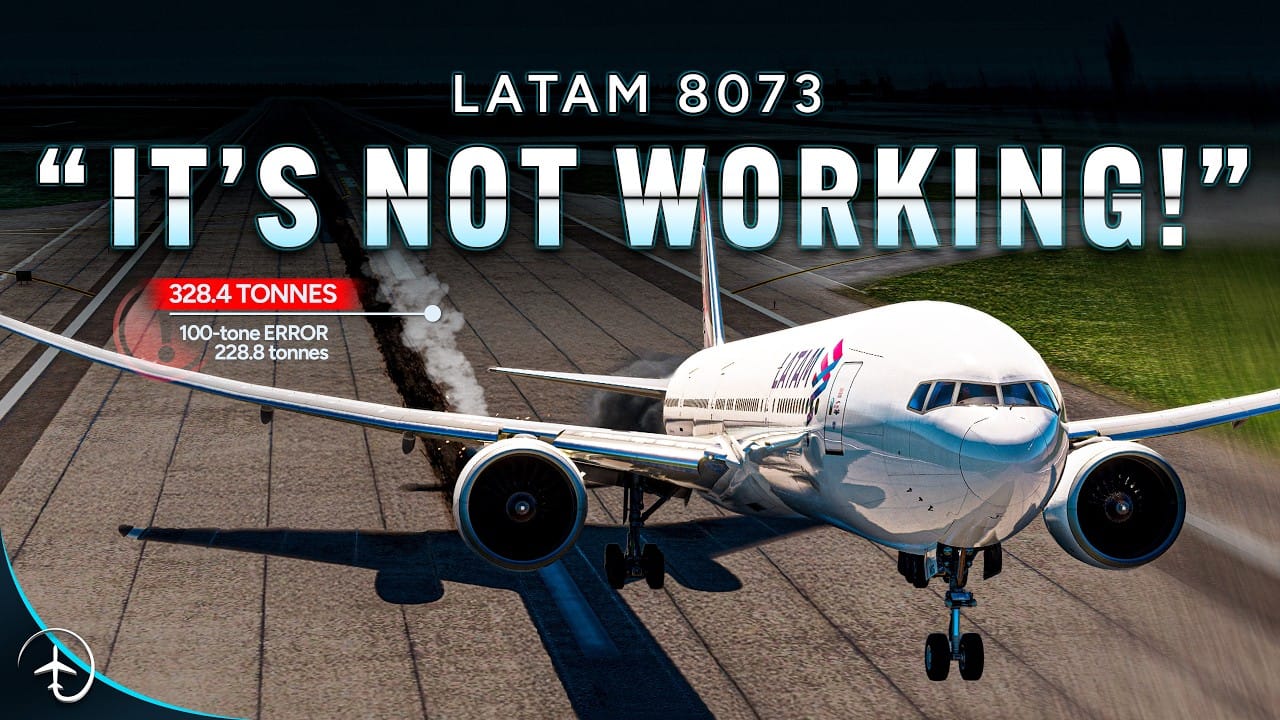
A calculation error made minutes earlier has terrifying consequences as a fully-loaded Boeing 777 barrels down the runway, unable to fly. This is the moment a procedural failure became a physical emergency.
LATAM Boeing 777 Fails to Lift Off After Crew Uses Grossly Incorrect Takeoff Data
Unaware of their critical data error, the pilots of LATAM Flight 8073 began their takeoff roll with engines at 92.8% N1, a thrust setting far too low for their actual weight. The aircraft accelerated sluggishly, reaching its erroneously calculated V1 speed of 145 knots—roughly 30 knots too slow—after 35 seconds. When the training captain rotated at 149 knots, the aircraft’s nose lifted, but its main gear remained firmly on the ground, as it lacked the speed to generate sufficient lift.
This was the physical culmination of a chain of human and systemic errors, transforming a procedural mistake in the cockpit into a high-speed crisis on the runway. The aircraft was now rapidly approaching the end of the runway, unable to fly and with insufficient space to stop.
Takeoff Weight Errors Identified as Systemic Aviation Risk, Preceded by Multiple Incidents
The LATAM incident is not an isolated case but highlights a recurring vulnerability in aviation. A 2004 MK Airlines Boeing 747 cargo flight crashed due to a similar weight calculation error. In 2009, an Emirates Airbus A340 struck an antenna after a 100-ton weight discrepancy caused a runway overrun, while in 2015, a Boeing 777 cargo crew nearly had a tail strike after dropping a digit from the takeoff weight.
This pattern of incidents, often involving dropped digits or incorrect verbal data, indicates a systemic issue rather than a unique pilot failure. It reveals how simple human errors can repeatedly bypass standard procedural safeguards across different airlines and aircraft types.
"The problem here likely wasn't just individual, but rather something systemic."
Pilots Overlooked 100,000 kg Weight Discrepancy Due to Inexperience and Habit
The pilots' performance calculations were based on a takeoff weight that was 100,000 kilograms too light—a discrepancy equivalent to the weight of 17 adult African elephants. This gross error went unnoticed due to a combination of human factors. The training captain, accustomed to flying the lighter Boeing 787, did not perceive the incorrect 228-ton figure as abnormal for a wide-body jet.
Simultaneously, the trainee captain, who was new to the Boeing 777, lacked the deep experience needed to instinctively recognise that the performance numbers were wrong. Deferring to his instructor, he did not challenge the incorrect data, allowing the critical error to pass through a key cross-check.
"100,000 kilos is substantially more than the weight of a Boeing 737-700, or, put it another way, about 17 adult male African elephants."
Incorrect Takeoff Data Creates Multiple Avenues for Catastrophe
Using a thrust setting and rotation speed calculated for a much lighter aircraft introduces several critical risks during takeoff. The most immediate danger is that the reduced thrust is insufficient for the aircraft to reach the actual required takeoff speed before running out of runway. Furthermore, rotating at a speed too low for the aircraft's true weight means it will not generate enough lift to become airborne.
This situation often leads to pilots pulling back further on the controls in an attempt to force the aircraft into the air, causing a tail strike. The resulting damage and increased aerodynamic drag make acceleration even more difficult, compounding the risk of a high-speed runway overrun and a catastrophic outcome.
Investigators Blame Ambiguous Procedures for LATAM Error, Recommend Automated Solutions
Italy's National Flight Safety Agency (ANSV) concluded that ambiguities in LATAM's procedures for verbalising and sourcing takeoff weight data created conditions ripe for human error. The investigation found that simply adding more manual cross-checks is an inadequate solution, as it increases workload during the already high-pressure pre-flight phase.
The ANSV instead recommended a technological solution: developing flight management system software capable of detecting and flagging gross performance calculation errors. New European regulations will now require such takeoff performance monitoring systems on all newly built aircraft, with optional retrofits available for older models.
"The best solution would be to develop flight management system software that could detect and flag gross errors."
Critical Takeoff Error Occurred When Captain Verbalized Wrong Weight, Bypassing Safety Check
The critical error was initiated when the training captain, likely through a mental lapse, dropped a digit and verbalised an incorrect takeoff weight of 228.8 tons instead of the actual 328 tons. This single mistake set in motion the chain of events. The procedure required both pilots to calculate the performance data independently to catch such an error.
However, the trainee captain, either to save time under pressure or out of deference to his instructor, did not perform his own calculation. He instead entered the incorrect weight he heard into his own performance tool, nullifying the independent cross-check and ensuring both pilots would be working from the same dangerously flawed data.
Final Safety Check Failed as Flight Computer Displayed Unprecedented 'V-Speeds Unavailable' Message
A final opportunity to catch the error was lost when the aircraft’s own systems failed to provide a crucial cross-check. After the pilots entered the incorrect data, the Control Display Unit (CDU) was supposed to display its own reference V-speeds, which would have been 30 knots higher and immediately flagged the discrepancy. Instead, the reference speeds were missing.
In their place, the CDU displayed an obscure message: "V-speeds unavailable." None of the pilots had ever seen this message before. It appeared because the aircraft's true weight made a safe takeoff impossible with the low thrust setting they had selected, a condition the system flagged by withholding the speed data entirely.
Crew Bypassed Critical Warning Message Due to Time Pressure and Obscure Documentation
The "V-speeds unavailable" message was a critical warning that takeoff with the selected parameters was not possible, but its meaning was not understood by the crew. The explanation for the message was buried in the flight crew operations manual, which the pilots did not consult due to the time pressure to depart. The manual stated a takeoff was not allowed if this message appeared.
Without understanding the warning's significance, and after a brief, inconclusive discussion, the crew proceeded with the manually entered—and incorrect—speeds. This decision effectively bypassed the final automated safety barrier, cementing the path toward a hazardous takeoff attempt.
Also mentioned in this video
- A fascinating story about an aircraft attempting to take off with 100,000 kilos… (0:01)
- The incident on July 9, 2024, involved a LATAM Airlines Brazil flight crew at… (0:40)
- The flight crew consisted of a 53-year-old trainee captain with 95 hours on the… (1:17)
- The training captain was qualified on both the Boeing 777 and 787, which is… (3:02)
- The highly experienced three-pilot crew, with over 50,000 combined hours, had… (4:10)
- During the pre-flight setup, the crew awaited the load sheet and decided the… (5:18)
- The pilots confirmed the planned fuel quantity of 109,625 kilos, which was… (6:41)
- The cockpit voice recording started with the pilots performing the takeoff… (7:25)
- The relief captain received the loadsheet on his cell phone and forwarded it to… (9:44)
- The relief captain dictated the zero fuel weight (219,460 kg) and takeoff gross… (10:16)
- Precise takeoff weight is critical for determining thrust settings, flaps, and… (11:00)
- Boeing 777 pilots at LATAM calculate V-speeds and takeoff thrust by entering… (13:16)
- Most planes lack weight sensors due to the difficulty of designing a more… (14:36)
- Pilots use the Boeing Onboard Performance Tool (OPT) on iPads to independently… (15:22)
- As Flight 8073 pilots began the procedure, unexpected time pressure arose from… (17:28)
- Under pressure, the trainee captain forgot the gross weight displayed on the… (18:44)
- The difficulty for instructors in maintaining a trainee captain's sense of… (23:03)
- The OPT calculated an assumed temperature of 56°C and a flap setting of five… (24:27)
- After takeoff, the crew received a tail strike warning, followed the abnormal… (37:37)
- With the 777 over its maximum landing weight, the crew dumped fuel over a rural… (39:19)
- Despite human error, the inherent safety margins in aviation allowed the… (42:29)
Summarised from Mentour Pilot · 44:05. All credit belongs to the original creators. Streamed.News summarises publicly available video content.