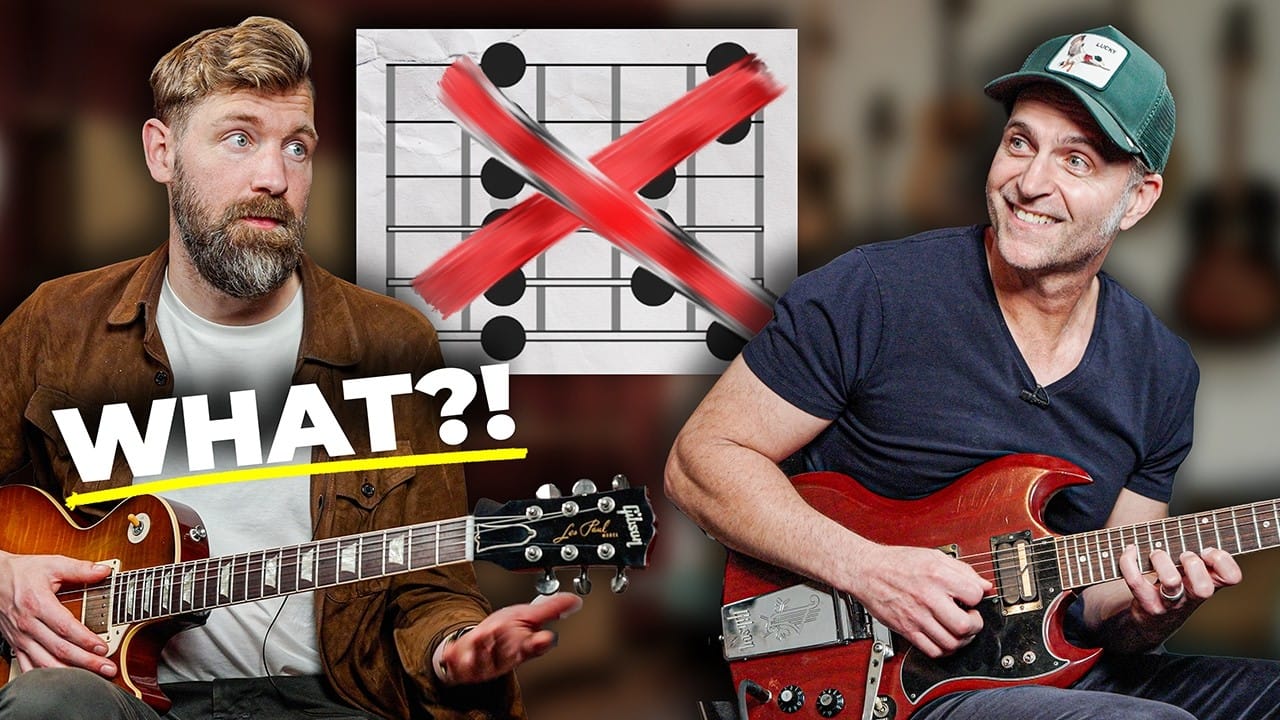
Original source: Paul Davids
This video from Paul Davids covered a lot of ground. Streamed.News selected 5 key moments and summarises them here. Everything below links directly to the timestamp in the original video.
This practice routine from Dweezil Zappa is more than just a finger exercise; it's a method for truly seeing and understanding the entire fretboard. Use it to connect seemingly distant notes and turn your scales into music.
Dweezil Zappa Shares Fretboard Exercise Combining Octaves and Unisons for Deeper Neck Knowledge
Dweezil Zappa presents a powerful exercise that merges octaves and unisons, challenging players to move the pattern chromatically up the neck. He also introduces a "brutal" but effective left-hand-only variation, designed to improve finger tone and the physical connection to the strings. This approach forces a player's brain to internalize note locations without relying on the picking hand, building true fretboard automation.
What Paul Davids loves about this is how it transforms a mechanical drill into a musical idea. By adding a single melodic note before each octave, the exercise blossoms into a phrase reminiscent of a Yes song. It proves that even the most fundamental practice can unlock new creative pathways and give players a much better idea of where notes exist on the fretboard.
"Everybody says break out of the pentatonic box, but sometimes there's still more in the box that we've never discovered."
Dweezil Zappa Reveals His 'Three Sets of Two Strings' Method for Fretboard Navigation
Dweezil Zappa shares his unique way of visualizing the guitar neck, viewing it not as six individual strings but as three distinct sets of two. By doing this, a simple two-note-per-string lick can be played on one set and then repeated verbatim on the next set—an octave higher—without changing the fingering pattern. It's a method for creating a diagonal scale across the fretboard with minimal mental effort.
What's so brilliant about this is how it tricks the ear into hearing something complex from something simple. Though it's just the same four notes repeated in three different octaves, the resulting phrase sounds far more fascinating and melodic. This shows how a simple shift in perspective can unlock new musicality from familiar patterns.
"I see the guitar as three sets of two strings... I can do the exact same thing without having to think about finger changes at all if I split the octave."
Dweezil Zappa Demonstrates How to Mobilize Pentatonic Clusters for 'Otherworldly' Sounds
Taking the three-string pentatonic cluster, Dweezil Zappa demonstrates how to move the entire shape up and down the fretboard to create beautiful, cascading melodic lines. The technique involves understanding how to get from one root note to the next on a single string and then applying that movement to the whole three-note chordal shape. Zappa also shows how reversing the pattern's direction adds another layer of musical interest.
What Paul Davids loves about this is the insight that each string can be viewed as moving independently. This completely breaks free from the static box shapes most players are used to, offering a new way to visualize and navigate the pentatonic scale that sounds fresh and almost otherworldly, even though it's built from the same familiar notes.
"That is beautiful and it's just pentatonic. Exactly."
Dweezil Zappa Shares the Fretboard Learning Method from His Childhood
Dweezil Zappa explains the foundational method he used as a child to master the fretboard. He would simply drone an open A string and then hunt for all the notes on each individual string that sounded good against it, effectively mapping out the A pentatonic scale across the entire neck. This ear-led exploration helped him intuitively discover the five repeating scale positions without relying on diagrams.
This process is what ultimately led to his sophisticated view of the fretboard, including his concept of seeing it as three sets of two strings. By starting with sound and recognizing patterns, he built a mental map that was musical from the ground up, rather than just a collection of memorized shapes.
"As a kid, that's how I learned... I just would drone an A note and then I would just see like what notes sounded good to that."
Dweezil Zappa Reimagines the Pentatonic Scale With 'Piano-Like' Three-String Clusters
Dweezil Zappa introduces a fresh way to break out of standard pentatonic boxes by reimagining the scale as a series of three-note clusters. Instead of playing notes linearly on one or two strings, this method places one note on each of three adjacent strings. When played, especially with fingers, the notes ring out together, creating a sound that is almost like a piano.
What's so powerful here is the textural shift. While the notes are the same as in the standard scale, the clustered arrangement allows them to sustain and interact, producing a rich, harmonic quality that is usually impossible to achieve with traditional pentatonic playing. It's a simple change in layout that completely transforms the character of the scale.
"It's like a piano almost, you know? They ring out and usually you cannot have this in the pentatonic scale."
Also mentioned in this video
- Can enhance the sound, and discusses reaching an octave higher. (4:12)
- Dweezil Zappa demonstrates similar pentatonic shapes on different string sets… (5:50)
- His playing pivots off octaves as visual anchors because he doesn't know every… (8:29)
Summarised from Paul Davids · 16:57. All credit belongs to the original creators. Streamed.News summarises publicly available video content.