🌐 Lee esto en Spanish →
Original source: Marcelo Longobardi
This article is an editorial summary and interpretation of that content. The ideas belong to the original authors; the selection and writing are by Streamed.News.
This video from Marcelo Longobardi covered a lot of ground. 6 segments stood out as worth your time. Everything below links directly to the timestamp in the original video.
When the software that decides whether to launch a missile belongs to a private shareholder with their own political agenda, the military chain of command is no longer exclusively a matter of state. That has already happened.
Pentagon hands control of military intelligence to Palantir in $10 billion contract
In late July 2025, the U.S. military signed a $10 billion contract with Palantir Technologies, the company co-founded by Peter Thiel, making its software the central operating system for the Pentagon's tactical intelligence, logistics, and personnel management. What was publicly framed as an administrative simplification — consolidating 75 separate agreements into one — amounts, according to researcher Francesca Bría, to the surrender of sovereign military functions to a company whose founder has publicly declared that freedom and democracy are incompatible.
The contract means that decisions on military targeting, troop movements, and battlefield intelligence are now processed through algorithms controlled not by the military chain of command, but by a private board of directors. Palantir also became the best-performing company in the S&P 500 in 2025, with quarterly revenues exceeding $1 billion, driven largely by its contracts with the Trump administration.
"The military didn't just buy software — operational sovereignty was handed over to a platform without which it can no longer function."
Anduril deploys autonomous warfare drones as former Thiel executives take command posts in Washington
Defense company Anduril, founded by Palmer Luckey — the original creator of the Oculus virtual reality headset — claims its systems can identify targets, strike, and return with no human intervention. Defense Secretary Pete Hegseth announced in July 2025 an initiative to fully integrate autonomous weapons into the U.S. military by 2027, a program in which Anduril, valued at $30.5 billion, plays a central role. Meanwhile, SpaceX's Starshield military satellite network is integrated into NATO communications, leading Bría to conclude that Europe's defensive autonomy is, in her words, theatrical fiction.
The merger of industry and state extends beyond contracts: Michael Obadal, an Anduril executive, was appointed Under Secretary of the Army while retaining shares in the company. Gregory Barbaccia, after a decade in Palantir's intelligence division, now oversees federal government data systems. In June 2025, the Pentagon directly commissioned four technology executives as lieutenant colonels, formally erasing the distinction between private contractor and military commander.
"The distinction between a contractor and a military commander, between profit-seeking and national defense, has been deliberately erased. There is no longer a line dividing them."
Thiel-linked executives occupy key positions at the White House and Pentagon
Peter Thiel's influence over the U.S. government runs through a network of individuals directly tied to his companies who now hold senior positions in Washington. Steven Miller, deputy chief of staff to Donald Trump, is a Palantir shareholder. Michael Kratsios, a Thiel associate, leads the White House Office of Science and Technology Policy. Gregory Barbaccia moved from Palantir's intelligence division to head federal government information systems, overseeing programs that directly benefit his former employer.
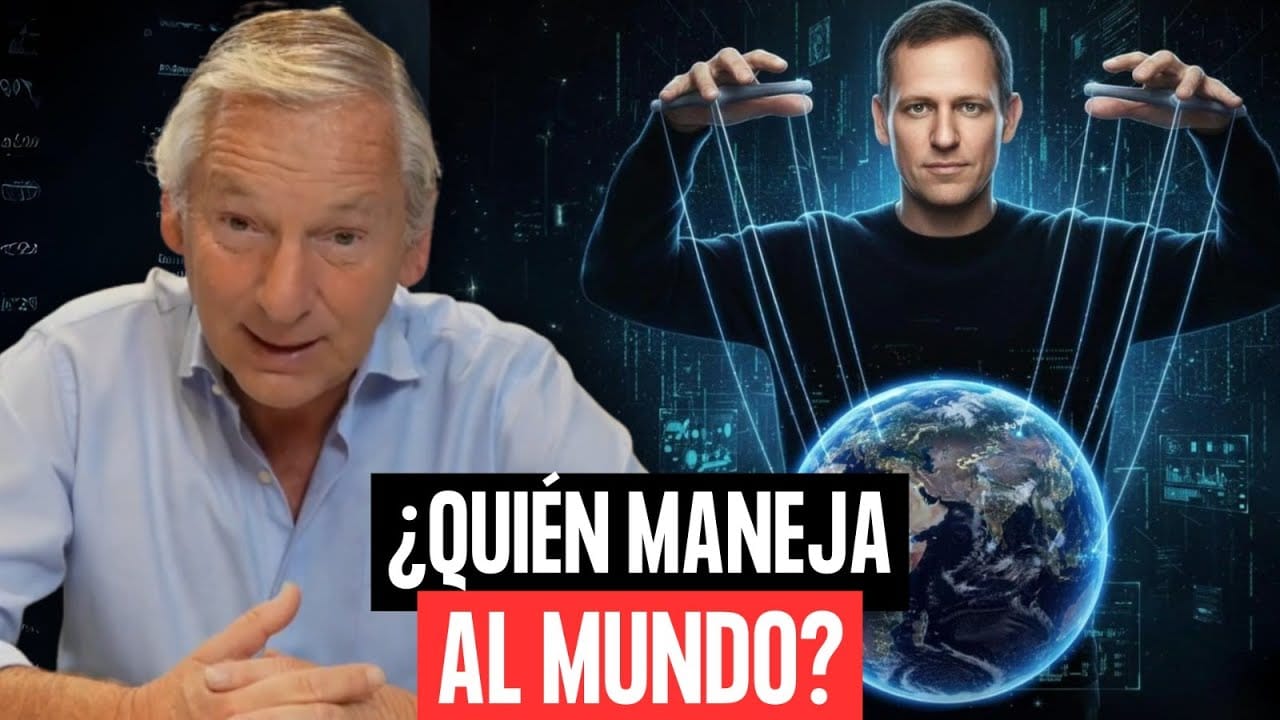
This concentration of overlapping loyalties between the private sector and the machinery of state turns the principle of following the money — popularized during the Watergate scandal — into a primary analytical tool. Thiel, who finances political campaigns, holds multibillion-dollar government contracts, and has placed his associates in positions of strategic control, represents, according to Bría, the clearest example of how technological power has learned to colonize the state from within.
"The line separating that from corruption must be very thin indeed."
Thiel and Vance-linked fund 1789 Capital grew sevenfold after Donald Trump Jr. came on board
Venture capital fund 1789 Capital, founded by close associates of both Peter Thiel and Vice President JD Vance, grew from $150 million under management to more than $1 billion after Donald Trump Jr. joined as a partner in November 2024. The fund, which Trump Jr. has publicly described as a patriotic investment vehicle, channels capital into military artificial intelligence projects, including contributions to Elon Musk's business ecosystem. This establishes, in the words of Bría's analysis, a direct line between presidential power and the defense industry.
The operation exemplifies what Bría describes as the transformation of venture capital into dynasty: the same networks that financed the political campaign now profit from the contracts that same administration awards. What began as an ideologically anti-state network has ended up becoming its primary beneficiary, reconfiguring critical public infrastructure as a source of private returns.
"What was born as a libertarian evasion has been transformed into an authoritarian takeover."
Bría coins the concept of the 'authoritarian stack' to describe Silicon Valley's emerging infrastructure of control
Researcher Francesca Bría describes in her analysis an emerging formation in Washington she calls the authoritarian tech complex: a coalition of companies, financiers, and ideologues that is coordinately building a planetary infrastructure of surveillance and control with no democratic accountability. At its core she identifies figures such as Peter Thiel, Elon Musk, Marc Andreessen, and Palmer Luckey, whose systems — cloud platforms, artificial intelligence models, drone networks, and orbital constellations — form what Bría calls the authoritarian stack. The United Kingdom's National Health Service is among the many European public bodies already dependent on these platforms.
The analysis warns that none of these outsourcing decisions triggered significant parliamentary debate in Europe, revealing a systematic surrender of sovereignty to companies whose leaders are actively undermining the democratic systems that contract them. Bría concludes that techno-authoritarians do not need to persuade voters: they need only control critical state infrastructure, turning democracy into what she defines as a legacy interface — maintained by inertia while being hollowed out.
"To exercise power, it is not enough to win elections — you have to win contracts."
Thiel and Yarvin: the anti-democratic ideas driving the world's most influential tech elite
Peter Thiel, one of Silicon Valley's most powerful investors, has written and publicly declared that democracy is incompatible with freedom, framing the world's fundamental conflict not between nations or traditional political ideologies, but between technology and politics. His intellectual influence intersects with that of Curtis Yarvin, a blogger and proponent of libertarian ideas with a wide following in MAGA circles, who openly advocates replacing elected governments with private corporations on the grounds that democracy is an obsolete system.
What makes these positions relevant is not their theoretical radicalism, but the fact that those who hold them now control military contracts worth tens of billions of dollars, finance electoral campaigns, and have placed their associates at the highest levels of the U.S. government. The question is no longer whether these ideas are dangerous in the abstract, but what happens when those who champion them have direct access to the infrastructure of the state.
"Democracy is incompatible with freedom."
Also mentioned in this video
- El artículo de Francesca Bría publicado en La Vanguardia y contextualiza las… (1:03)
- El presentador vincula a Peter Thiel y JD Vance con el financiamiento de la red… (6:05)
- El presentador presenta a Francesca Bría como experta europea en tecnología… (12:10)
- El presentador contextualiza la tesis de Thiel sobre el conflicto mundial entre… (17:17)
- El presentador narra el episodio del submarino soviético durante la crisis de… (33:22)
- El presentador concluye la lectura del artículo de Bría con la tesis de que los… (47:10)
Summarised from Marcelo Longobardi · 49:21. All credit belongs to the original creators. Streamed.News summarises publicly available video content.
Streamed.News
This publication is generated automatically from YouTube.
Convert your full video library into a digital newspaper.
Get this for your newsroom →