🌐 This article is also available in Spanish.
Original source: Mentour Pilot
This article is an editorial summary and interpretation of that content. The ideas belong to the original authors; the selection and writing are by Streamed.News.
This video from Mentour Pilot covered a lot of ground. 6 segments stood out as worth your time. Everything below links directly to the timestamp in the original video.
A single spoken number — wrong by exactly one digit — bypassed multiple safety checks on a fully loaded transatlantic jet. Understanding how that happened matters for anyone who designs procedures under time pressure.
A Spoken Number Sent a Loaded Boeing 777 Down the Runway 100 Tonnes Underweight
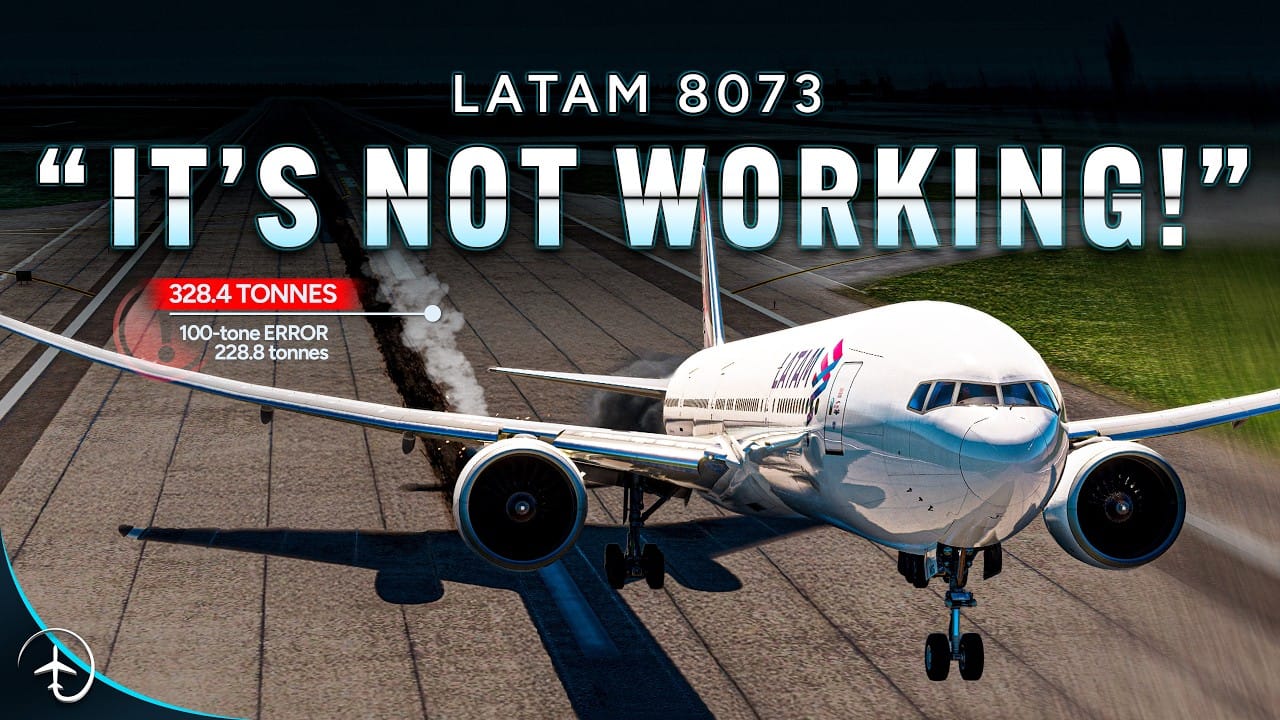
When a training captain mentally subtracted taxi fuel from the aircraft's gross weight during a hurried pre-departure calculation at Milan Malpensa, he dropped a digit and announced a takeoff weight of 228.8 tonnes to his colleague. The actual weight was 328 tonnes. Instead of calculating the figure independently, the trainee captain simply copied what he heard, meaning both pilots' tablet-based performance tools produced identical — and identically wrong — thrust settings, flap angles, and takeoff speeds calibrated for an aircraft a hundred thousand kilograms lighter than it actually was. A cross-check that should have caught the error was rendered useless because both inputs were already compromised.
The chain of failures had a clear human logic to it. The training captain also flew the Boeing 787, where 228 tonnes is an unremarkable takeoff weight, dulling his instinct that the figure was wrong. The trainee, on only his tenth flight on the type after years on Airbus aircraft, lacked the numerical intuition to challenge his instructor. A sudden change to the departure schedule had introduced time pressure moments earlier, and the third pilot was occupied with the cabin crew. Any one of those factors alone might have been manageable. Together, they neutralised four layers of designed redundancy.
"One moment, OPT, 228.8."
A Boeing 777's Own Computer Warned the Crew Not to Take Off — They Did Not Know What the Warning Meant
When the crew of LATAM Flight 80073 entered their calculated V-speeds into the flight management computer, the system refused to display its own reference speeds and instead returned a cryptic message: "V-SPEED UNAVAILABLE." The reason was that the aircraft's computer, which knew the plane's real weight, had determined that the selected thrust level was so deeply reduced that the runway at Milan Malpensa was simply too short to support a safe departure. By withholding reference speeds entirely, the system had effectively activated a prohibition on takeoff — but it communicated this through a single unexplained phrase that none of the three experienced pilots had ever encountered before and that occupied only one brief passage in the flight manual.
Rather than consulting that manual, the crew checked whether a technical setting was toggled incorrectly, concluded it was not the problem, and pressed ahead. The episode exposes a fundamental weakness in aviation system design: a safety barrier is only effective if the people it is meant to stop can understand what it is telling them. An obscure warning with no clear call to action is functionally close to no warning at all, and in this case it was the last automated gate standing between the aircraft and the runway.
"The jaws of disaster had started opening up."
Wrong Takeoff Weight Errors Are a Recurring Pattern in Commercial Aviation, Investigators Warn
Taking off with thrust set for a significantly lighter aircraft creates two compounding dangers: the plane may not reach flying speed before the runway ends, and if the pilot rotates at the artificially low calculated speed, the wings cannot yet generate enough lift to climb. The aircraft's nose rises while its main gear stays on the ground, dramatically increasing drag at precisely the moment when thrust is already insufficient — a physics trap that can end in a runway overrun or a tail strike severe enough to rupture the fuselage.
This is not a novel failure mode. In 2004, an MK Airlines cargo Boeing 747 crashed after a crew entered a takeoff weight from a previous, empty flight. In 2009, an Emirates Airbus A340 departing Melbourne used a weight that was also exactly 100 tonnes too low, becoming airborne past the runway end and striking a navigation antenna before returning safely. A 2015 incident at Paris Charles de Gaulle involved a Boeing 777 cargo crew who, as in the LATAM case, verbalized an incorrect weight that was again 100 tonnes light. Investigators noted the verbal contamination of calculations as a specific shared mechanism, suggesting the problem is rooted in systemic workflow design rather than individual pilot failure.
"My point in sharing these stories is to highlight that the problem here likely wasn't only the involved crew. Something systemic was also at play."
LATAM Boeing 777 Dragged Its Tail for 723 Metres Before a Jump-Seat Pilot's Shout Forced It Airborne
Cleared for takeoff at Milan Malpensa at 13:25, Flight 80073 began its roll with engines throttled back to 92.8 percent of maximum thrust — the limit imposed by the crew's incorrectly calculated assumed temperature of 56 degrees Celsius. The aircraft accelerated slowly down one of Europe's longest runways, and the crew did not initially notice the discrepancy. When the automated voice called out the decision speed of 145 knots and the training captain rotated at the calculated 149 knots, the Boeing 777 refused to lift. The wings, moving far too slowly to support 328 tonnes, could not generate sufficient lift, and as the nose rose the tail drove into the asphalt. The tail skid gouged a six-centimetre scar into the runway surface across 723 metres of tarmac while the training captain, caught by what investigators call the "startle effect," continued pulling instinctively.
It was the relief captain, sitting on the jump seat behind the two pilots, who broke the paralysis. He twice shouted a single word — "Toga" — the instruction to push thrust levers to their maximum position. On the second call, the training captain complied. The engines surged, overcame the drag of the high pitch angle and the grinding tail strike, and forced the aircraft into the air at 178 knots, roughly 80 percent of the way down the runway. Without that intervention, the outcome would almost certainly have been a catastrophic overrun.
"It's not working. Something strange. It's not working."
LATAM Flight 80073 Dumped Fuel Over Rural Italy for 36 Minutes Before Landing Safely With 398 On Board
As the damaged Boeing 777 climbed away from Malpensa, warnings confirmed what the runway had already made clear: the tail strike had ruptured pressure lines for the auxiliary power unit's fire extinguisher bottles and triggered a structural alert. The crew followed the abnormal procedure for a tail strike — depressurising the cabin to avoid worsening any hull damage — and levelled off at 6,000 feet to assess their options. Because the aircraft was carrying a full transatlantic fuel load and was far above its maximum landing weight, the relief captain recommended jettisoning fuel before attempting a return. Air traffic control directed them over a rural area southwest of Milan, where the crew circled for 36 minutes releasing fuel until the weight came down to a safe landing threshold.
In a further demonstration of sound airmanship under stress, the training captain voluntarily moved to the left seat and ceded the right seat to the more experienced relief captain for the approach and landing. The return to Malpensa was largely routine, interrupted only by a bird strike on final approach. The aircraft touched down at 14:36 with all 398 passengers and crew unharmed. The aircraft was subsequently ferried to LATAM's maintenance base in São Paulo, repaired, and returned to service by February 2025.
EASA Mandates Takeoff Performance Monitors on New Jets, But Most Existing Aircraft Won't Require Retrofit Until 2033
Italy's national aviation safety agency, ANSV, concluded that procedural ambiguity in LATAM's pre-flight workflow contributed to the incident — specifically, the absence of an explicit prohibition on verbalizing performance data during independent calculations, and unclear guidance on where pilots should source their takeoff weight. The training captain himself recommended adding a final cross-check between the load sheet, the performance tablet, and the flight management computer. The ANSV declined to endorse that approach, reasoning that the pre-departure phase is already saturated with checks and that piling on more procedures under time pressure is as likely to increase error risk as reduce it. Software, not checklists, is the appropriate fix.
That technology exists. In 2025, the European Union Aviation Safety Agency mandated that all newly developed large aircraft must include a takeoff performance monitoring system capable of detecting and flagging data errors both before and during the takeoff roll. Aircraft types currently in production will be required to incorporate the system from 2033 onward, but there is no retrofit obligation for aircraft already flying — a gap that the ANSV analysis implicitly highlights. Airbus offers the capability as an optional retrofit today, but widespread adoption across existing fleets remains years away.
"Procedures alone don't seem to prevent flight crews from making performance calculation errors when under pressure."
Also mentioned in this video
- The story of LATAM Airlines Brazil Flight 80073 begins, detailing the July 9,… (0:51)
- The crew begins pre-flight setup, assigns pilot roles, waits for the load… (5:20)
- In detail how Boeing 777 pilots at LATAM calculate takeoff performance,… (9:43)
Summarised from Mentour Pilot · 44:05. All credit belongs to the original creators. Streamed.News summarises publicly available video content.
Streamed.News
This publication is generated automatically from YouTube.
Convert your full video library into a digital newspaper.
Get this for your newsroom →