🌐 This article is also available in Spanish.
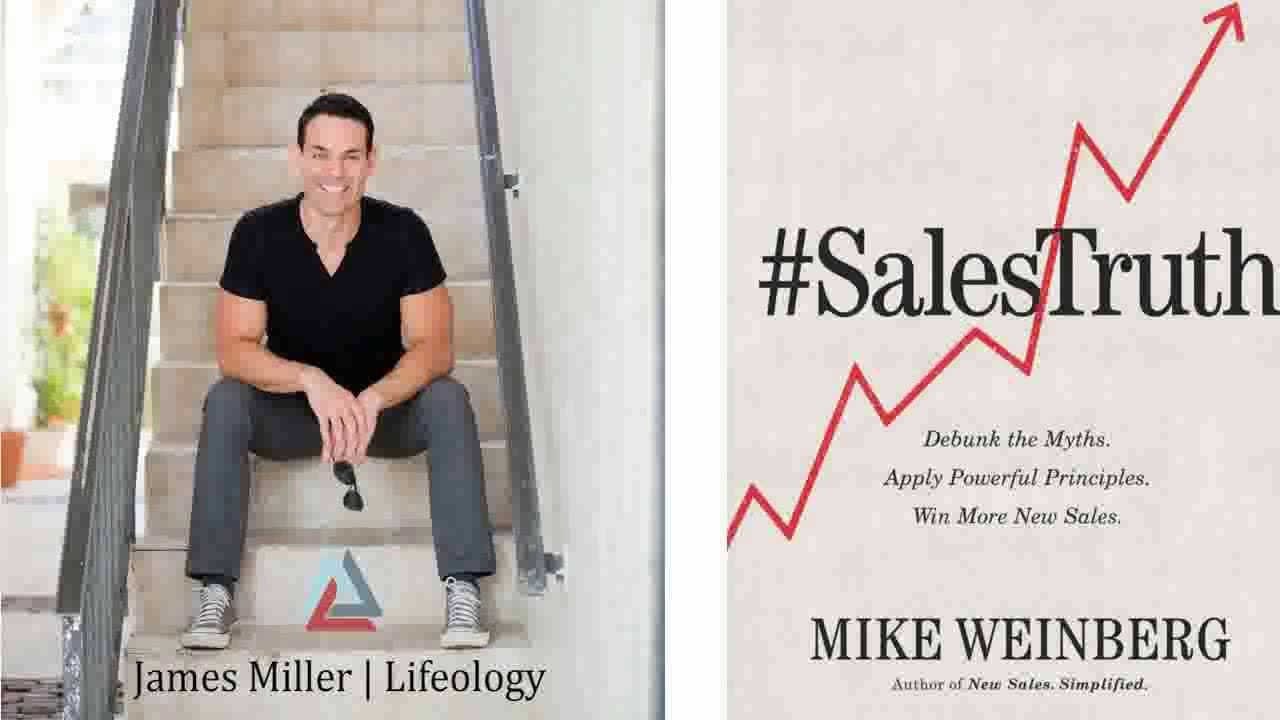
Original source: James Miller | LIFEOLOGY®
This article is an editorial summary and interpretation of that content. The ideas belong to the original authors; the selection and writing are by Streamed.News.
This video from James Miller | LIFEOLOGY® covered a lot of ground. 4 segments stood out as worth your time. Everything below links directly to the timestamp in the original video.
If you've ever felt steamrolled by a salesperson who never bothered to ask what you needed, this conversation names exactly what went wrong — and what the best in the business do differently.
The Best Salespeople Talk Less and Listen First, Sales Consultant Argues
The clearest sign of a skilled salesperson, according to sales consultant Mike Weinberg, is restraint: they enter conversations asking questions rather than delivering pitches. Weinberg illustrates the gap with a personal car-buying experience. At an Audi dealership, a young salesman spent ten minutes reciting a rehearsed script about virtual cockpits and heads-up displays without asking a single question about what Weinberg actually wanted — a quiet interior for long Midwestern road trips with his three college-age kids. Weinberg walked out. By contrast, Tom, a Volvo salesman Weinberg describes as the top car seller in North America with 490 vehicles sold in a single year, drove him to a park and spent five minutes circling the car from every angle so Weinberg could see it the way his own clients would when he picked them up at the airport.
The contrast points to something most people have experienced on both sides of a sales counter: the feeling of being talked at versus genuinely heard. Weinberg argues that amateur salespeople conflate persuasion with volume — more words, more features, more enthusiasm — while professionals treat a sales call as a diagnostic exercise. The expert's goal before any presentation is to map a customer's current situation against where they want to be, a discipline Weinberg calls discovery. Without it, he says, a salesperson cannot credibly claim to be a trusted adviser.
"You can't be trusted if you go in in pitch mode."
Weinberg Uses 2016 Election as Sales Case Study: Clinton's Wisconsin Absence and Trump's Chaotic Convention Hold Business Lessons
Sales consultant Mike Weinberg drew two pointed lessons from the 2016 presidential race for his book 'Sales Truth,' framing both candidates' missteps as cautionary tales any salesperson could recognize. Hillary Clinton became the first major-party nominee after clinching the nomination not to visit Wisconsin — a state Democrats had carried reliably since Ronald Reagan. She lost it by seven-tenths of a percentage point. For Weinberg, the parallel to sales is direct: neglecting your most loyal customers, even briefly, can cost you an account you assumed was secure. The Republican convention, meanwhile, was a showcase of dysfunction — Ted Cruz urging delegates to vote their conscience, Scott Baio as a featured speaker, speakers contradicting the nominee — yet Donald Trump won the election anyway.
That second observation carries the sharper edge for salespeople. Clinton's convention was polished, emotional, and professionally produced; Trump's was, by most accounts, a mess. Yet the outcome flipped the conventional wisdom that winning the room wins the deal. Weinberg's argument is that sales are decided in the preparatory work — understanding the customer, building consensus, and following through after the presentation — not in the quality of the pitch itself. A flawless slide deck cannot substitute for the relationships and groundwork laid long before anyone sits down in a boardroom.
"You don't win in the boardroom by being a silver-tongued devil and presenting perfectly. You win the deal by getting to know the people on the front end and doing discovery."
A Simple Question — 'Are You Ten Happy or Six Happy?' — Can Unlock a Stalled Sales Conversation
When a prospect shuts down a sales conversation with a reflexive 'we're fine, we're covered,' Mike Weinberg deploys a single quiet question: are you ten happy, or more like six happy? The phrasing forces a specific answer rather than a yes-or-no deflection, and Weinberg says the pause that follows it frequently reveals a problem the prospect hadn't planned to mention. If the answer genuinely is ten out of ten, Weinberg takes that at face value, leaves his card, and moves on — his reasoning being that nobody abandons a supplier they are completely satisfied with, so there is nothing to sell. The tactic reflects a broader principle he attributes to sales writer Anthony Iannarino: that selling is something done with someone and for someone, not to someone.
The distinction matters beyond technique. A profession widely associated with pressure and manipulation, Weinberg suggests, largely earned that reputation because so many practitioners skip the step of establishing whether a genuine need exists before attempting to fill it. When salespeople treat discovery as optional, they waste their own time and erode trust across the entire field. The 'ten happy' question is a small mechanism for restoring that discipline — it creates space for an honest conversation rather than a confrontation between a scripted pitch and a rehearsed brush-off.
"Sales is not something you do to somebody. It's something you do with somebody for somebody."
Pitching Before Listening Is Sales Malpractice, Consultant Argues — Psychology Research Backs Him Up
A statistic from clinical psychology gives unexpected weight to the case for listening in sales: when a practitioner hears out a brand-new patient for more than 90 seconds without interrupting, there is an 80 percent chance that patient will remain long-term. The implication, drawn by host James Miller, is that the same mechanism operates in commerce — customers who feel genuinely heard stay. Mike Weinberg extended the medical analogy further, asking listeners to imagine a doctor who spends ten minutes recounting her credentials, pitches a pharmaceutical company's latest drug, and writes a prescription without examining the patient or asking a single question. The absurdity is obvious; Weinberg's point is that salespeople do an equivalent thing routinely, walking into meetings and presenting solutions before they understand the problem.
Weinberg's term for it is sales malpractice — presenting without first doing discovery. The medical framing is deliberately provocative, but it reframes a common professional failure as an ethical one rather than merely a strategic mistake. In medicine, skipping the diagnosis to reach the prescription carries legal consequences. In sales, the penalty is subtler — a lost deal, a client who doesn't return — but the underlying error is identical: treating the solution as the starting point rather than the outcome of understanding.
"It's medical malpractice to write a prescription without doing the diagnosis. In sales, to do a presentation without doing discovery — it's the same thing."
Also mentioned in this video
- The importance of effective communication, differentiating between open-ended… (2:26)
- His initial aversion to sales, how an executive mentor exposed him to the true… (5:54)
- The motivation in sales should be to make the customer as successful as… (8:16)
- James Miller and Mike Weinberg discuss the importance of integrity and trust in… (22:04)
Summarised from James Miller | LIFEOLOGY® · 25:57. All credit belongs to the original creators. Streamed.News summarises publicly available video content.
Streamed.News
This publication is generated automatically from YouTube.
Convert your full video library into a digital newspaper.
Get this for your newsroom →