🌐 Lee esto en Spanish →
Original source: Fundacion Anselmo Lorenzo
This article is an editorial summary and interpretation of that content. The ideas belong to the original authors; the selection and writing are by Streamed.News.
This video from Fundacion Anselmo Lorenzo covered a lot of ground. 6 segments stood out as worth your time. Everything below links directly to the timestamp in the original video.
Is a better life possible by consuming less? An expert challenges the notion that economic growth is always good, proposing a vision of degrowth that could dignify the lives of young people.
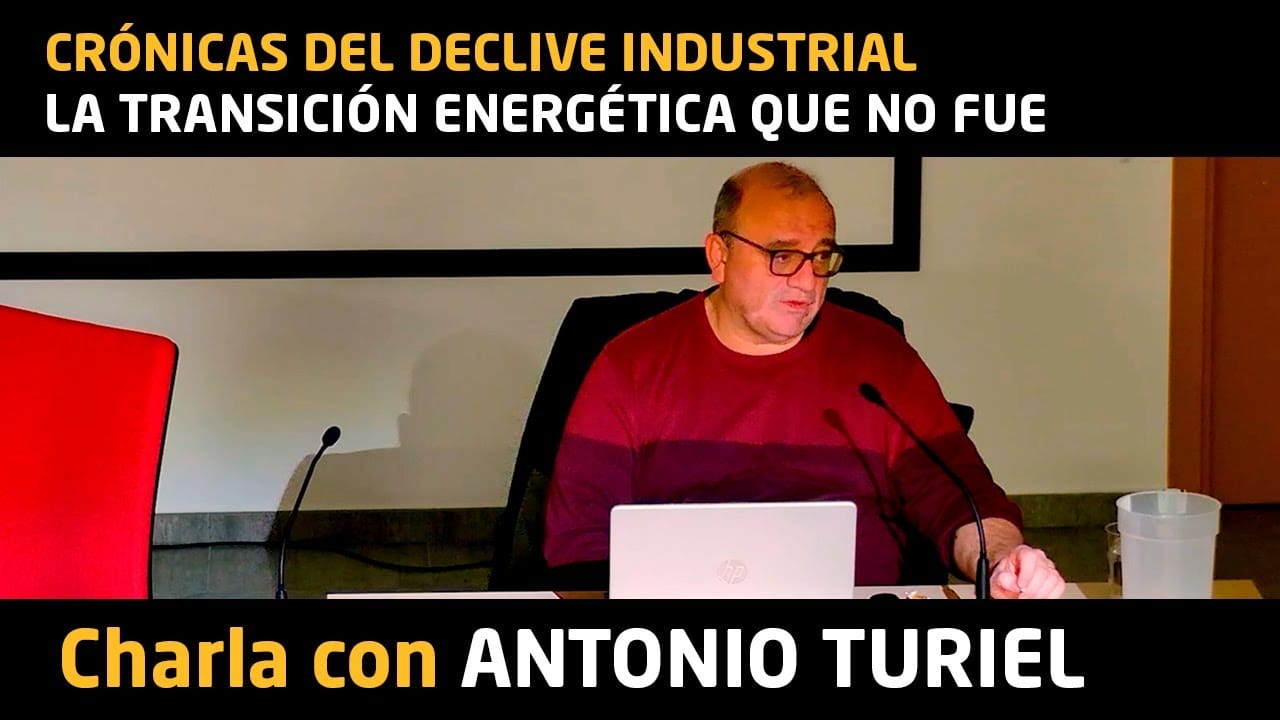
Antonio Turiel: The Industrial Renewable Energy Model Has Failed; Degrowth is the Only Way to Give Young People a Dignified Life
The current industrial renewable electricity model has led to vast environmental and social destruction without providing substantial energy or economic benefits, acting as a 'major speculative bubble,' according to expert Antonio Turiel. Faced with unavoidable energy scarcity and severe environmental problems, Turiel argues that an energy transition is urgent but must involve a decrease in society's metabolic activity, aligning with planetary limits. This restructuring demands a radical reform of the socioeconomic system and a profound change in cultural values. For overdeveloped nations like Spain, the only logical and practical path is degrowth, understood not as impoverishment, but as a democratic strategy to achieve sustainable consumption levels. Turiel emphasizes that the current impoverishment of young people, evidenced by job insecurity and rents like 1300 euros for a 50m² apartment in Barcelona, is what degrowth seeks to reverse, offering a dignified life with work and housing, rather than mere survival.
"The proposal of degrowth is precisely the opposite of impoverishment. Impoverishment is what is currently being offered, especially to young people."
Europe Turns to Biomass 'Plan B' in the South Amid Deindustrialization, Threatening Spanish Forests
Europe is facing a profound process of deindustrialization, evidenced by the sustained decline in German industrial production since 2017, a trend that even predates the pandemic. In desperation over the lack of cheap energy and the failure of the industrial renewable electricity model, a 'Plan B' is emerging that involves the sacrifice of Southern Europe, including Spain, Italy, and Greece. This 'Plan B' focuses on the massive burning of biomass and biogas to convert them into liquid fuels, using processes like Fisher-Tropsch. This scheme, already underway, portends 'great environmental destruction,' with the deforestation of Spanish forests for firewood – a practice expert Antonio Turiel calls a 'fancy way of saying firewood.' The implementation of this strategy is not only polluting and wasteful of water but also threatens water cycle regulation and biodiversity, transforming these regions into 'Europe's rot pit' while their economies become impoverished.
"Plan B, which I knew we would reach someday 15 years ago, and unfortunately, we're now arriving here. And what is Plan B? Plan B is: we're going to burn everything, but in Southern Europe."
Non-Renewable Energy Sources, 84.5% of Global Supply, Enter Inexorable Decline
Non-renewable energy sources — oil, coal, gas, and uranium — which currently account for between 84.5% and 91% of global primary energy, are reaching their production peaks and heading towards an inexorable and terminal decline. Conventional crude oil already peaked in 2005, total oil in 2018, and uranium in 2016, while coal and natural gas are approaching their respective extraction zeniths. This gradual, not sudden, depletion of major energy sources will manifest as a continuous reduction in global availability, comparable to a constant 'salary reduction' for society. Antonio Turiel warns that this scenario, foreseeable for over five decades, will cause increasing energy scarcity and a significant rise in conflict both within countries and internationally, forcing us to transition 'one way or another' to a 100% renewable model.
"The problem with the depletion of non-renewable energy sources is not running out, but falling short."
Deindustrialization Triggers Electricity Bubble in Spain: Installed Capacity Five Times Average Consumption
Electricity consumption in Spain, the European Union, and the OECD has seen a constant decline since 2008, primarily due to a process of deindustrialization reducing industrial demand. This trend has created a paradox in Spain, where installed electrical capacity, which reached 132 GW last December, is five times higher than the national average consumption, standing at 26.5 GW. This 'bubble' of overcapacity means that despite high investments in renewable energy, there are many hours with excess production that cannot be consumed, leading to up to 71% curtailment at certain times. To maintain grid stability amidst the intermittency of renewables, Spain is forced to burn gas, which not only accounts for 10% of total generation but also significantly raises electricity bills for consumers, despite abundant green generation.
"The average consumption in Spain right now is five times less, it's 26.5 GW, with consumption peaks in some moments of summer and winter reaching up to 41 GW, which is still only one-third of all installed capacity."
The Industrial Renewable Energy 'Bubble' Bursts Globally with Capital Flight and Project Cancellations
The industrial renewable electricity bubble is 'bursting' globally, with major capital withdrawing from the sector and numerous projects being canceled. Expert Antonio Turiel points out that large investments have already proven unprofitable, leading companies like ENGIE to close their global solar initiatives and others to abandon offshore wind projects due to their high costs and low profitability. This massive divestment occurs while, in an 'insulting' manner according to Turiel, the Community of Madrid protects 96% of its territory from solar projects, citing the defense of traditional crops—a stance reflecting economic short-sightedness and a failure to acknowledge the model's breakdown. The sector's future seems to be oriented towards capacity services for grid stabilization and artificial intelligence, though these paths promise much less business and only add costs to try and maintain an increasingly fragile system.
"The numbers don't add up. We've been saying it for years, the numbers don't add up. And now these people seem to have just found out."
Offshore Wind Farms Yield 20% Less Than Expected and Energy Transition Collides with Critical Material Scarcity
Offshore wind farms in the North Sea are producing 20% less electricity than anticipated, a deficit attributed to turbulent wakes left by wind turbines, which extend up to 200 kilometers and interfere with neighboring mills. This phenomenon, warned about by scientists from the University of Valladolid in 2011, demonstrates unforeseen physical limitations in large-scale wind energy extraction. Furthermore, the ambitious global energy transition faces a critical scarcity of essential materials. Professor Alicia Valero of the University of Zaragoza has identified at least 14 elements, including silver, tellurium, gallium, indium, lithium, manganese, nickel, cobalt, and copper, whose global reserves would not be sufficient if all countries attempted a simultaneous transition. Antonio Turiel notes that some of these materials, such as copper and silver —indispensable for photovoltaic panels and electrical wiring— are already reaching their extraction peaks, causing price increases and thefts, signaling an insurmountable material barrier for the current model of massive electrification.
"Without copper, there's no paradise, no electrical paradise."
Also mentioned in this video
- Antonio Turiel explica que el modelo de transición energética actual es… (2:08)
- Las inversiones de las compañías petroleras en exploración y explotación… (4:11)
- La producción de los "todos los líquidos del petróleo" incluye gases y otros… (10:39)
- La extracción de uranio alcanzó su máximo en 2016 y se prevé que caiga a la… (14:59)
- La producción mundial de diésel ha disminuido un 15% desde su máximo entre 2015… (17:08)
- La transición a un modelo 100% renovable es ineludible, pero el modelo actual… (23:44)
- La industria de la energía renovable eléctrica industrial depende fuertemente… (28:57)
- El modelo de energía renovable eléctrica industrial se centra en la producción… (33:02)
- Nigeria, uno de los principales proveedores de petróleo de España, enfrenta la… (52:50)
- Es posible otro modelo de transición energética basado en tecnologías probadas… (53:50)
- Las propuestas de reindustrialización incluyen el aprovechamiento de materiales… (57:23)
Summarised from Fundacion Anselmo Lorenzo · 1:03:54. All credit belongs to the original creators. Streamed.News summarises publicly available video content.
Streamed.News
This publication is generated automatically from YouTube.
Convert your full video library into a digital newspaper.
Get this for your newsroom →