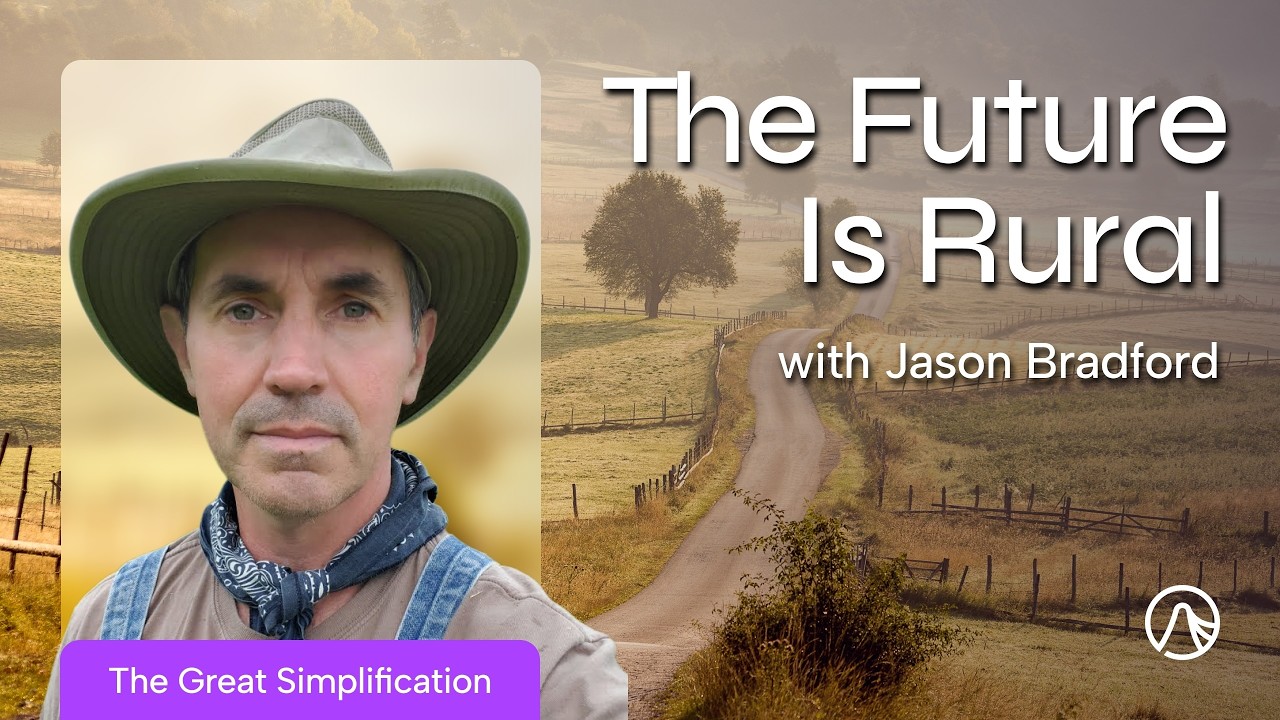
Original source: Nate Hagens
This video from Nate Hagens covered a lot of ground. 21 segments stood out as worth your time. Everything below links directly to the timestamp in the original video.
In an era increasingly dominated by digital and abstract knowledge, consider how direct, sensory engagement with the physical world might offer a more profound and resilient understanding of our place within ecological systems.
Ecological Farming Cultivates Embodied Wisdom, Contrasting with Disembodied AI
Jason Bradford contends that transitioning from an academic, head-centric existence to hands-on farming profoundly reshaped his worldview, imbuing him with embodied knowledge that theoretical frameworks or artificial intelligence can never replicate. This sensory interaction with the environment, from feeling the earth to smelling the rain and identifying bird calls, contrasts sharply with analytical, spreadsheet-driven intellectualism, which he views as fundamentally incomplete without a physical connection to the world.
This shift highlights a critical tension as industrial society faces a "great simplification," which Bradford believes will necessitate a forced reconnection between humans and their local ecologies. He suggests that without direct engagement in practices like farming, individuals remain trapped in abstract thought, unable to conceive of or navigate a truly different, more localized future. This calls for a re-emphasis on practical, sensory engagement over purely cognitive understanding as biophysical constraints tighten.
"We're an animal that has senses that moves through the world and feels the pressure of air and and the ground on our feet and and what it what it smells like after it rains and what the different soundscapes are depending upon what season it is and which bird species are coming through."
▶ Watch this segment — 1:03:14
Philanthropists Could Fund Community Farms as 501(c)(7) Nonprofits, Creating Local Food Security
Jason Bradford and Nate Hagens propose that philanthropists could establish community-owned farms, structured as 501(c)(7) non-profit social clubs, to foster food security and social capital. Members would pay dues, similar to country clubs, to access land and receive professional guidance in farming. This model, likened to historical social clubs that provided essential services before extensive government welfare, would equip individuals with critical agricultural skills and local food production capabilities.
This initiative stands in stark contrast to prevailing large-scale investments in artificial intelligence, offering a significantly cheaper and more biophysically beneficial alternative. The proposal highlights a tangible, community-centric pathway to resilience that builds practical knowledge and local networks, addressing fundamental human needs for food and belonging rather than accelerating abstract technological development.
"Imagine you have a 501c7 owned farm. Members pay dues like they pay dues to a country club right now to play golf… instead of golfing, you have professional staff who are paid well as professionals to help people become farmers and grow their food."
Embracing 'Peasant Culture' Offers Path to Food Sovereignty, Resisting Centralized Power
Jason Bradford suggests that a re-embraced "peasant culture" could offer a vital path toward personal and communal resilience in a radically changing world. He posits that reconnecting with ancestral, indigenous ways of life—characterized by local food sovereignty and deep ecological understanding—represents an active choice to resist the centralizing and extractive power structures that historically precipitated ecological and social collapses. Such a shift moves beyond superficial appreciation for indigenous wisdom to an embodied, practical engagement with the land and community.
Historically, the rise of centralized urban states, like ancient Rome, led to immense violence against land and rural populations, extracting resources to sustain their complexity. Bradford argues that individuals who choose to cultivate skills and embrace a localized, decentralized way of living are not merely seeking a simpler life, but actively building resilience against the systemic fragilities inherent in modern, globalized systems. This direct agency, starting with food sovereignty, offers a tangible counter-narrative to the prevailing forces of technological advancement and centralized control.
"If you don't want to be one of these powerful people and good luck, you know, being one of the oligarchs or whatever, get these skills and embrace this other way of living that actually, you know, most people kind of liked it."
Farming Offers Antidote to Social Media and AI-Induced Isolation, Especially for Young Men
Jason Bradford voiced significant concern over the rising rates of social media and AI addiction, particularly noting their isolating effects on young men. He advocates for the creation of opportunities that enable individuals to engage in meaningful, purposeful activities such as farming. Such endeavors, he argues, can cultivate vital skills, build robust community connections, and provide a valued role within a specific place, addressing fundamental human needs for belonging and contribution.
This approach stands as a direct counter to the prevalent societal belief that technological solutions will resolve complex human and ecological challenges. Bradford criticizes the media's focus on green energy transitions, green chemistry, and AI as panaceas, arguing that these narratives distract from the urgent need to rebuild local, embodied capacities and social fabric. The gap between what society believes about technological fixes and the practical realities of human well-being remains vast, underscoring the necessity of re-engaging with material reality and community.
"Can we get young men especially? I mean women of course but out doing stuff that's healthy. Give them skills that are about providing for God's sakes. Providing."
▶ Watch this segment — 1:12:04
Skilled Human Labor and Organic Methods Lead to Food Abundance, Not Starvation on Small Farms
Jason Bradford asserts that small-scale farms employing skilled human labor and organic methods can achieve food abundance, effectively countering the notion that such practices would lead to widespread starvation. He clarifies that while certain crops, specifically those bred for high synthetic nitrogen uptake, may experience some yield reduction without these inputs, diversified agroecological systems integrating livestock, nutrient cycling, and locally adapted crops are inherently productive. This stands in stark contrast to conventional farming’s destructive overproduction, much of which does not directly feed humans but instead fuels industrial processes or feedlots.
The core problem, Bradford argues, is the ecologically destructive overproduction of industrial agriculture, which often necessitates the creation of entire industries to manage its waste products, like ethanol. Rather than focusing on maximizing a narrow definition of yield or profit, agroecological systems prioritize diverse food production, ecosystem health, and community building. This reorientation towards systemic well-being suggests a pathway to food security that is biophysically sound and socially enriching, provided sufficient skilled labor and societal coherence can be maintained.
"Overproduction of horrific ecologically destructive farming is the real problem not small farmers figuring out how to grow food ecologically. We will not starve if we have enough skilled small farmers."
Farming Clubs Emerge as Prototypes for De-industrializing Future, Offering Gradual Path to Resilience
Jason Bradford envisions his farming club as a crucial early prototype for reconnecting individuals with the land and imparting vital skills necessary for a de-industrializing future. He hopes these clubs can scale, evolving into "safe havens" and models of coherence amid expected periods of chaos. This practical model aims to provide a less daunting, gradual pathway for individuals to cultivate food sovereignty and build community without abruptly abandoning their existing modern lives.
The farming club concept offers a "staircase" of practical steps, allowing middle-aged individuals with mortgages and families, for whom a radical shift to farming might be impossible, to gradually gain skills and resilience. This approach contrasts with the prevailing societal belief in technological solutions, emphasizing the importance of building social capital and hands-on knowledge. Such initiatives are seen as essential for navigating a future where financial capacity to meet basic needs becomes increasingly constrained, fostering local stability and adaptability.
"This is this gracious path now I have where I can I'm gonna keep my job in this crazy modern world because I I don't have a I to get away from this would be like jumping off a cliff. But what I'm what I'm having is I'm seeing a staircase now."
▶ Watch this segment — 1:14:27
Technology Distractions Hinder Local Farming Initiatives, Despite Holistic Benefits
Nate Hagens and Jason Bradford discuss the significant cultural barrier posed by technological distractions, including AI, which divert individuals from engaging in vital local farming clubs. Despite the clear holistic and financial benefits—even for low-wage workers who could improve their economic and personal well-being by growing their own food—societal narratives promoting technology and space colonization impede widespread participation in these ground-level initiatives.
Bradford stresses the urgent necessity of establishing and scaling these local models and networks of coherence before potential societal disruptions make such efforts even more challenging. The current cultural focus on abstract technological solutions, rather than tangible, local food production, creates a critical lag in building essential resilience. This dynamic underscores the chasm between short-term societal priorities and long-term biophysical necessities.
"The challenge of course is our cultural narrative of technology and colonizing other planets and it's energy and systems blind. So most people are not yet getting the signal, the memo that things are going to change except maybe AI."
▶ Watch this segment — 1:01:22
Ecologically Managed Farms Offer Awe and Humility, Countering Industrial Agriculture's Wastelands
Jason Bradford observes that visitors to his ecologically managed farm frequently experience profound awe and wonder, realizing the stark contrast between vibrant, biodiverse agricultural landscapes and the industrial wastelands characteristic of conventional farming. This direct engagement highlights the critical importance of reconnecting with the beauty and complexity of working land, fostering a sense of humility and appreciation in what he describes as an "absurd, unsustainable world."
The experience reveals a widespread disconnect in modern society, where many only interact with food through commercial outlets, oblivious to its origins or the ecological conditions of its production. Bradford emphasizes that farms do not have to be industrial monocultures; they can be rich ecosystems supporting abundant life, from insects to diverse bird species. Re-embodying a relationship with the land cultivates a necessary humility, offering a vital counterbalance to the human superorganism's overextension and its detached, intellectualized approach to the natural world.
"What also I want people to see is that farms don't have to be that way. Farms can be places. It's a weird kind of beauty in a sense that, you know, we're sort of engineering it, right? But it's still there."
▶ Watch this segment — 1:05:55
Industrial Farming Machines Drive Ecological Degradation and Rural Community Erosion
Jason Bradford explains that large-scale commercial farming, inherently driven by heavy machinery and a production-system mindset, leads to extensive ecological degradation. This industrial approach demands landscape simplification, such as leveling topography and removing natural borders like hedgerows and fences, to maximize the efficiency of large equipment. This homogenization and reliance on chemical inputs, rather than practices like cover cropping, dictate a mode of operation fundamentally out of sync with ecological realities.
The economic valuation within this system further exacerbates the problem, as ecological degradation carries zero cost in the optimization models of commercial agriculture. Beyond the environmental impact, this mechanization minimizes the need for human labor, leading to the erosion of vibrant rural communities. Bradford recounts how areas once rich with extended families and localized self-sufficiency have become depopulated, losing the social fabric and cultural knowledge that once characterized rural life, highlighting a systemic tradeoff where economic efficiency sacrifices both ecology and community.
"You just get this ecological degradation because the machines are dictating a way of being that is not in sync with any kind of ecological reality."
Cultural Reluctance, Not Land, Bottlenecks Local Food Production Expansion
Jason Bradford argues that the primary bottleneck to expanding local food production is not the availability of land, but rather a deep-seated cultural reluctance. This hesitation stems from a pervasive belief that industrial machinery is inherently more efficient for food production, overlooking the substantial hidden costs embedded in the industrial food system. These costs include extensive processing, long-distance transportation, and elaborate packaging, which collectively account for 92 cents of every dollar spent on food, with only 8 cents going to the raw ingredients.
This industrial structure generates manufactured food products that offer diminished nutritional value compared to fresh, locally grown alternatives. By bypassing this costly and less healthy system, individuals can significantly reduce their food expenditure and improve their well-being. The challenge lies in shifting the cultural mindset to recognize that human-scale, local food production, despite requiring direct labor, is ultimately more efficient in terms of net energy, health outcomes, and true cost when all externalities are considered.
"Everyone thinks the machines have done everything so efficiently that there's no way we could do this ourselves. When if you go to like peasant cultures and you study how much like time studies, they're pretty busy."
Accelerating Pace of Change Prompts Call for Systemic Collapse to Scale Resilient Models
Jason Bradford expresses profound shock at the accelerating pace of social, political, and environmental changes, perceiving society as undergoing a rapid phase shift driven by overwhelming technological developments, particularly artificial intelligence. He laments the pervasive addiction to these technologies and the immense investments in infrastructure like data centers, which further entrench the human superorganism into unsustainable trajectories. This confluence of crises, from climate disruption to geopolitical instability, creates a sense of simultaneous tipping points across multiple systems.
Bradford voices a dual hope and frustration: while he wishes for his community-based, resilient models, such as farming clubs, to scale rapidly, he also expresses a desire for a quicker collapse of the current system. This desire stems from the belief that such a collapse might be the only way to enable a swift reorientation towards localized, coherent models, as the existing system appears too entrenched to voluntarily transform. He urges immediate, tangible action from individuals to build local resilience before it is too late.
"My hope is that it all actually kind of falls apart sooner than later. Like there's this duality of like I would like the farming clubs to scale across the nation and we're going to have a million of these chapters and we'll have trained 100 million people to be small farmers."
▶ Watch this segment — 1:19:57
Ecological Farming Practices Enhance Biodiversity, Attracting Numerous Bird Species
Jason Bradford's farm demonstrates that ecological management practices, including the complete absence of pesticides, increased organic matter in soils, and strategic tree planting, significantly enhance biodiversity. These methods foster a thriving ecosystem of insects and other forms of invisible life within the soil and vegetation, which in turn supports a remarkably rich bird population. His farm has recorded 121 bird species this year alone, placing it among the top in Oregon for avian diversity.
This high level of biodiversity directly contrasts with conventionally managed agricultural fields nearby, which lack such ecological interventions. The abundance of insects, unhindered by chemical applications, provides a crucial food source for birds, particularly after rain events. Bradford actively seeks scientific collaboration to formally study this correlation, reinforcing the observable benefits of agroecological approaches for restoring and sustaining ecosystem function, thereby proving that productive farming can coexist with, and indeed enhance, natural complexity.
"The difference between farms that are managed like I'm managing this or we're managing it as a as sort of a a team here, right? And the next door field that isn't managed like this is absolutely tremendous."
Economic Model Skews Against Ecological Farmers, Favoring Industrial Scale and Capital
Nate Hagens suggests that small-scale, ecologically minded farmers face inherent economic challenges because they operate within a market driven by incorrect long-term prices. This prevailing economic model incentivizes the substitution of human labor with capital equipment, favoring large-scale industrial farming that can deploy extensive machinery. Such a system prioritizes labor efficiency, making it difficult for small farms to compete in terms of dollars and profits, particularly when energy costs for machinery are low.
The entire market infrastructure, from commodity prices to processing and distribution, is structured to support these large-scale operations, which convert raw agricultural products into manufactured foods for mass consumption. Consequently, while small-scale ecological farming may not be highly viable when measured by conventional financial metrics, its value may lie in other areas, such as food quality, environmental health, and community resilience. This broader definition of return on investment, encompassing social and ecological capital, is rarely acknowledged within the dominant economic framework.
"Small farming is not economically a highly viable thing when denominated in dollars and profits, it's not, but maybe in other areas it is."
100-Acre Farm Demonstrates Multifaceted Ecological Restoration and Production
Jason Bradford describes how his 100-acre farm, situated in the Wamid Valley with a mile of riverfront, serves as a dynamic hub for diverse ecological and agricultural projects. The property supports dry farming, permaculture design, and various small farm businesses, made possible by strategically allocating different areas for specific functions. This includes extensive riparian zone restoration, planting hedgerows to delineate boundaries and provide habitat, and removing invasive species to re-establish native flora.
The farm also features silvopasture and shelterbelts, which are crucial for enhancing ecological diversity and function. Shelterbelts, rows of trees and shrubs, mitigate the impact of high winds, protecting crops and animals, a vital consideration on farms where natural vegetation has been removed by industrial practices. This integrated approach demonstrates how a substantial piece of land can simultaneously support food production, habitat restoration, and the re-establishment of vital ecosystem services, illustrating a pathway to agroecological resilience.
"I'm planting shelter belts. I'm planting what's called the silvo pasture."
Farming Clubs Offer Healthier Food and Cost Savings, Requiring Just 90 Hours Annually
Jason Bradford outlines a scalable model for farming clubs where members contribute approximately 90 hours per year to meet most of their produce needs. This time commitment, he argues, is significantly less than the 400 hours the average U.S. household spends earning money to purchase processed food annually. By participating, members bypass the costly industrial food system, which allocates only 8 cents of every food dollar to raw ingredients, with the remaining 92 cents covering processing, transportation, and packaging.
This model not only offers substantial financial savings but also provides access to much healthier, unprocessed food. Beyond the economic and nutritional benefits, engagement in farming clubs fosters physical activity, social relationships, and a direct connection to the food source, enhancing overall well-being. Bradford emphasizes that this system could particularly benefit underemployed individuals, providing them with a direct means of food security and community engagement, challenging the cultural perception that individual food production is inefficient or impractical.
"It's about 90 hours a year, we say. And what are they going to get? Really? Yeah. And what are they going to get out of it? They're going to get out almost all their produce needs and a few other things."
Industrial Agriculture Erases Rural Community Vibrancy, Micro-Farms Seek to Revitalize Connection
Jason Bradford reflects on the stark decline of vibrant rural communities within his lifetime, contrasting the close-knit, self-sufficient neighborhoods of the past—where extended families lived and worked together, sharing resources and building forts—with today's depopulated and less engaging rural areas. The historical shift towards large-scale, industrialized agriculture, which requires minimal human labor, has systematically eroded the social fabric and intergenerational connections that once characterized these regions.
His micro-scale farming initiatives aim to revitalize this lost sense of community and connection. By opening his farm to neighbors and encouraging collective engagement, Bradford seeks to re-establish human-scale relationships with both the land and each other. The ultimate goal extends beyond merely growing food to fostering a renewed sense of belonging and shared purpose, countering the social isolation and ecological disconnection wrought by the industrial food system.
"These rural areas are not as interesting and fun and vivacious as they used to be. And sort of part of what I'm trying to do right at this micro scale is bring people out, bring a lot of small farmers out here."
Commercial Farms Resist Ecological Practices Due to Short-Term Financial Metrics
Jason Bradford explains that commercial farming operations are slow to adopt ecological practices due to the difficulty in demonstrating a clear return on investment (ROI) for chief financial officers (CFOs). Despite efforts by government and private organizations to incentivize sustainable practices through grants and programs, the short-term time horizons and discount rates prevalent in corporate finance do not align with the long-term, systemic benefits of ecological farming. These benefits, such as enhanced soil health or increased biodiversity, often accrue over decades rather than quarters.
While some studies may show localized ecological advantages, such as reduced pest intensity near natural shrub plantings, these findings struggle to translate into the immediate financial language required by corporate decision-makers. The inherent conflict between maximizing short-term profits and investing in long-term ecological relationships creates a systemic barrier to widespread adoption of more sustainable agricultural methods, perpetuating practices that prioritize immediate economic gain over ecological resilience.
"It's very hard to get to to speak their language. And it may be that it's impossible because their time horizon isn't appropriate for the relationships you're trying to build over 5, 10, 20 years, discount rate, blah blah blah."
Loss of Traditional Ecological Knowledge Heightens Need for Practical Farming Skills
Nate Hagens and Jason Bradford discuss practical farming techniques like coppicing hazelnut and ash trees, highlighting how such traditional ecological knowledge is increasingly lost due to prevalent technological distractions such as social media and artificial intelligence. Coppicing, a method where trees are cut to the ground to promote new growth from the stump, is a centuries-old practice that ensures a renewable source of wood and maintains tree health, with some coppiced trees living for a thousand years.
This loss of practical wisdom, from understanding the timing of coppicing to recognizing its benefits for managing tree species like ash against pests such as the emerald ash borer, underscores a growing cultural vulnerability. As society becomes more reliant on digital interfaces, the intimate, hands-on understanding of natural processes diminishes. The conversation implicitly argues that without actively preserving and transmitting these foundational skills, communities risk losing essential capacities for resource management and adaptation in a biophysically constrained future.
"It's one of the dominant trees in my forest and I'm just terrified and I know they're all probably going to die. But I have a plan I'm going to try where the ashbor likes to have diameter of a certain amount because it needs enough cambian in there."
▶ Watch this segment — 1:07:55
Ecologically Destructive Overproduction, Not Small Farmers, Poses Food System Crisis
The true problem within the global food system is the ecologically destructive overproduction of conventional farming, not the efforts of small farmers to grow food ecologically. Jason Bradford asserts that most produce from conventional farms does not directly feed people; instead, it often becomes a waste product or is channeled into industries like ethanol production or livestock feed. In contrast, diverse agroecological systems, when managed skillfully with human labor and organic methods, can lead to genuine food abundance.
These resilient systems integrate practices such as nutrient cycling and livestock, alongside a diversity of crops adapted to local conditions, ensuring both ecological health and food security. Therefore, the narrative that small-scale, ecological farming will lead to starvation is fundamentally misplaced. The real challenge lies in reorienting agricultural practices away from industrial overproduction towards models that prioritize ecological integrity and direct human sustenance.
"Overproduction of horrific ecologically destructive farming is the real problem not small farmers figuring out how to grow food ecologically."
Farming Club Model Cultivates Skills, Community, and Ecological Restoration
Jason Bradford describes his farming club as an innovative association where members collectively cultivate his land, evolving from his personal journey to restore soil and provide opportunities for community engagement. Recognizing the challenges faced by small farmers—including physical injuries and financial strain—Bradford created a system that allows people to acquire farming skills and grow food without the typical harsh tolls. His own shoulder injury highlighted the impossibility of solo farming, leading him to invite friends to help, which subsequently revealed the potential for a broader community model.
This club provides professional training in farming techniques, enabling individuals to become skilled in food production while receiving fresh, healthy food in return. The model prioritizes building community and offering a viable pathway into agriculture, sidestepping the economic and physical barriers that prevent many from pursuing small-scale ecological farming. It represents a practical, localized response to the anticipated "great simplification," aiming to rebuild essential capacities and social connections.
"The problem is if you want to become a far small farmer, you're likely going to ruin your body, ruin your finances, ruin a relationship."
K-Shaped Economy Creates Dual Pressures for Industrial and Ecological Farming
Nate Hagens and Jason Bradford observe that the K-shaped economy, characterized by prosperity at the top 20% and stagnation or decline for the majority, is creating two conflicting dynamics within agriculture. On one hand, economic hardship will likely push some landowners to intensify industrial farming practices, maximizing profit from their land through larger machinery and simplified systems. This perpetuates the current model of extracting maximum output with minimal labor input, ignoring ecological externalities.
Conversely, a growing segment of the population, facing unemployment or food insecurity, possesses the time and desire to learn small-scale, ecological farming. These individuals are motivated by food security and community building, seeking a wider definition of capital that includes social relationships and ecological health, not just financial returns. This dual pressure creates a societal tension, with powerful incentives pulling agriculture in diametrically opposite directions: towards further industrialization for profit and towards localized, regenerative systems for resilience and human well-being.
"So, both that's going to be pulling our society in two different directions. Do you have any thoughts on that?"
Summarised from Nate Hagens · 1:23:20. All credit belongs to the original creators. Nate Haggens summarises publicly available video content.