Original source: Nate Hagens
This video from Nate Hagens covered a lot of ground. 7 segments stood out as worth your time. Everything below links directly to the timestamp in the original video.
Understanding how individual choices can collectively alter planetary trajectories offers a powerful, actionable framework for engaging with seemingly overwhelming global challenges.
Reclaiming Individual Agency Essential for Addressing 'Meta-Crisis'
Nate Hagens posits that re-establishing individual agency is a fundamental prerequisite for navigating the complex 'meta-crisis' facing humanity. While not a singular solution, increased personal agency is presented as a catalyst that can shift the probabilities for future outcomes, fostering new collaborations, enabling more effective policy, and scaling local initiatives. This reassertion of individual capacity is crucial for influencing humanity's default trajectory away from less desirable futures.
From a systems perspective, small shifts in initial conditions can lead to profoundly different future states. Hagens suggests that reclaiming agency acts as such a critical initial condition, potentially nudging humanity towards outcomes that preserve more biodiversity and mitigate the harshest impacts of current global challenges. This re-engagement with personal efficacy is argued to precede larger institutional and infrastructural changes, offering a pathway to collective traction.
"Agency changes whether new collaborations can form, that better policies can be enacted, and many other possibilities."
First Step to Agency: Dedicate One Hour to Personal Re-Engagement
Nate Hagens proposes a practical first step for individuals seeking to reclaim agency: dedicating one hour within the next three days to an activity that reinforces personal control. Examples include strengthening the body, stabilizing the nervous system, nurturing relationships, or making 'ninja moves' — small, anticipatory actions that increase self-reliance and reduce systemic susceptibility. This deliberate choice aims to help individuals relearn a sense of traction often lost to modern systemic pressures.
This simple, concrete action serves as a micro-intervention against the 'human superorganism's' tendency to diminish individual volition. By intentionally carving out time for self-directed activity, individuals can begin to rebuild the internal feedback loops necessary for sustained agency. This process of re-engagement is not about achieving grand solutions instantly, but about fostering the internal conditions that enable more purposeful navigation within a complex, energy-intensive world.
"Pick one hour in the next three days… and during that hour do something that increases your agency."
Calendar Reveals True Priorities in Rebuilding Agency
Nate Hagens suggests that rebuilding personal agency requires establishing a 'small protected loop' between intention and outcome in a world increasingly characterized by biophysical and macro-scale unpredictability. This involves making and keeping small, consistent promises to oneself, which gradually rebuilds trust in one's own capacity for action. He argues that an individual's calendar serves as a concrete, biophysical document reflecting actual priorities and energy investment, offering a more accurate measure of agency than abstract opinions or worldviews.
In an environment where effort often feels unreliable, especially within digital spaces, creating these small, successful loops helps recondition the system to recognize the efficacy of personal action. This re-patterning is crucial for moving beyond intellectual understanding of global issues towards active engagement, fostering the willingness to tolerate discomfort and strategically invest time and energy where it truly matters, rather than merely consuming information about crises.
"If you want to measure your agency, don't look at your opinions and worldview. Instead, just look at your calendar from last week."
Civilizational 'Learned Helplessness' Inhibits Collective Response
Nate Hagens describes 'learned helplessness' as a societal phenomenon, where persistent uncontrollability in the environment leads to widespread freeze and withdrawal, preventing necessary human capacities like sustained attention, cooperation, and choice from mobilizing. This contrasts with 'mastery experiences,' which are small, measurable successes that build self-efficacy and a belief in one's ability to influence outcomes. In a complex, energy-intensive world, the cumulative effect of a lack of perceivable control can render a populace behaviorally immobilized.
The human superorganism, continually evaluating the controllability of its environment, enters a state of conservation when actions consistently yield no discernible change. This behavioral immobilization, while rational under conditions of true uncontrollability, becomes a critical hurdle for any serious response to systemic crises. Cultivating 'mastery experiences,' or 'tiny habits' that guarantee success, offers a pathway to re-establish the feedback loop between effort and outcome, fostering a willingness to engage more deeply.
"The long-term term for this is learned helplessness, and we are now running an experiment in it at a civilizational scale."
Interrupting Digital Patterns Reclaims Personal Choice
Nate Hagens shares personal strategies for consciously interrupting patterns of rationalization and delay that often precede engagement with digital screens, which he sees as defining modern existence. His methods include choosing alternative behaviors, such as stepping away from an article, observing nature, engaging in quiet reflection, writing poetry, or having genuine conversations via phone calls. The specific alternative activity is less important than the act of reclaiming the felt experience of personal choice itself.
This deliberate practice of inserting 'voluntary speed bumps' into daily routines strengthens the 'agency muscle,' preventing its atrophy. By consistently choosing behaviors that are not dictated by external stimuli or ingrained habits, individuals can train their neural pathways to reinforce proactive decision-making. This incremental re-establishment of personal choice creates the foundation for engaging with larger, more complex challenges, demonstrating that even small acts of intentional redirection can lead to greater systemic possibilities.
"What matters is reclaiming the felt experience of personal choice, and letting your system learn and repeat the behavior."
Modern Culture Fosters 'Ritualized Agency' Leading to Paralysis
Nate Hagens observes that modern culture, particularly in Western societies, ritualizes agency through formal participation mechanisms like voting or social media engagement. This creates a significant disparity between formal participation and lived, felt agency. As awareness of complex global problems accelerates through the information age, it often outpaces the collective capacity to intervene, leading to a profound sense of paralysis, cynicism, and what he terms 'moral injury.'
This gap leaves individuals feeling small and powerless within an immense system, contributing to feelings of resignation, shame, and a tendency to withdraw or merely signal purity. Such immobilization makes people easier to steer, as they become disengaged from the active pursuit of change. Hagens contends that what are culturally perceived as 'freedoms' increasingly resemble 'prison gates,' trapping individuals in a cycle where comfort and convenience mask a fundamental loss of control over one's life, attention, and time.
"The gap that I think is central here is that formal participation and lived agency have diverged."
Agency Defined as Lived Control Over Life, Attention, and Time
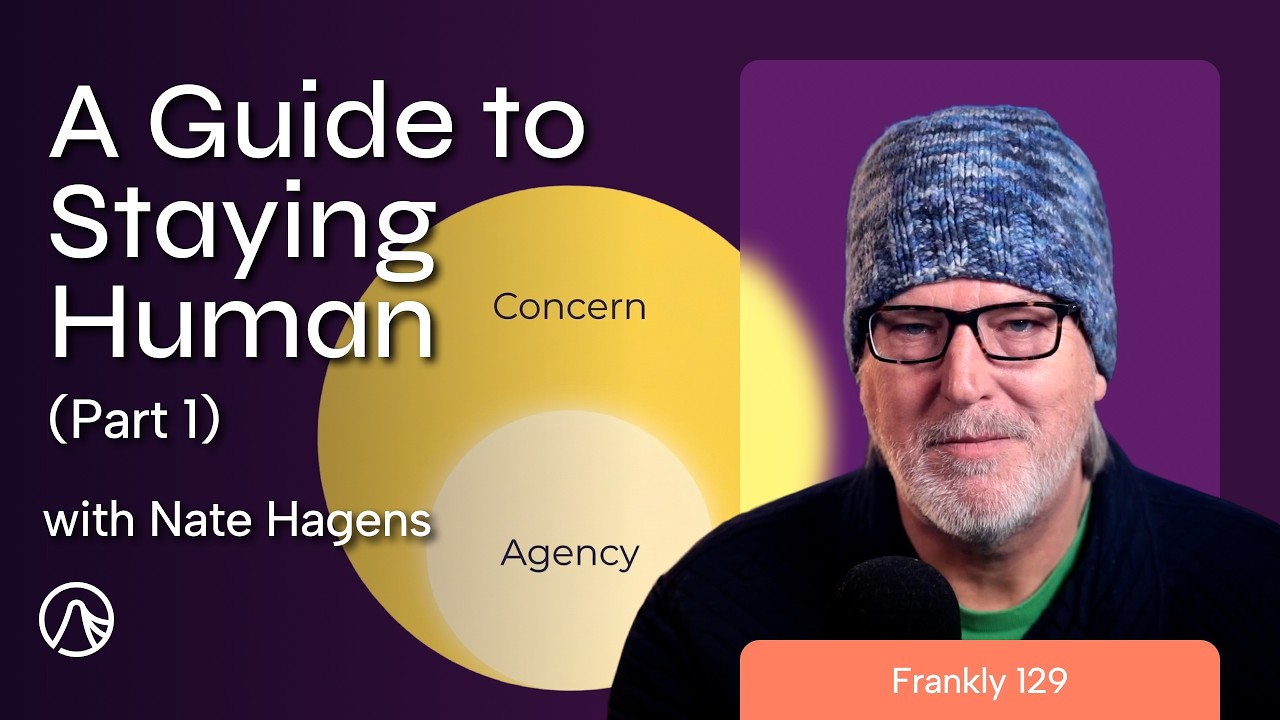
Nate Hagens defines 'agency' as the tangible, lived experience of having control over one's own life, attention, and time, emphasizing the capacity to choose one's next action. He posits that this practical form of agency is increasingly crucial in an era where many people feel a profound lack of meaning, community, or authenticity, often experiencing exhaustion, disorientation, and an inability to focus. Despite the overwhelming volume of information about global challenges, the core issue for many is the loss of this fundamental sense of control.
This loss of agency is presented as a foundational problem, preceding many of the environmental, social, and economic crises humanity faces. The ability of individual humans to direct their lives and attention, even amidst a system that increasingly pulls them in disparate directions, is identified as a critical test for navigating the future. Reclaiming this personal sense of control is framed not merely as a psychological benefit, but as a necessary precondition for engaging meaningfully with the magnitude of current global challenges and steering towards more desirable collective futures.
"When I say agency, I mean the lived experience that your life is yours, your attention is yours, your time is yours, you can choose what you do next."
Summarised from Nate Hagens · 26:58. All credit belongs to the original creators. Nate Haggens summarises publicly available video content.