Original source: Nate Hagens
This video from Nate Hagens covered a lot of ground. 4 segments stood out as worth your time. Everything below links directly to the timestamp in the original video.
If the system cannot be steered from the top, the question becomes who is quietly building the alternative from the bottom — and whether they can find each other in time.
Hagens Abandons Policy-First Thinking, Bets on 'Islands of Coherence' as Path Through Overshoot
After years of assuming that voting, technology deployment, and governance reform could redirect industrial civilisation's trajectory, Hagens now regards the system as too structurally committed to its current path for top-down intervention to matter much. His revised theory of change focuses instead on altering initial conditions: seeding reality-based understanding through education, pilots, and conversation, then cultivating networks of grounded individuals whose changed behaviours and supply chains gradually coalesce into what he calls 'islands of coherence' — local and organisational nodes of sober sense-making that could persist through and beyond the current order.
The shift matters because it represents a broader pattern in systems thinking: when a complex system's momentum exceeds the leverage available at its control points, the most durable interventions happen at the level of culture and cognition rather than policy. The human enterprise runs on energy, but it is steered by narrative, and Hagens is placing his bet on changing the narrative substrate — quietly, transpartisanly, and from the edges inward.
"My theory of change is that emergence is possible — and the goal is to change the initial conditions."
Hagens: Information Epistemology, Not Energy Blindness, Is the Deeper Civilisational Problem
What surprised Hagens most over years of working on biophysical limits was not that societies remain blind to energy throughput and ecological overshoot — that was expected — but that the deeper obstruction is epistemological: how humans receive, filter, and act on information. Misinformation, fragmented media environments, and the mechanics of human cognition now constitute a binding constraint on collective response, arguably more immediate than the resource constraints themselves. Equally unexpected was his revised understanding of what the Great Simplification will actually reduce: not primarily consumption, but freedom — the ability to speak, to organise, and to participate in shared analysis across borders. He described the trend toward concentrated power and authoritarian governance, whether from the left or right, as one he finds genuinely alarming.
The implications extend well beyond any single thinker's diagnosis. If the bottleneck to navigating overshoot is epistemic rather than technical, then the institutions most critical to a managed transition — open universities, pluralist media, cross-border civil discourse — are precisely the ones now under the greatest structural pressure. Complexity has costs, and one of them is that the systems needed to process complexity are among the first casualties of the stresses complexity generates.
"The epistemology is way more important than I used to think."
Hagens Warns AI Will Amplify Fear-Driven Media Maelstrom, Crowding Out Grounded Public Discourse
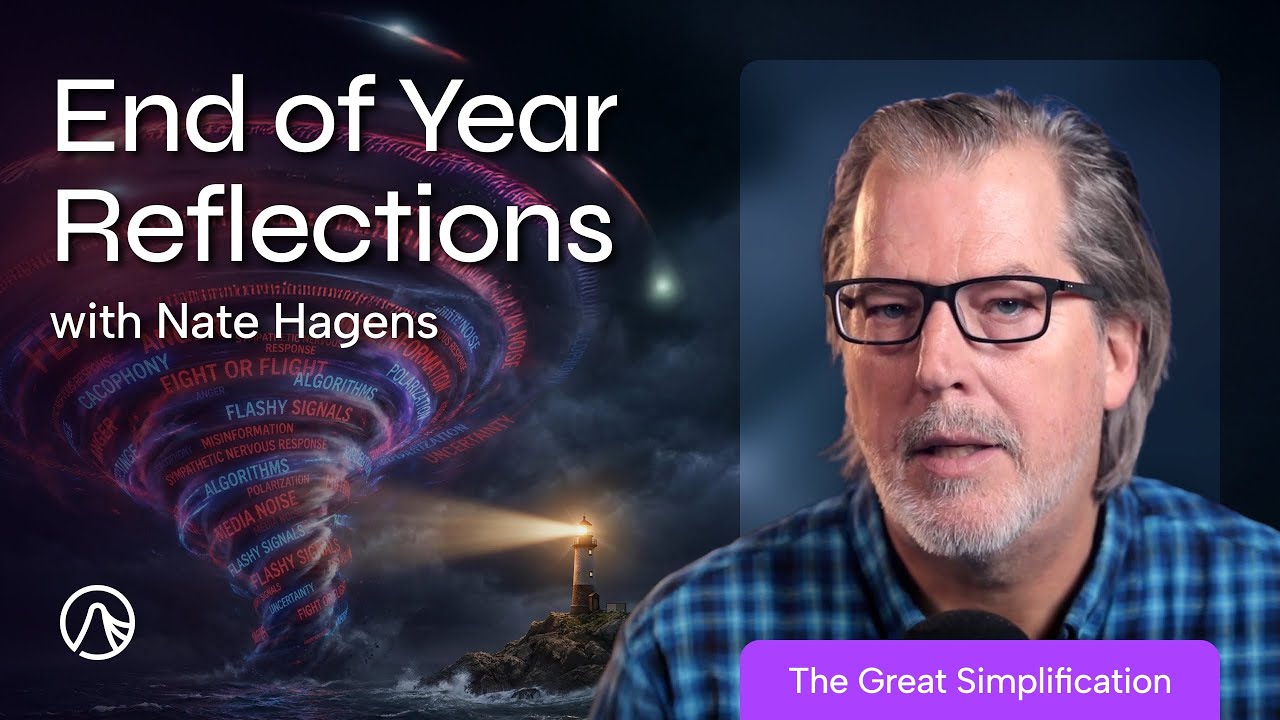
Among the less-discussed threats Hagens identifies, two stand out for their systemic reach. The first is the narrowing space for honest public discourse: university social sciences have grown increasingly constrained by ideological pressure, and the ability to speak unflattering truths about civilisational trajectory is becoming harder to sustain within institutional settings. The second is what he describes as a maelstrom — a self-reinforcing mass of fear, anger, and algorithmically curated outrage that activates the sympathetic nervous system and crowds out the reflective, pro-social cognition that systemic challenges require. Artificial intelligence, he argues, will intensify this dynamic by orders of magnitude, shrinking the relative share of grounded, reality-based communication in the broader information environment. A joke he recounts makes the structural point: two people who agree on nearly everything — ecology, inequality, human welfare — can have their entire relationship severed by a single unresolved 5% disagreement, with no mechanism to hold the 95% in place.
The gap between what people collectively know and what they collectively do has always been the central puzzle of civilisational overshoot. What Hagens is pointing to is a mechanism that actively widens that gap: an information architecture engineered to maximise emotional arousal will systematically degrade the cooperative, disagreement-tolerant behaviour that any managed transition demands. The human superorganism is increasingly running on cortisol.
"AI is going to do that on steroids."
Hagens Argues Authentic Hope Requires a Reality-Based Foundation, Not Technological Rescue
Hagens approaches the concept of hope with scepticism about its common usage. Most hope circulating in public discourse, he contends, is unconsciously anchored to the continuation of modernity's material conditions — an assumption that solar panels and wind turbines will straightforwardly replace the current 19-terawatt global energy system and that the deeper question, humanity's relationship with energy rather than merely its source, can be deferred. He draws a distinction between hope built on projection and hope grounded in what is materially plausible: clean water, healthy children, protected ecosystems, and basic needs met — outcomes worth pursuing regardless of the energy trajectory. What genuinely encourages him is the growing number of people who are engaging seriously with the question of what it means to be alive at this particular moment in the human enterprise.
The distinction between reality-based and reality-denying hope is not semantic. Societies that invest hope in implausible rescue scenarios — whether technological, political, or spiritual — tend to under-invest in the adaptive groundwork that more modest but achievable futures require. The biophysical constraints are not waiting for the culture to catch up.
"Authentic hope must be reality-based."
Summarised from Nate Hagens · 26:52. All credit belongs to the original creators. Nate Haggens summarises publicly available video content.