Original source: Nate Hagens
This video from Nate Hagens covered a lot of ground. 14 segments stood out as worth your time. Everything below links directly to the timestamp in the original video.
The case for protecting forests and soils is not primarily moral — it is structural. Lose them and the physical systems that stabilise rainfall, agriculture, and climate regulation degrade in ways that no technology has yet demonstrated the ability to reverse.
Old-Growth Forests and Living Soils Identified as Irreplaceable Buffers Against Ecological Collapse
Intact old-growth forests are not simply carbon repositories — they are active systems that generate rainfall through what ecologists call the biotic pump, support food webs, and provide fire resilience that no plantation or managed stand can replicate. Healthy soils function as living infrastructure: communities of organisms that cycle nutrients, lock up carbon, absorb rainfall, and buffer ecosystems through drought. The directional imperative, given the biophysical constraints already in motion, is to protect what remains and actively rebuild what has been lost.
The human enterprise runs on energy, but it also runs on ecological services that have no market price and no substitute. Every hectare of old-growth cleared or topsoil exhausted reduces the system's capacity to absorb the shocks that overshoot inevitably delivers. Treating trees and soil as inputs to be liquidated rather than infrastructure to be maintained is a form of energy throughput accounting that books short-term revenues while running down the capital stock the entire civilisation depends upon.
"Intact forests create rain via the biotic pump — soils are living infrastructure that cycle nutrients and lock up carbon."
At a Species-Level Crossroads, the Shift From 'Can We' to 'Should We' Defines the Stakes
The civilisational question is no longer primarily technological — it is a question of judgment. A culture that asks only whether something is possible, rather than whether it is wise, deploys extraordinary power without the wisdom to govern its consequences. The argument is that humanity stands at a species-level rite of passage: the first generation with sufficient systemic understanding of how it arrived at this juncture, what the impacts are, and what alternative trajectories remain accessible. That understanding, if it exists, creates an obligation — what might be called apprenticing to reality rather than overriding it.
The gap between what is known and what is done has never been wider. The technical capacity to model planetary consequences coexists with institutions and incentive structures that continue rewarding short-horizon extraction. Moving from intelligence to the sapiens half of the species name — genuine wisdom built on humility and self-observation — is not a philosophical luxury. It is the precondition for ensuring that the energy throughput and complexity the human enterprise commands serves life rather than progressively erodes the biophysical foundations on which life depends.
"Instead of a culture asking, can we — we might increasingly ask, should we, or if we do, what might we break."
Prices That Ignore Physics Are Lying, and Markets Built on Lies Cannot Steer Toward Sustainability
Current market prices systematically misrepresent physical reality. They treat carbon emissions, fossil water extraction, mined materials, and toxic waste as free — effectively subsidising depletion and pollution while taxing the labour and enterprise that might address them. The structural correction is to shift taxes and incentives from human activity onto energy throughput and material flows, so that the cost of eroding natural capital is internalised rather than deferred onto future generations and ecosystems. Done with sufficient scope — covering not just carbon but fossil water, extracted minerals, and hazardous outputs — this would redirect innovation away from pure acceleration and toward efficiency, substitution, and genuine stewardship.
This is not a marginal reform. Prices are the primary signal through which the human superorganism allocates effort and investment. A price system that lies about physics cannot produce behaviour that respects physics. The longer those false signals persist, the deeper the misallocation — and the more abrupt the eventual correction imposed by biophysical constraints rather than by policy.
"Prices are the language of our system — lying about physics and pollution under the current structure means markets are not actually aware of depletion and pollution right now."
Expanding Identity Beyond the Self May Be the Deepest Structural Shift Humanity Can Make
The deepest driver of ecological overshoot is not technology or governance — it is the tight radius of self-interest baked into human neurobiology. Dopamine, oxytocin, and the evolutionary imperatives they encode push individuals to acquire and secure resources for themselves and their immediate kin. Those impulses served the gene's agenda well enough to produce modern civilisation, but they now operate at a scale where their aggregate expression constitutes a planetary force. The developmental proposition is that individual humans can, through deliberate practice and cultural reinforcement, widen the identity boundary — coming to experience watershed health, species continuity, and community resilience as extensions of the self rather than abstractions.
When caring for the whole feels indistinguishable from self-care, collective action problems dissolve from within rather than requiring external enforcement. This is not idealism untethered from mechanism — neuroscience and developmental psychology both document the plasticity of self-concept across the lifespan. The species-level transition underway requires not just new technologies or new prices, but enough individuals operating from an enlarged sense of who the 'we' actually includes.
"The work is to grow an identity big enough to include the watershed and even other species, so that acting for the whole feels natural."
Cooling the Planet Requires Far More Than Emissions Cuts — It Demands a Redesign of Built and Natural Environments
Regardless of what happens with the rate of greenhouse gas emissions, Earth's climate trajectory is already locked toward conditions warmer than any ecosystem on the planet evolved for within the Holocene. The practical implication is a massive, deliberate push on cooling — passive building design, shade canopy, reflective surfaces, and critically, the restoration of water to landscapes that have been drained and dried. Beyond human infrastructure, the argument extends to the non-human world: other species have functioned as background scenery in human planning, characterised as non-player characters in the civilisational project. Treating them instead as kin and stakeholders — designing fishing practices to leave viable populations, creating wildlife corridors and pollinator habitat, designating acoustic quiet zones — reframes biodiversity not as sentiment but as structural necessity.
Ecosystems already drifting outside the climate envelope they evolved within are less resilient buffers and more sources of compounding risk. The web of life that supports human food systems, water cycles, and atmospheric regulation cannot be maintained by human engineering alone. Recognising non-human life as a stakeholder in decisions, rather than a resource to be managed, is the architectural change that makes all other ecological strategies coherent.
"We need to start treating other species as kin — the ecosystems that support them are the foundation, and our children and grandchildren depend on that foundation too."
Building Autonomy From the Economic Superorganism Is Both a Survival Strategy and a Health Practice
Modern individuals are almost entirely dependent on globally integrated supply chains for food, energy, skills, entertainment, and even emotional regulation. That dependency — described here as being plugged into the economic superorganism — is a source of both material and psychological fragility. As complexity has costs, and as global supply chains grow more brittle under resource constraints and geopolitical stress, the capacity to partially self-source daily needs becomes a form of resilience insurance. Psychological sovereignty — the ability to disengage from social media and algorithmic attention capture without experiencing it as deprivation — is a prerequisite for the clearer thinking that navigating a turbulent transition demands.
The 'rocks in the river' framing captures something structurally important: communities and individuals with sufficient autonomy, basic repair skills, food knowledge, and mutual aid networks become stabilising nodes within a system under increasing stress. They do not need to be self-sufficient in any absolute sense; they need only enough rootedness to hold ground when the current accelerates. The alternative — total dependence on systems that are themselves under pressure — is a single-point-failure architecture for human lives.
"These humans can become rocks in the river — points of stability that hold ground as the rushing water and the current picks up."
'Goldilocks Tech' Framework Challenges the Assumption That More Powerful Technology Is Always Better
Most technology being built and deployed today was designed under the assumption that the future will resemble the recent past — abundant energy, stable global supply chains, and continuous economic growth. Under those assumptions, bigger, faster, and more connected makes sense. Under the biophysical constraints of a resource-constrained future, the same technology becomes brittle: dependent on rare materials, vulnerable to shipping lane disruptions, and incapable of local maintenance. The 'Goldilocks' framework proposes a practical filter — technologies that are energy- and ecology-informed, that lower aggregate demand rather than merely reshaping it, that can be repaired locally, and that add resilience rather than creating new dependencies. Bikes and buses over robo-taxis; passive building design over energy-intensive climate control.
The market currently has no mechanism to distinguish between technology that is appropriate for the transition ahead and technology that deepens vulnerability to it. Net energy analysis — measuring what energy a system delivers after accounting for the energy required to build and run it — remains largely absent from investment decisions. Getting clearer on that distinction before capital is further misallocated is, on this account, among the more consequential analytical tasks facing investors and policymakers.
"Right now the market is building tech way too hot — it increasingly needs to aim for just right, informed by energy and ecology."
Chronic Fear Shrinks the Time Horizon Needed to Navigate Long-Range Civilisational Risk
Fear is a rational response to genuine danger, but as a chronic operating state it is cognitively and strategically disabling. It hands control to the brain's threat-detection circuitry — the amygdala — at the expense of the prefrontal cortex, which is the seat of long-range reasoning and considered trade-offs. In a media environment engineered to exploit novelty bias, fear becomes self-reinforcing: attention gravitates toward immediate dramatic dangers while slower-moving but more consequential risks — soil depletion, debt accumulation, ecosystem degradation — remain invisible because they are no longer novel. The practical consequence is a population poorly equipped to act on the predicament that actually matters.
The behavioural shift proposed is not denial but nervous system regulation — using sleep, sunlight, physical movement, unstructured outdoor time, and in-person social connection to maintain the capacity for calm, deliberate action under pressure. A regulated nervous system produces better trade-offs and broader frames of concern. The argument is structural rather than purely therapeutic: a civilisation navigating a multi-decade transition cannot afford to have its most aware citizens locked in sympathetic nervous system overdrive, capable only of reactive, short-horizon responses.
"Fear is natural, but fear alone is a mind killer — it shrinks our time horizon and lets our amygdala grab the wheel."
Shifting From Consumption to Legacy Reorients the Deepest Motivational Drivers of Economic Behaviour
The dominant cultural script optimises for salary, profit, portfolio size, and the accumulation of convenience — a script so thoroughly internalised that departing from it requires active deliberate effort. Yet the pursuit of meaning and legacy, rather than consumption, is not a countercultural eccentricity — it is a documented and recurring human motivational state across cultures and centuries, suppressed in modern societies by relentless commercial reinforcement of the alternative. The proposal is concrete: redirect effort toward building things that will still exist and function in thirty or a hundred years, and toward contributions whose value compounds across generations rather than depreciating at the checkout counter.
The people best positioned to make this shift first are those who have already secured material sufficiency — individuals with discretionary time and resources who are currently optimising those assets for further accumulation. If a meaningful fraction of that demographic redirects toward legacy and stewardship, the cultural signal reaches younger cohorts who are still forming their aspirations. Career choices, investment decisions, and status hierarchies all shift accordingly — and with them, the flow of talent and capital toward or away from the long-term.
"What would happen if an increasing number of humans moved from consumption and convenience towards legacy — building things that will still be here in thirty years or a hundred?"
Redefining Return on Capital to Include Soils, Communities, and Ecosystems Challenges Finance at Its Foundation
Standard financial accounting draws a narrow boundary around what counts as a return: cash flows, balance sheet assets, and shareholder value expressed in monetary terms. Everything outside that boundary — watershed health, community cohesion, topsoil depth, ecosystem function — is treated as externality, a cost borne by the world but not by the balance sheet. The wide-boundary capital framework inverts that logic, asking whether the full system — including grandchildren and intact landscapes — would register a gain or a loss from a given investment decision. A development that looks excellent on a spreadsheet but drains an aquifer or fragments a watershed is, on this account, wide-boundary destruction marketed as value creation.
Philanthropy is identified as the natural early adopter of this cultural shift, precisely because it operates outside the competitive pressure to match narrow-boundary returns. A filter as simple as 'would my grandchildren thank me for this?' begins to approximate wide-boundary accounting without requiring a complete overhaul of financial infrastructure. The stakes are high because capital allocation is how the human enterprise decides what gets built — and what gets built over the next two decades will determine the material conditions of life for the rest of the century.
"It looks great on the spreadsheet, but the watershed is being destroyed — that's wide-boundary destruction marketed as value creation."
As Global Institutions Remain in 'Consensus Trance,' Small Groups Become the Seeds of Systemic Coherence
Large institutions — governments, multilateral bodies, financial regulators — are structurally constrained to operate within the prevailing consensus, even when that consensus is materially disconnected from the physical reality it purports to govern. The concept of 'islands of coherence' names a complementary phenomenon: small, committed groups of people who see the situation clearly and respond accordingly, pioneering approaches that larger systems are not yet capable of adopting. These might be local councils that formally represent the interests of future generations, knowledge commons that keep systemic understanding alive outside official channels, or communities that make decisions in explicit acknowledgment of biophysical limits.
The governance proposal with the sharpest edges is the suggestion of designated seats — on local councils or planning bodies — for the unborn and for keystone species, represented by humans whose explicit mandate is to speak for long-term and non-human interests. The idea sounds radical only against the backdrop of a system that treats both future generations and other species as having no standing. On a longer time horizon, excluding them from decisions that will determine their conditions is the more radical choice.
"Maybe one symbolic move might be a seat for the unborn and a seat for the keystone species — designated humans whose explicit role is to add a longer-term, non-human voice."
A Compass for the 21st Century: Away From Fragility and Fake Prices, Toward Continuity and an Inclusive 'Us'
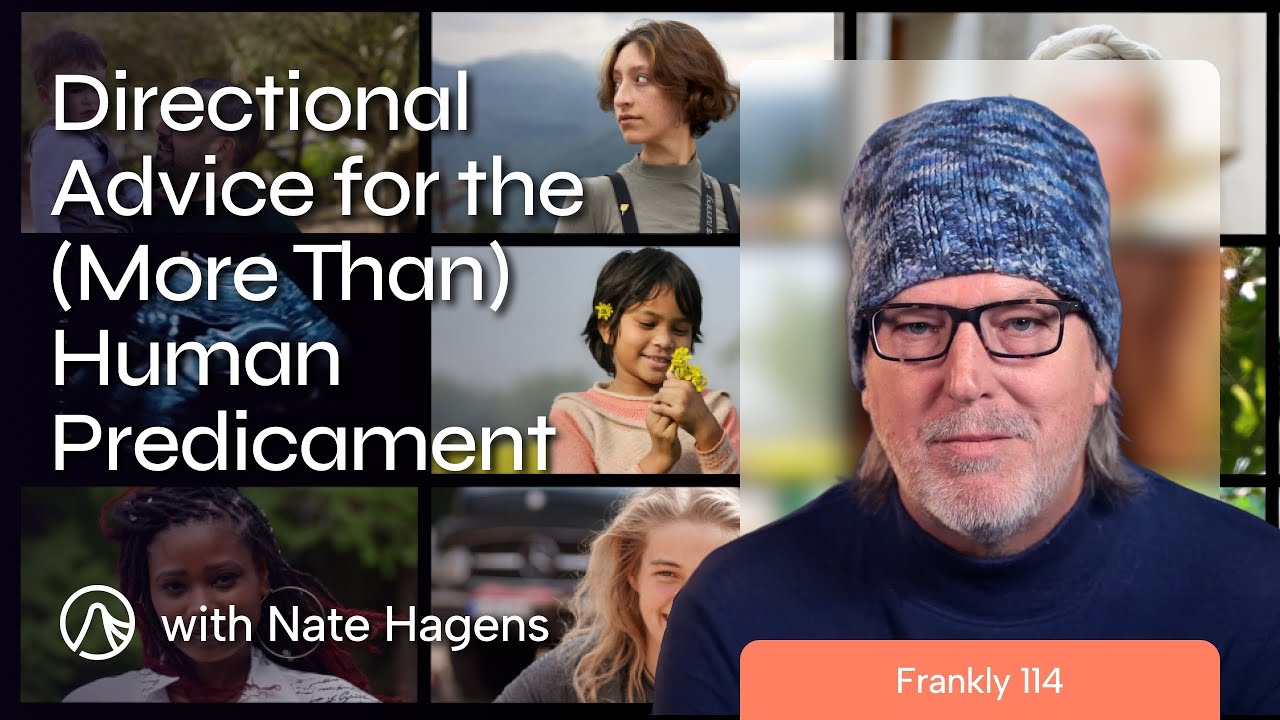
The directional framework assembled across ecology, technology, governance, behaviour, and human development resolves into a single compass: away from single-point failures, biophysically dishonest prices, conspicuous accumulation, heat, fear, and the isolated self — toward continuity, material honesty, stewardship, Holocene-range stability, grounded agency, and an identity large enough to include all life. None of these directions are presented as achieved states or rigid doctrines, but as orientations that improve humanity's odds of threading the bottlenecks ahead. Even small directional shifts, applied across enough domains and enough people, alter the trajectory of a complex system in ways that large individual actions in isolation cannot.
The underlying argument is that overshoot does not resolve itself through a single technological fix or policy intervention. It resolves — if it resolves well — through simultaneous movement across the physical, economic, cultural, behavioural, and developmental dimensions of the human enterprise. The energy throughput of civilisation, the complexity it has built, and the ecological systems it depends upon are all in motion together. A compass that orients across all of those dimensions simultaneously is not utopian — it is the minimum requirement for navigating what is coming with anything recognisable still intact on the other side.
"Away from single-point failures and toward biophysical honesty — away from fear and toward grounded agency — away from me alone and toward us, and the more than human."
Treating the Atmosphere and Oceans as Commons Requires Embedding That Principle in Trade Rules and Financial Architecture
The atmosphere, oceans, biodiversity, and orbital space are shared assets — systems that no nation owns and all nations depend upon. Current international arrangements treat them largely as open-access resources: available for exploitation or disposal at no cost to the party doing the exploiting. The 'overview effect' — the perceptual shift astronauts describe upon seeing Earth as a single bounded system from orbit — captures the cognitive reframe that commons thinking requires, but translating it into governance means embedding it in the mechanisms that actually govern behaviour: trade agreements, financial flows, and security architectures.
The structural challenge is that commons governance fails whenever any party can gain competitive advantage by defecting — extracting more than their share while others exercise restraint. Hardwiring commons protection into trade rules and financial regulation changes the payoff structure so that wrecking shared systems is no longer individually rational even in the short term. The analysis is sobering: on this measure, current international governance is near zero. The direction of travel — from near-zero to some, and over time to much more — is the work of building the institutional infrastructure that the scale of shared risk actually demands.
"One can win only so long by wrecking the shared system — and then it's a disaster for everyone."
Status Attached to Maintenance, Repair, and Stewardship Would Redirect the Aspirations of an Entire Generation
Cultures do not change by argument — they change when the activities that command admiration change. In contemporary societies, status accrues overwhelmingly to conspicuous consumption: the size of a house, the newness of a car, the scale of a portfolio. Roles that keep systems functioning — the mechanic, the teacher, the land steward, the caregiver — are compensated and admired less than roles that generate financial returns, regardless of what each actually contributes to the web of life. The directional shift proposed is to invert that hierarchy: to make maintaining, repairing, teaching, and stewarding the activities that signal competence and earn respect.
The mechanism is generational. When young people observe genuine admiration flowing toward stewardship and community contribution rather than accumulation and display, career choices shift accordingly — and with them, the allocation of human talent and energy. The flip side is equally pointed: if society genuinely valued intact old-growth forest and healthy watersheds, the decision to clear either for development would lose its current social legitimacy. Status hierarchies are among the most powerful regulatory systems that exist, operating continuously without enforcement costs. Redesigning them is slow — but it is not impossible, and no other intervention reaches as deep.
"Directionally, we need a status shift — toward caring and stewarding land and knowledge — because when young humans see admiration for those things, their career choices shift accordingly."
Summarised from Nate Hagens · 40:16. All credit belongs to the original creators. Nate Haggens summarises publicly available video content.