Original source: Rich Roll
This video from Rich Roll covered a lot of ground. Streamed.News selected 7 key moments and summarises them here. Everything below links directly to the timestamp in the original video.
Have you ever felt so trapped in a life you built that the only way out seemed to be burning it all down? This may be the hidden psychological driver behind many high-profile falls from grace.
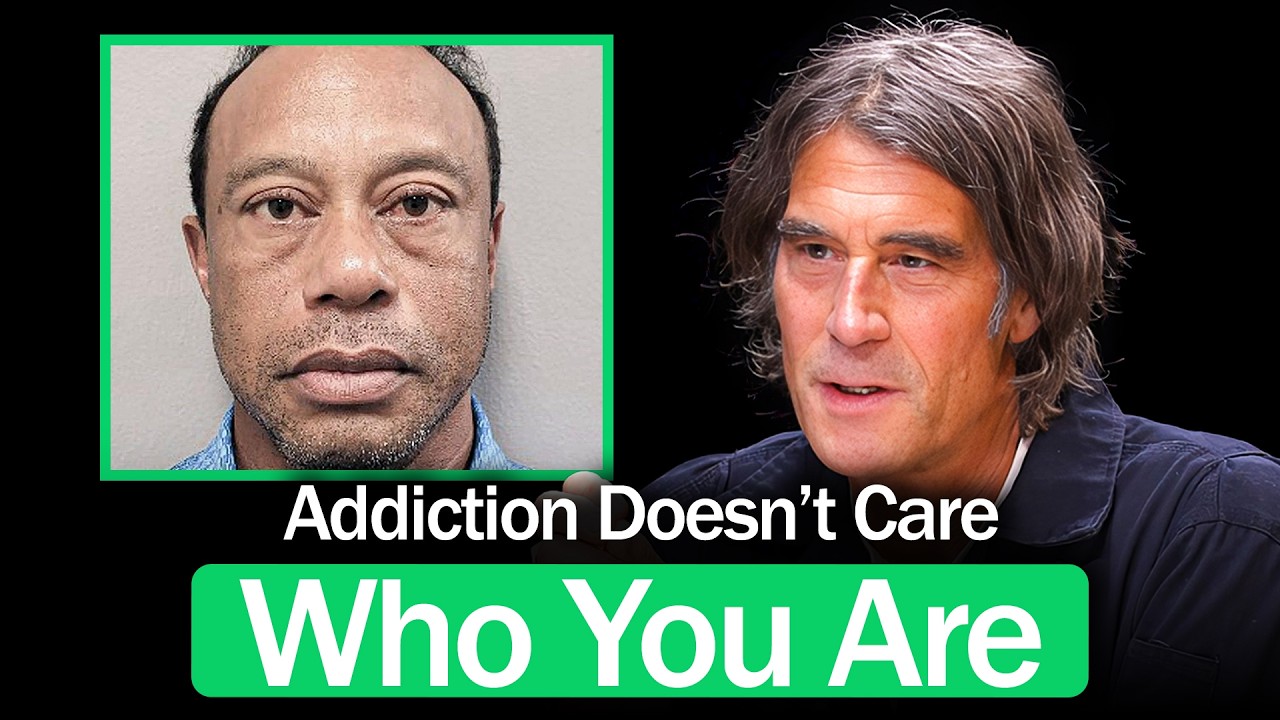
Tiger Woods' Behavior May Reflect Unconscious Self-Sabotage to Escape an Unwanted Life
It is worth considering the possibility that Tiger Woods' destructive behavior may be a form of unconscious self-sabotage, a dynamic previously observed in figures like former NFL quarterback Todd Marinovich. For Marinovich, self-implosion became the only perceived exit from a life of immense pressure he felt powerless to quit on his own. This suggests that for some, creating chaos is a desperate act to compel others to make the choice to remove them from a situation they cannot escape.
Ultimately, the question becomes about a profound sense of entrapment. When an individual lacks the courage to walk away from a life they no longer feel connected to, self-sabotage can emerge as the only tool to force a change, beckoning external forces to intervene where internal resolve has failed.
"He wanted out. But he couldn't get out. The only way that he could get out was to self-sabotage his life, to basically implode everything around him so that other people had to make that choice for him."
Having Conquered Every Summit, Tiger Woods May Face a Profound Existential Crisis
After achieving every imaginable victory in his sport, Tiger Woods may be confronting an existential crisis born from a lack of new mountains to climb. If love and self-worth are unconsciously perceived as conditional upon victory, a person who has won everything is left with a profound internal void. In this context, his interest in a comeback is not merely about sport, but perhaps the only known way to feel worthy—what Gabor Maté calls 'sating the hungry ghost'.
The implications of this are significant, as one faces a choice: find new meaning larger than oneself, or act out to numb the pain and prove a fundamental sense of unworthiness. The intense media scrutiny only exacerbates this deeply personal struggle.
"What is it that you're supposed to do when you've already won everything and you still don't feel entitled to love, still don't feel worthy of love."
Unconditional Love and Healthy Boundaries Are Crucial for Supporting Those in Addiction's Grip
For anyone currently suffering from addiction, it is important to underscore that help is available, no matter how dire the circumstances seem. Recovery is a non-linear process that begins with small, courageous steps: the single act of raising a hand to ask for help, and then remaining open to receiving it. The journey is built on tiny, strung-together actions, encapsulated by the recovery axiom of just trying to 'hit the pillow sober' one day at a time.
For those seeking to support a loved one, the approach must be grounded in unconditional love, compassion, and non-judgment, paired with healthy boundaries to avoid codependency. One must be available for the solution, not a cosigner on the destructive behavior, because ultimately, love is always the answer.
"Love is always the answer. More love, more love, more love. Love with healthy boundaries, but unconditional in your availability and your willingness to help see somebody through their difficult time."
Addiction Obliterates Rationality, Explaining Tiger Woods' Illogical Choices
The public's confusion over why a person with Tiger Woods' vast resources would behave so irrationally fails to account for the nature of addiction. The first thing to understand is that once a substance enters an addict's system, rationality is completely obliterated and logic becomes irrelevant. Asking why he didn't simply call a driver presupposes a state of mind that, for an addict under the influence, simply does not exist.
This perspective, informed by personal experience with past DUIs, reveals that addiction is a form of insanity. Understanding this creates a necessary space for empathy, recognizing that the addicted brain makes decisions that a sober mind would find incomprehensible.
"There isn't anything normal about the brain of an addict under the influence. Addiction is so cunning, so baffling, so powerful, it just obliterates rationality and makes logic irrelevant."
The 'Superpowers' of Tiger Woods and Others May Be Driven by Unhealed Childhood Wounds
It is instructive to view the self-destructive patterns of figures like Tiger Woods, Todd Marinovich, and Shia LaBeouf through the lens of their childhoods, which often feature domineering father figures and immense expectations. These environments forged their extraordinary talents—veritable 'superpowers' in their respective fields—but these abilities were simultaneously driven by unhealed emotional wounds and traumatic experiences from a young age.
If these foundational wounds remain unaddressed, they tend to metastasize in adulthood. The very 'superpowers' that brought success become an Achilles' heel, manifesting as substance abuse, emotional disturbance, and acts of profound self-sabotage later in life.
"These are superpowers, but they're all being driven by childhood wounds, traumatic experiences that are unhealed, and that if they remain unhealed, end up metastasizing into problems."
Intervention Is Complicated by an Insular World and the Psychology of Addiction
Attempting to intervene with a figure like Tiger Woods presents unique challenges, as his inner circle may be comprised of sycophants on his payroll who are not incentivized to engage in difficult truth-telling. While his children or a peer of similar stature, such as Michael Phelps, might be able to penetrate his veil of denial, an addict is often deeply resistant to help until they become receptive to it.
This resistance is illustrated by the metaphor of an elevator descending to 'rock bottom.' An addict can step off at any floor, but often the pain of their circumstances must become greater than their fear of change before they are willing to do something different.
"The addict often has to hit that ground level before they get off, meaning they need to experience a sufficient amount of pain, sufficient enough to overwhelm the fear of change."
Unmet Childhood Needs Can Drive Adult Dysfunction; Unconditional Love Is the Antidote
It is important to underscore that emotional needs that go unmet during childhood often manifest as problematic behaviors and obstructive patterns in adulthood. The public struggles of high-achievers offer an instructive lens for our own self-reflection, urging us to identify how wounds from our youth may be shaping our present reality and hindering our ability to evolve into more actualized versions of ourselves.
This insight is also crucial for parents. While holding ambitions for children is natural, love and approval must never become transactional; they must be unconditional to foster genuine emotional well-being and prevent the cycle of performance-based worthiness.
"You can hold an ambition for your child, but you have to hold it loosely. And the most important piece is that no matter what, they know they are loved unconditionally."
Summarised from Rich Roll · 33:40. All credit belongs to the original creators. Rich Roll Newspaper summarises publicly available video content.