Original source: Nate Hagens
This video from Nate Hagens covered a lot of ground. 11 segments stood out as worth your time. Everything below links directly to the timestamp in the original video.
Have you ever found yourself endlessly scrolling or making impulse purchases, only to feel a lingering sense of emptiness? This analysis suggests that much of modern consumption isn't about satisfaction, but a pervasive, subtle form of engineered distraction.
Consumption as 'Escape and Dopamine Sinks' Fuels Dissatisfaction Amid Chronic Stress
The highest tier of consumption, termed 'escape and dopamine sinks,' functions as a form of anesthesia and dissociation, driven by a deep, restless unease in modern society. This category includes behaviors such as gambling, 'doom scrolling,' binge shopping, and substance use. These activities are often algorithmically engineered to keep individuals in a state of perpetual, slight dissatisfaction, ensuring continued engagement and consumption within a culture marked by chronic stress and technological temptation.
This dynamic highlights a fundamental misalignment between human biological needs and the imperatives of the current economic system. The continuous pursuit of fleeting digital or material gratification, powered by vast energy throughput, diverts attention and resources away from more sustainable forms of well-being. This pattern not only exacerbates individual stress but also underlines the biophysical costs of an economic model that thrives on perpetual novelty and engineered discontent, rather than genuine fulfillment.
"I increasingly think a large portion of what is driving so much consumption in our lives is not pleasure, it's anesthesia."
Status and Signaling Drive Consumption as a Social Language
Consumption in the 'status and signaling' layer functions as a potent form of social language, where purchases are not merely utilitarian but convey identity, taste, success, or belonging. Historically, humans have always used objects and adornments as symbols, but in contemporary society, a significant portion of this consumption acts as 'social armor,' driven by conscious or unconscious objectives to secure or maintain one's position. This form of consumption tends to be expensive, precisely because its value is derived from its visibility and scarcity, serving as a clear signal to others.
This systemic drive towards status-driven consumption underscores how human social hierarchies are deeply intertwined with material throughput. The continuous demand for novel and exclusive goods, fueled by a desire for positional advantage, places additional strain on global resource flows and energy systems. In a world facing biophysical limits, the energy expenditure associated with producing and distributing these signaling goods represents a significant, yet often overlooked, cost to ecological stability.
"The key point is consumption in this layer is not about the object that is purchased, it's about the social meaning of that object."
The Hidden Costs of Comfort and Convenience: Dependency and Skill Atrophy
The 'comfort and convenience' layer of consumption encompasses services and products designed to save time and reduce effort, ranging from delivery services and subscriptions to technological upgrades and larger living spaces. While these offerings provide genuine relief in a high-pressure modern existence, their widespread adoption carries an often-unseen cost. Convenience can lead to the atrophy of previously mastered skills and foster a decreased tolerance for minor inconveniences, transforming them into perceived emergencies.
This pervasive shift towards outsourced ease fundamentally alters human adaptive capacity. As complex systems deliver ever more bespoke comfort, individuals may become increasingly reliant on external provisions, diminishing personal resilience. The human enterprise runs on energy, and this quest for frictionless living diverts substantial energetic throughput to maintain elaborate support structures, potentially leaving societies more fragile when confronted with systemic disruptions that challenge these conveniences.
"The catch is, while these are very pleasant, it can atrophy you out of skills you used to have."
Novelty and Stimulation Drive Consumption to Combat Intolerable Boredom
The 'novelty and stimulation' layer of consumption is largely driven by a restless discomfort and an inability to tolerate boredom in contemporary society. This category includes constant engagement with technology, impulse purchases, and the endless consumption of digital content, all aimed at temporarily shifting internal states and avoiding mental stagnation. The immediate availability of novel stimuli, often just a single click away, means that the extraordinary experiences of past generations are now the baseline expectation for maintaining a sense of aliveness.
This constant demand for stimulation has profound implications for individual well-being and the broader biophysical system. It represents a continuous draw on energy and material resources to fuel an economic model predicated on perpetual innovation and instant gratification. The capacity for sustained attention and intrinsic contentment diminishes as the human superorganism becomes conditioned to an unbroken stream of external novelty, ultimately creating a more brittle individual and societal response to periods of less abundance or systemic disruption.
"I believe this is where a lot of modern consumption and the slope of the carbon pulse sits by default because we just can't tolerate boredom."
Consumption Pyramid: Higher Layers Face Collapse in a 'Simplifying' World
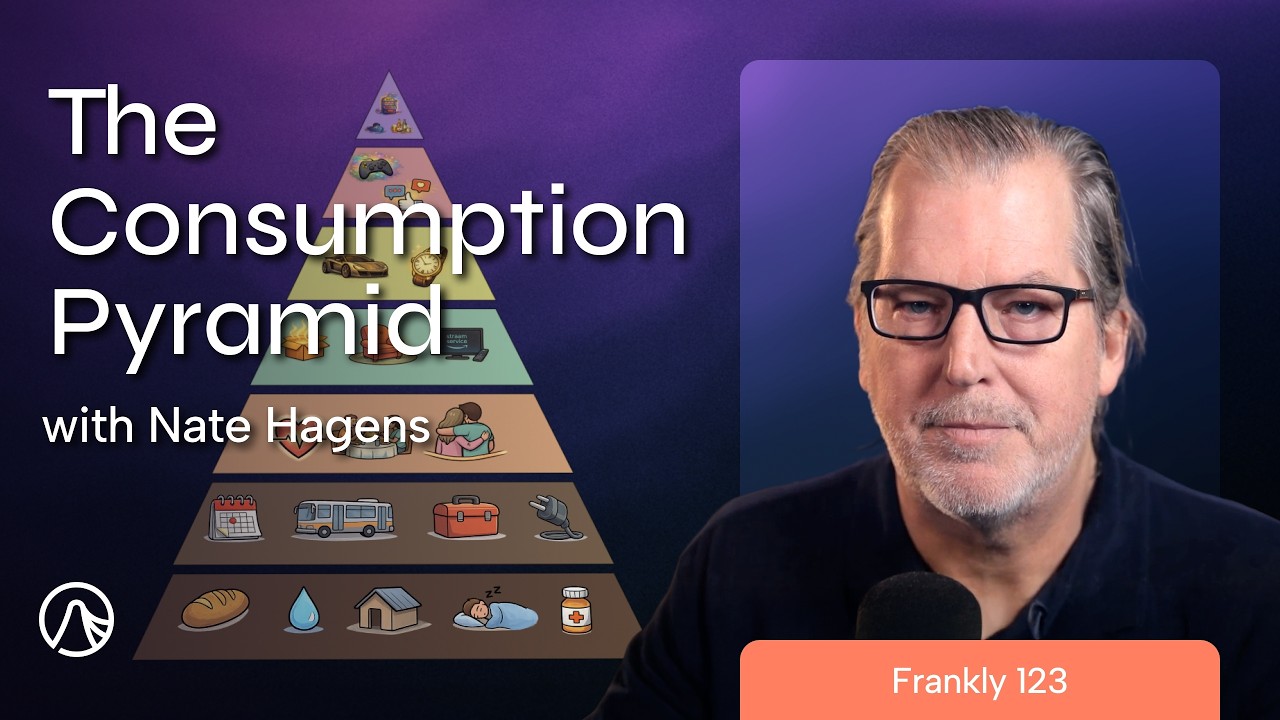
A framework for understanding consumption, presented as a seven-layer pyramid, is intended as a self-awareness tool rather than a moral judgment, acknowledging that different consumption categories carry varied meanings based on individual context and global baselines. The speaker posits that the past few generations have experienced an era of unprecedented cheap energy, expanding credit, stable institutions, and a generally peaceful world, allowing for a natural drift towards higher, more complex consumption layers.
However, if the world is transitioning into a period of simplification—driven by energy constraints, geopolitical shifts, or environmental factors—the higher, more brittle layers of the consumption pyramid are most vulnerable to collapse. These layers, often globalized and interdependent for their affordability, are inherently less adaptable than the foundational layers tied to direct survival. This systemic vulnerability suggests that societies may be forced to shed complex consumption patterns as biophysical realities reassert themselves, shifting emphasis towards more resilient, localized provisions.
"If we're moving into a period of simplification from energy constraints, geopolitical instability, or probably some combination, then these higher, more global, more brittle, more interdependent layers of the world, the top of the consumption pyramid, it likely even probably snaps at some point."
Critique Labels 'Consumer' as Economically Reductionist, Shapes Lives into 'Shopping Buffet'
The prevalent Western cultural label of 'consumer' is critiqued as a narrow and economically reductionist descriptor that fundamentally shapes human existence. This term, often used as a neutral, almost scientific classification, reduces individuals to little more than an 'appetite with a wallet.' The speaker argues that decades of ingrained Western culture have transformed human lives into a 'shopping buffet' and, by extension, conceptualized the planet itself as a mere 'warehouse' of resources for perpetual extraction and consumption.
This linguistic framing reveals a deeper systemic issue: the embedding of an extractive, high-throughput economic paradigm into the very definition of human identity. By reducing individuals to their role in the consumption cycle, society implicitly prioritizes economic growth over ecological limits and holistic well-being. This perspective underscores how language itself reinforces the biophysical imperative of perpetual expansion, creating a human superorganism whose primary function becomes the ingestion and processing of matter and energy, often at the expense of systemic health.
"I believe that after many decades of Western culture, it turns our lives into a shopping buffet, and then indirectly, our vibrant planet into a warehouse."
Intentional Simplification Builds Personal Resilience for an 'Intermittent World'
For individuals who foresee a future characterized by increased global intermittency and volatility, intentional simplification of consumption patterns offers a strategic path towards personal resilience. This proactive approach involves consciously moving down the consumption pyramid, prioritizing foundational needs and adaptable practices over the brittle, higher-level desires. The rationale behind this shift is not primarily altruistic, such as 'saving the planet,' but rather pragmatic: to build individual capacity for self-sufficiency and adaptive coping mechanisms, effectively 'beating the rush' before external pressures necessitate such changes.
This recommendation aligns with a biophysical understanding of systemic constraints. As the human superorganism confronts diminishing net energy returns and increased ecological turbulence, reliance on complex, high-throughput systems becomes a liability. Intentional simplification fosters a more robust connection to local resources and community, reducing dependency on globalized supply chains and energy-intensive services. It represents an adaptive strategy for navigating a future defined by less energetic abundance and greater uncertainty, re-centering human activity on what is truly essential.
"For people who are aware that the world will be more intermittent, it can make sense to move down the consumption pyramid."
Consumption Pyramid Outlined: A 'Weather Map' for Self-Awareness, Not Moral Judgment
A seven-layer consumption pyramid is introduced as a framework to understand human consumption patterns, ranging from basic survival needs at the bottom to mood and identity-driven purchases at the top. The model emphasizes that individuals fluidly move between these layers, experiencing different consumption priorities based on their current circumstances. For instance, one might practice minimalism in certain areas while engaging in 'dopamine sink' consumption when stressed.
Crucially, this framework is presented not as a moral hierarchy but as a 'weather map' for self-awareness, designed to help individuals notice and understand their own consumption behaviors. This perspective helps decouple personal spending from inherent moral value, allowing for an objective analysis of how energy and resources are channeled through human choices. Understanding these patterns is critical for assessing societal resilience in the face of future biophysical constraints, as different layers of consumption carry distinct energetic footprints and levels of adaptability.
"As you follow, please don't take any of this as some sort of a moral or a judgment, it's more like a weather map, a way to notice where you are."
The 'Consumption Pyramid' Introduced as a Tool for Navigating Global Instability
A new conceptual tool, the 'consumption pyramid,' has been introduced to dissect the multifaceted nature of consumption in human life. This diagram aims to delineate various connotations of consumption, spanning from fundamental survival necessities to activities aimed at stress alleviation. The relevance of this framework is underscored by escalating global instability and rising costs, suggesting that a clear understanding of consumption patterns is becoming increasingly vital for personal and societal resilience.
This analytical model offers a timely perspective as the human superorganism confronts an era of increasing volatility and resource constraint. By categorizing consumption, it provides a lens to evaluate how our energetic throughput is allocated across different needs and desires. In a world predicted to become less stable and more expensive, understanding these distinctions transforms consumption from a mere economic act into a form of sovereignty and adaptive capacity, enabling more intentional choices in the face of biophysical limits.
"I think the world is going to feel less stable, more volatile, and more expensive in ways that are hard to predict, other than maybe to say, that the default way of being, if you even entertain the possibility of this premise, then being intentional about consumption becomes a form of sovereignty or resilience."
Consumption Pyramid: Objects Can Fulfill Multiple Needs Across Fluid Layers
The consumption pyramid, a conceptual model designed to illustrate various motivations for consumption, emphasizes that its seven layers are not rigidly defined. The same physical object can reside on different layers for different individuals or even for the same person at different times, depending on context and individual needs. For example, a smartphone might serve as a status object for one individual, while for another, it is a critical tool for work, banking, and accessing public services, thus fulfilling more foundational needs.
This fluidity highlights the complex interaction between material goods and human behavior within the broader energetic system. An air conditioning unit, for instance, might represent comfort in one climate but a survival necessity in another extreme. Similarly, a meal delivery service could be a convenience for some, but a lifeline during periods of vulnerability. Such contextual variability demonstrates that the energetic footprint and resilience implications of any given consumption act are not static but are deeply embedded in individual circumstances and the surrounding biophysical reality.
"The same physical thing can reside on different layers of the pyramid for different people, and for the same person at different times."
'Care and Belonging' Drives Consumption for Social and Emotional Well-being
The 'care and belonging' layer of consumption moves beyond purely material acquisition to encompass spending related to maintaining relationships and personal health. This includes expenses for shared meals, community obligations, therapy, exercise, and hobbies that foster social connection and emotional well-being. This category of consumption underscores the human requirement for 'social glue' and mutual care, acknowledging that these non-material needs are fundamental to human flourishing, extending beyond mere physical sustenance.
This dimension of consumption highlights the essential role of social capital and relational health in the overall human enterprise. While not always directly tied to the immediate conversion of raw materials, the energy and resources dedicated to fostering community and individual well-being are crucial for the resilience of the human superorganism. Neglecting these 'care' aspects can lead to societal fragility, even if basic survival needs are met, as the complexity of human systems relies heavily on robust social bonds and collective support structures.
"On the surface, it's not about consumerism, but humans require social glue. We require human care of human and non-human."
Summarised from Nate Hagens · 22:58. All credit belongs to the original creators. Nate Haggens summarises publicly available video content.