Original source: Nate Hagens
This video from Nate Hagens covered a lot of ground. 5 segments stood out as worth your time. Everything below links directly to the timestamp in the original video.
Before debating policy responses to economic disruption, it helps to know which of four fundamentally different futures you are actually navigating toward. This framework attempts to draw that map.
Four Economic Scenarios Map the Space Between Green Growth and Civilisational Collapse
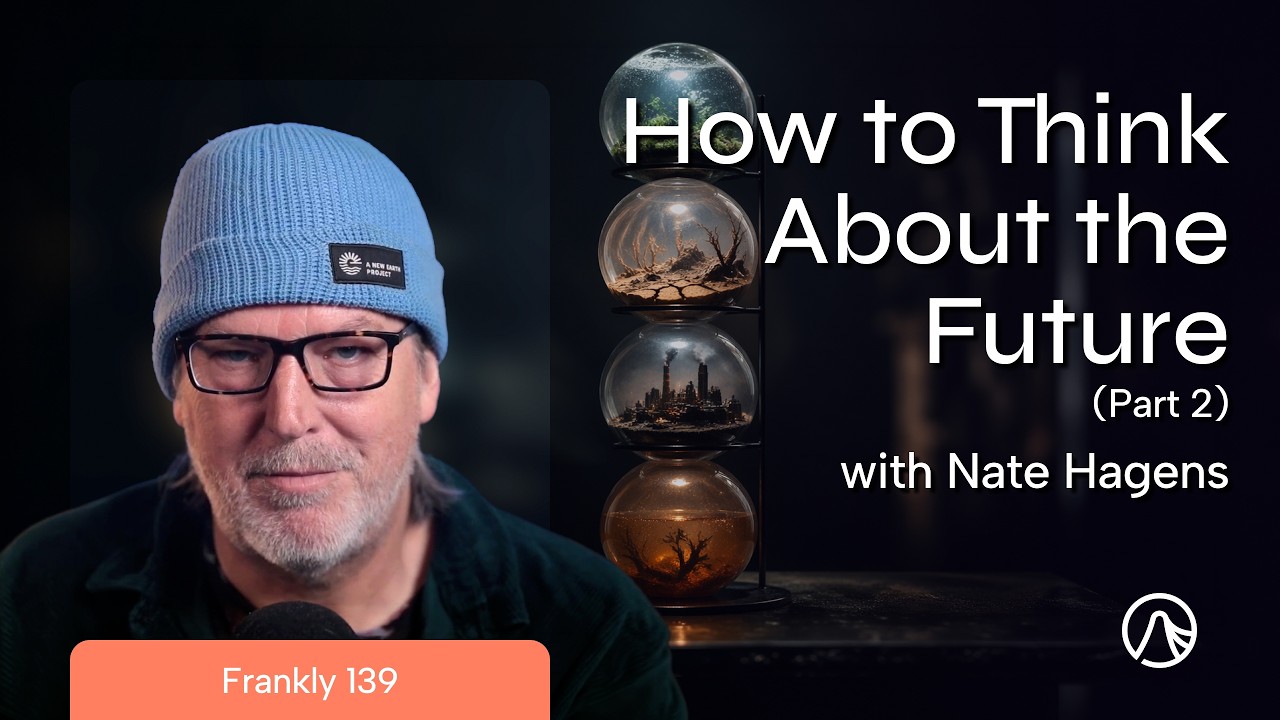
A framework built on two intersecting axes — whether the global economy grows or contracts from current levels of energy throughput, and whether that trajectory moves toward or further into ecological overshoot — generates four distinct directional scenarios: Green Growth, in which expansion couples with regeneration; MoreOr, in which expansion continues past planetary boundaries; The Great Simplification, in which contraction occurs within ecological stewardship; and Mad Max, in which contraction deepens overshoot and disorder. The framework is explicitly not predictive; different regions may inhabit different quadrants simultaneously, and the future will blend elements of all four.
The analytical power of the exercise lies less in any single quadrant than in what the axes reveal about biophysical constraints on human organisation. Whether contraction happens within or outside ecological limits is not primarily an economic question — it is a question about the material reality the human enterprise runs on. Pinning that question first, before introducing political or social variables, is the move that makes the subsequent grids legible.
"None of our futures will be purely one of those quadrants. These are directional possibilities via a simplistic two-axis frame."
Power Has Four Sources, and Their Concentration Is the Variable That Changes Everything
Power, in this analysis, resolves into four distinct sources: military force, which ultimately backstops the other three; political authority, which sets the rules everyone else operates under; financial capital, which decides what gets funded and has grown substantially relative to the other categories over recent decades; and technological control — the algorithms, data infrastructure, and artificial intelligence that have emerged as an independent power source in their own right. The current trend across all four dimensions, the analysis argues, runs toward concentration rather than distribution, with AI capabilities held by a relatively small number of companies.
The distinction matters enormously when mapped onto economic conditions. During growth, the distribution of these power sources shapes questions of fairness. During contraction, the same distribution shapes questions of survival — whether families can meet basic needs, and who absorbs the losses when the aggregate shrinks. Financial claims on biophysical reality, the framework notes, do not automatically correspond to actual resources; a society can have broadly distributed voting rights and still concentrate the gains of material production in very few hands. Complexity has costs, and those costs fall unevenly.
"A country might have broadly distributed political power and still be deeply unequal because money ends up in very few hands."
Four Governance Quadrants Reveal How Power Distribution Shapes Who Bears the Cost of Contraction
The power grid yields four quadrants defined by two variables: whether power is broadly distributed or concentrated, and whether the material gains of a society reach most people or accrue to a narrow group. The civic ideal combines distributed power with broadly shared gains — public goods during growth, coordinated rationing with dignity during contraction. The stewardship deal concentrates power but distributes gains through the choices of those at the top, with Singapore and several East Asian post-war economies offered as partial analogues; it is stable but fragile, dependent entirely on the character of whoever governs. Captured democracy maintains formal democratic structures while real gains flow to a small elite, lobbyists shape legislation, and the majority retain just enough political voice to register grievance without redirecting outcomes. Forced feudalism — concentrated power, narrow gains — resembles colonial extraction and becomes the terrain where authoritarianism grows most likely.
The framework argues that the distinction between these quadrants sharpens dramatically during contraction. In a growing economy, the question of distribution is primarily about fairness. When the aggregate shrinks, it becomes a question of whether basic needs can be met at all. The gap between what the governance structure promises and what it actually delivers — already visible in much of the West — threatens to widen as energy throughput declines, accelerating the regime instability the captured-democracy quadrant tends to produce.
"During contraction, this is a phase shift from focus on fairness to focus on survival — can I feed my family?"
Geopolitical Grid Maps Four Scenarios as Adversarial Interdependence Emerges as the Most Dangerous
The third grid organises international relations along axes of cooperation versus adversarial orientation, and interdependence versus self-sufficiency, producing four scenarios. The globalisation ideal — cooperative and deeply interdependent — describes the trajectory the international order aimed for between roughly 1990 and 2015, but its vulnerability is that everything wired together means shocks transmit everywhere simultaneously. A second quadrant — friendly neighbours with good fences — combines cooperative relations with greater regional self-sufficiency and redundancy, which the analysis identifies as the more resilient configuration under conditions of energy contraction. The third quadrant, adversarial and interdependent, is described as arguably where the world sits today: hostile relations between major powers that remain economically entangled, turning every node into a potential chokepoint. The fourth, adversarial and self-sufficient, resembles a Cold War partition — two or more decoupled blocs that are also hostile, which paradoxically lowers the economic cost of direct conflict.
The ongoing conflict involving Iran and its effects on fertiliser supply, energy markets, and regional stability illustrates in real time how the adversarial-interdependent quadrant transmits shocks. Whether the movement toward greater energy security that many countries are now undertaking happens cooperatively or competitively will determine which of the remaining quadrants the international system drifts toward. The human superorganism, it turns out, has a geopolitical metabolism — and it is currently running hot.
"We're about to learn it — we can see this grid playing out live right now."
Earth System Grid Defines Four Trajectories — and Notes Humanity Has Already Left the Safe Starting Point
The fourth grid differs from the preceding three in a fundamental way: its axes describe what the planet is doing, not what humans choose. One axis tracks stress from global heating — not average temperature but volatility, compound weather events, and cascading crop shocks. The other tracks biosphere integrity, asking whether ecological support systems including fisheries, pollinators, and water tables remain broadly functional or are unraveling. The resulting quadrants run from strained but workable, in which moderate stress still permits adaptation, through quiet unraveling — in which biological systems degrade without the drama of a hurricane, eroding carrying capacity silently — to hothouse triage, defined by perpetual emergency management, and finally to cascading breakdown, in which severe climate stress and an unraveling biosphere interact so that each successive shock hits a system already weakened by the last. At that point, the analysis notes, ecological overshoot finally stops being an abstraction.
Critically, the framework does not treat the upper-left quadrant — strained but workable — as a pristine baseline. Seven of nine planetary boundaries have already been crossed. The grid describes trajectories from a position of existing degradation, not from stability. Yet the analysis insists that choice still matters: soil health can recover over manageable timescales, and some biosphere functions can be restored. The gap between what we know and what we do remains wide, but it has not closed entirely.
"We are not choosing between a fully healthy system and degradation. We are choosing between degrees of degradation — and choice still matters."
Summarised from Nate Hagens · 32:34. All credit belongs to the original creators. Nate Haggens summarises publicly available video content.