Original source: Nate Hagens
This video from Nate Hagens covered a lot of ground. 6 segments stood out as worth your time. Everything below links directly to the timestamp in the original video.
Two independent intellectual traditions — one literary and ecological, one biophysical and economic — have arrived at the same unsettling diagnosis: the system optimises itself, not us.
Paul Kingsnorth's 'The Machine' Finds an Echo in Biophysical Economics
Paul Kingsnorth, writing with the precision of a poet and the scope of a civilizational critic, frames industrial modernity as a machine that converts living creatures into interchangeable components. The argument, anchored in a Wendell Berry observation about the forced choice between being a creature or a mechanism, traces a lineage of thinkers who recognised the same dynamic long before it acquired its current technological scale. The economic superorganism concept — the idea that the aggregate human enterprise behaves as a metabolic entity optimising for energy throughput and growth regardless of individual intent — finds in Kingsnorth's historical survey an older philosophical root than most contemporary analysts acknowledge.
What makes this convergence analytically significant is that it situates today's debates about automation, platform dependency, and ecological overshoot within a much longer arc of civilisational logic. If the machine is not a recent invention but a persistent organising force, then tinkering with its outputs — regulating algorithms, taxing carbon — may address symptoms while leaving the structural driver intact. The question Kingsnorth and the superorganism framework together raise is whether the machine can be subordinated to life, or whether it simply recruits each reform into its own expansion.
"The machine as a civilizational force turns creatures into components — and the question is whether we choose to be creatures or machines."
Tolkien and Kingsnorth Converge on the Same Civilisational Fault Line
Rereading Tolkien's 'The Lord of the Rings' alongside Kingsnorth's work on the machine reveals a structural parallel that neither author manufactured deliberately: both frame their central conflict not as a contest between armies or ideologies, but as a battle between life and power — between the organic, rooted, and creaturely on one side, and the will to dominate, systematise, and expand on the other. The quest for ever more electricity to feed the machine finds its mythic antecedent in the logic of the One Ring, which subordinates all other energies to a single centralising will.
This kind of cross-textual resonance matters beyond literary analysis. When independent imaginative traditions — one a mid-century fantasy epic, one a contemporary ecological critique — converge on the same structural tension, it suggests that the pattern they are describing has sufficient depth and persistence to be legible across very different registers of human experience. The fact that these themes feel urgent rather than archaic when read today is itself a data point about where the human enterprise currently sits on the arc of complexity and overshoot.
A Titanium Knee Reveals the True Cost and Wonder of Industrial Complexity
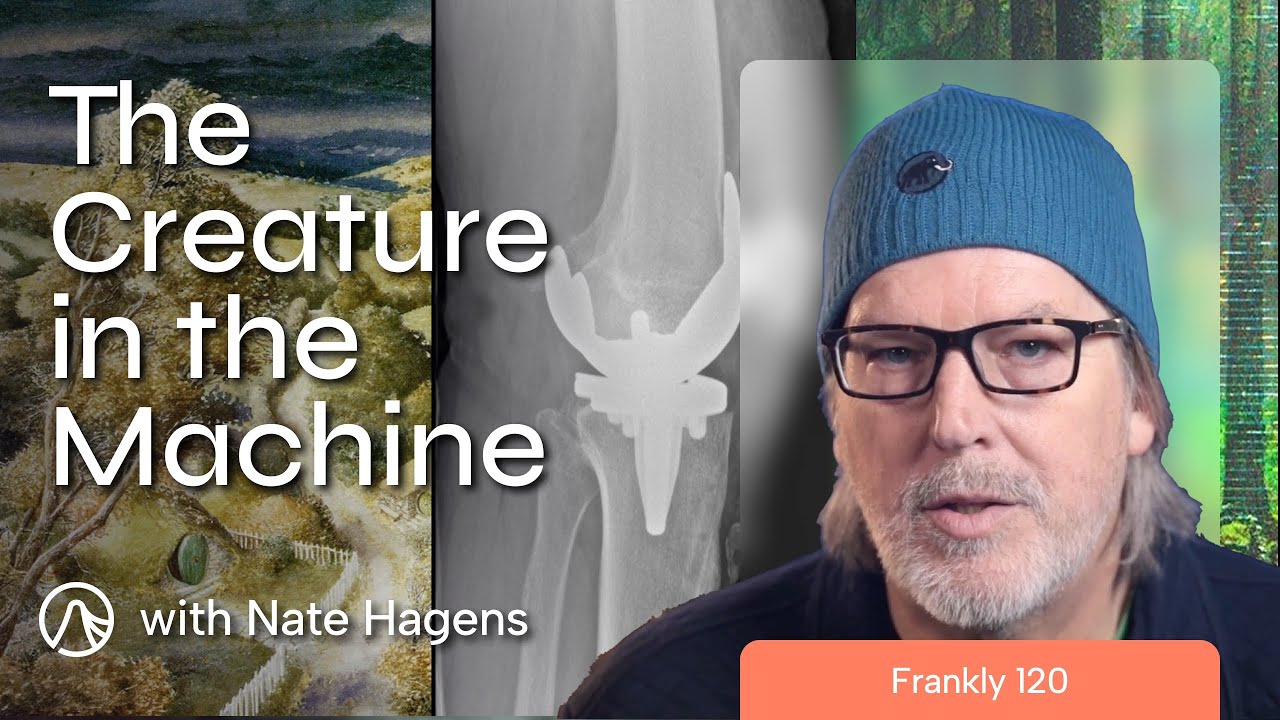
A recent knee replacement surgery — titanium components fitted in a technologically saturated operating room staffed by nine specialists and underwritten by layers of insurance, logistics, and invisible supply-chain reliability — offered a visceral encounter with what industrial civilisation can, at its best, actually do. The procedure worked. Within days, movement returned without a walker, and the motivation to recover fully was immediate and sharp. By any measure of human welfare, the intervention was extraordinary.
Yet the same complexity that can restore a damaged joint is not neutral in its broader accounting. The energy throughput, material flows, and institutional coordination required to deliver one elective orthopaedic surgery at scale represent a civilisational commitment that carries costs dispersed across ecosystems and future generations. Acknowledging the genuine good that complexity produces is not a concession that undermines systemic critique — it is the intellectually honest starting point for any serious analysis of what would actually be lost, and what would need to be preserved, in a lower-energy future.
The Same System That Heals Also Distracts, Entraps, and Destroys
The complexity that powers modern medicine — the same interlocking web of knowledge, supply chains, and institutional coordination that can rebuild a damaged knee — is structurally identical to the complexity driving ecological overshoot, digital distraction, and deepening dependence. The machine does not have a separate mode for care and a separate mode for destruction; it runs on the same energy throughput, the same competitive logic, the same growth imperative. Recognising this does not require rejecting the tools; it requires refusing the illusion that the beneficial applications are separable from the damaging ones.
The practical implication is both clarifying and uncomfortable. Technology subordinated to genuine care — protecting the vulnerable, restoring function, extending connection — is possible within the existing system, and that possibility is real and worth defending. But the same system that enables care also systematically promotes competition over cooperation, screens over presence, and extraction over regeneration. The gap between what the machine can do and what it reliably does is not a design flaw waiting to be engineered away; it reflects the deeper logic of a superorganism optimising for throughput rather than wellbeing.
Minneapolis ICE Controversy Points to Deeper Fractures in Institutional Trust
The controversy unfolding around federal immigration enforcement activity in Minneapolis is functioning as a live stress test of American institutional coherence. People reading the same headlines are arriving at sharply different conclusions — not because the facts are contested, but because the underlying frameworks through which authority, legitimacy, and trust are interpreted have diverged. The gradient between federal power and state or local responses is steepening, and historical precedent is unambiguous: under sufficient systemic stress, power consolidates. The questions that follow — where it consolidates, at what scale, and around what unifying logic — are not yet answered.
Those questions become structurally harder in a post-peak-carbon world. The energy surplus that historically underwrote centralised governance, military reach, and continent-scale coordination is not an indefinite endowment. As net energy declines, the material basis for maintaining complex federal institutions narrows. Bioregionalism — the idea that governance might reorganise around ecological rather than political boundaries — has long seemed peripheral to mainstream policy debate. The biophysical pressures now accumulating suggest it may become less fringe not because it wins an argument, but because the conditions that made continental-scale centralisation viable are themselves changing.
"History suggests that power ultimately consolidates — the question is around what, and at what scale."
Resistance to Mechanisation Begins in the Body, the Place, and the Ordinary
Against the machine's tendency to convert creatures into components, the most durable counter-force is not political mobilisation or technological counter-design but something quieter: practices that return people to their bodies, their local places, and the specific human beings around them. The hobbits of Tolkien's narrative defeated Sauron not through military strength or strategic brilliance but through what can only be described as the accumulated weight of ordinary commitments — the kind of soft-spoken loyalty to everyday life that no system can manufacture at scale and no algorithm can replicate.
This is not a retreat from systemic analysis; it is its complement. The human enterprise runs on energy, and the structural pressures of overshoot and complexity are real and impersonal. But the creatures inside that system retain the capacity for embodied, rooted, relational experience that the machine cannot fully metabolise. Preserving that capacity — through whatever practices sustain physical presence, local knowledge, and genuine interdependence — is not a lifestyle choice peripheral to the larger predicament. It is, in a meaningful sense, what the larger predicament is ultimately about.
"Even inside a system that has tilted us toward becoming a machine, we are not components."
Summarised from Nate Hagens · 20:33. All credit belongs to the original creators. Nate Haggens summarises publicly available video content.