Original source: Nate Hagens
This video from Nate Hagens covered a lot of ground. 7 segments stood out as worth your time. Everything below links directly to the timestamp in the original video.
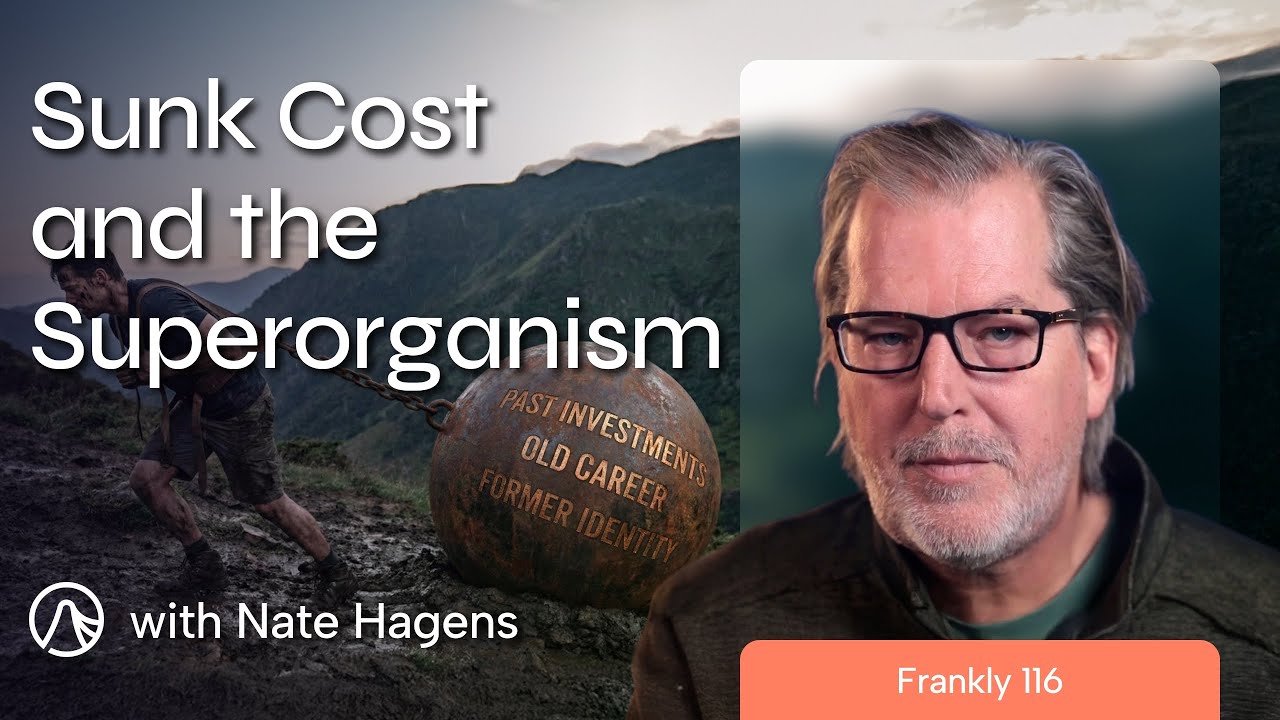
The psychology that makes you finish a bad meal because you paid for it is also the force preventing cities and nations from rebuilding their infrastructure for a lower-energy future. Understanding that link is a prerequisite for doing anything about it.
Sunk Cost Psychology Identified as Structural Barrier to Societal Adaptation
The same cognitive trap that keeps someone sitting through a bad film or wearing an ill-fitting jacket operates at civilisational scale, locking societies into roads, grids, suburbs, and global supply chains long after the underlying conditions have changed. The argument is not merely behavioural but biophysical: entire status systems, careers, and institutions were constructed around an implicit expectation of perpetual material growth, and that expectation is itself a sunk cost — one that now stands directly in the path of the deep structural changes that energy and ecological constraints are beginning to force.
Minneapolis Highway 94 Debate Exposes How Sunk Cost Logic Traps City Budgets
At the household level, accumulated mortgages, school enrolments, and social circles create inertia that makes downsizing feel like failure even when the energy and financial arithmetic is clear. At the municipal level, the dynamic is structurally identical but larger in consequence: city budgets are engineered around tax bases that assume growth, which means declining revenues do not trigger consolidation but instead produce chronic underfunding of dispersed infrastructure. The debate over Highway 94 in Minneapolis — a major corridor now at the end of its physical lifespan, where lower-energy alternatives exist but psychological attachment to the lifestyles built around the highway has blocked rational redesign — illustrates how sunk costs in wood and asphalt translate directly into sunk costs in governance.
Narrative Sunk Costs Link Progress to Material Throughput, Crowding Out Alternative Stories
The most durable sunk costs may not be physical at all. The dominant cultural story — that progress means more convenience, more gadgets, more individual accumulation — has an entire ecosystem of careers, institutions, and emotional identities built around it. Alternative narratives centred on sufficiency, repair, and local resilience do not simply compete with that story; they rub against the deep grooves it has worn into collective psychology. The compounding factor is energetic: as the fossil fuel surplus that underwrote twentieth-century complexity begins to recede, the window for large-scale, high-energy infrastructural moves narrows. Each major investment made now carries its costs forward, and there are only so many such moves available before biophysical constraints foreclose the option entirely.
Thought Experiment Reveals How Much Resource Demand Is Inherited Rather Than Chosen
A thought experiment — in which every person on Earth wakes to find their home replaced by a sturdy tent of identical footprint, with essential services intact but all material differentiation erased — strips away the social comparison engine that drives a significant share of modern consumption. The exercise suggests that perhaps a quarter to a half of the pressure to accumulate stems not from genuine desire but from the imperative to maintain parity with neighbours, and that the psychological weight of sunk cost is itself a major reason transitions to lower-energy arrangements remain blocked even when those arrangements would be cheaper, cleaner, and more systemically stable. From a biophysical perspective, the tent scenario reveals that a substantial portion of current energy throughput exists to service inherited infrastructure and choices, not to satisfy needs that would survive an honest reckoning.
Practical Protocols Proposed to Loosen Grip of Sunk Cost at Individual and Cultural Levels
A set of concrete practices is offered for individuals and communities seeking to reduce sunk cost lock-in. A "write-down ritual" — modelled on how financial institutions periodically mark assets to reflect current conditions rather than original investment — invites people to formally acknowledge what a past choice provided, honour it, and then release it. Separating the symbolic function of possessions from their practical use suggests replacing objects that serve mainly as identity markers with practices that deliver the same meaning at lower material cost. Pre-committing to future-friendly defaults — choosing smaller next appliances, building modularity into new investments, acquiring transferable skills — deploys present deliberation to constrain future inertia. And rewriting status stories to celebrate repair, mentorship, and local resilience rather than accumulation creates the cultural scaffolding within which individual choices can shift without social penalty.
Releasing Sunk Costs Reframed as Risk-Adjusted Asset Management, Not Surrender
Applying the tent thought experiment locally — asking what one would rebuild first if inherited structures vanished overnight, and which elements would simply not be restarted — can surface genuine preferences buried beneath accumulated obligation. The critical reframe is that releasing investments which no longer serve their purpose is not defeat but what might be called risk-adjusted stewardship of a living civilisation. The arborist analogy is precise: an old oak that was never pruned grows strange, heavy branches that become sunk costs in wood, and the tree is more likely to fail catastrophically in a storm than a well-tended, smaller specimen. A good arborist removes the dangerous growth, braces the viable structure, and guides new growth deliberately — accepting that the result will be a smaller tree in exchange for a stable and enduring one.
Community Gardens, Repair Shops, and Microgrids Identified as New Growth After Necessary Cuts
The concluding argument is that reducing the grip of sunk cost is less an act of mourning than of reclaiming agency. By making careful cuts in cultural wood, bracing what can genuinely carry the civilisation forward, and directing energy toward already-sprouting alternatives — community gardens, repair shops, local microgrids, school-yard plantings, and neighbourhood social organising — societies can increase optionality for an uncertain future while lightening the material and psychological burden of the present. The human superorganism that emerges from this process, the argument runs, shows up less status-anxious, less materially encumbered, and more capable of the neighbourly cooperation that lower-energy arrangements will require. The gap between what is structurally necessary and what cultural inertia currently permits remains wide, but the direction of movement is identifiable and the first steps are already visible.
Summarised from Nate Hagens · 23:28. All credit belongs to the original creators. Nate Haggens summarises publicly available video content.