🌐 Also available in: 🇫🇷 Français
Original source: Squidge Rugby
This video from Squidge Rugby covered a lot of ground. Streamed.News selected 8 key moments and summarises them here. Everything below links directly to the timestamp in the original video.
Understanding England's defensive missteps in this moment reveals how crucial clear communication and instinctual decision-making are under pressure, especially when facing an opportunistic Irish attack that thrives on exploiting such hesitation.
Irish Offensive Brilliance Exposes English Defensive Confusion for O'Brien Try
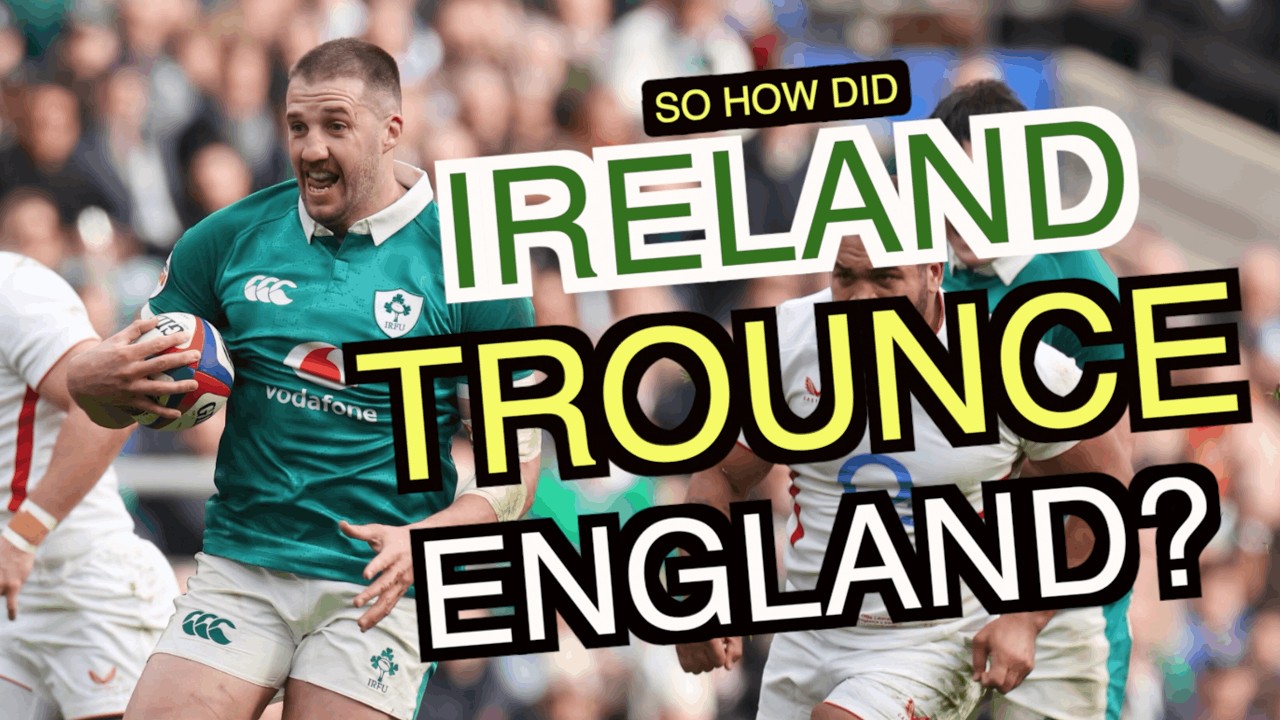
Ireland's Tommy O'Brien scored a crucial try by exploiting England's indecisive defense, which struggled between holding off and rushing up. Caelan Doris delivered a perfectly timed pass, following a hitch-kick, drawing in Fraser Dingwall and freeing Robert Baloucoune. Baloucoune's subsequent acceleration past a hesitant Tommy Freeman, who bought a dummy, created the opening for O'Brien to cross the whitewash.
The defensive disarray stemmed from England's players, particularly Fraser Dingwall, being caught between their usual club defensive patterns and the team's desired aggressive "fly up" approach. This mix-up allowed Ireland to generate an overlap and execute a fluid attacking move, highlighting the importance of clear defensive communication and role clarity against a dynamic Irish offense.
"It's a brilliantly timed pass and Baloucoune, who has worked incredibly hard having started on the opposite wing, works all the way round, gets into position, and from here accelerates, goes through Tommy Freeman, does exactly the thing you're coached not to do."
England's Deviation from Aerial Strategy Undermined Core Game Plan
England's primary attacking strategy, reliant on winning aerial contests with strong escorts, faltered significantly due to critical selection choices and Ireland's effective counter-tactics. The inclusion of Henry Arundell, who won only two of eight aerial contests, severely weakened England's ability to consistently gain territory, reducing their once reliable 70/30 advantage in these contests.
This departure from their established "Plan A" prevented England from generating the chaos scenarios that previously led to numerous tries. As Ireland smartly adapted to counter the slap-back tactics and focused on clean catches, England's game unravelled, leading to frustration and a loss of belief in their system, mirroring past teams under pressure.
"You have sacrificed your biggest weapon for occasional brilliance. You then look at the way Ireland were able to, without actually getting the better escort consistently... they're being really smart to the tap back."
Gibson-Park's Defensive Acumen and Strategic Kicking Create Irish Opportunities
Jamison Gibson-Park demonstrated exceptional defensive intelligence and kicking prowess, turning crucial moments against England into Irish advantages. His strategic tackle on Ben Youngs during an English lineout peel disrupted a planned cleanout, leading to a turnover. This defensive action, combined with his perfectly weighted kick into a contested "dead space" zone, created an attacking opportunity that culminated in a try.
Gibson-Park's acute understanding of player roles and defensive vulnerabilities allowed him to exploit England's structure. His precise kick positioned Tommy O'Brien to win the aerial contest against a backtracking Tommy Freeman, forcing England's back three to re-adjust their defense and setting the stage for Ireland's offensive success.
"The best thing about that kick is he manages to send that into a little bit of dead space. It's quite unclear from an England back three perspective whether Tommy Freeman should be backpedalling to take this ball or whether Freddie Stewart should come up."
Crowley's 'Boring' Brilliance: Fly-Half Exploits England's Aggression
Jack Crowley's understated yet highly effective play at fly-half proved crucial for Ireland, as he consistently executed simple passes and strategic kicks to gain advantageous field position. Notably, in the build-up to Jamison Gibson-Park's try, Crowley successfully baited England's Joe Heyes into rushing him, then quickly distributed the ball and re-involved himself in the play, creating an overlap.
Crowley's ability to remain deep in the pocket, exploiting the English defensive system's mandate to "hammer" the opposition, drew in an aggressive Heyes, who was then taken out of the play. This allowed Ireland to maintain continuity and penetrate England's defensive line, demonstrating how calculated, less flashy play can dismantle an opponent's high-pressure tactics.
"Crowley here looks up, has one look, looks Joe Heyes in the eye, right? And there's a moment of going, 'Yeah, I'm having you. I'm gonna do you.' And so Heyes flies up on him."
England's Lineout and Attacking Communication Errors Undermined Performance
England's performance was significantly hampered by a series of fundamental communication errors, particularly in their lineout and attacking phases. An early lineout saw Luke Cowan-Dickie throw the ball over the top without a jumper, a clear misinterpretation of the call, exposing a disconnect within the front row and across the team.
Similar issues plagued their attack, as exemplified by a knock-on resulting from a miscommunication between George Ford and Ellis Genge. Ford's pass to Genge, who had anticipated a different line, demonstrated a broader pattern of players not being on the same page. These small, pervasive errors prevented England from building momentum and capitalising on opportunities.
"Cowan-Dickie just clearly misunderstood the call and throws it in wrong. Misreads the trigger, misreads the call, gets it completely wrong. And this seemed to be the issue with so often it was like Cowan-Dickie in particular."
Crowley's Unassuming Play Orchestrates Baloucoune Try
Jack Crowley's effective yet understated play at fly-half was instrumental in orchestrating a key try for Robert Baloucoune, contrasting sharply with the tendency of some players to over-complicate matters. By remaining incredibly square and delivering precise, "boring" 3-meter passes early, Crowley created momentum.
This simple, direct approach allowed Stewart McCloskey to run a brilliant line, exploiting a man-short England defense and forcing Ollie Lawrence to make difficult choices. The sequence culminated in Baloucoune scoring, demonstrating how Crowley's tactical discipline in distributing the ball enabled Ireland to consistently exploit even small defensive gaps.
"One thing Jack Crowley is incredibly good at is giving incredibly boring 3-meter passes which are incredibly effective. So Jack Crowley notices that they're a man short and they are making up for it. So he goes, 'Right lads, we're going to run tight here.'"
England's Back Row Selection Contributed to Breakdown Chaos and Turnover Deficit
England's back row selection significantly contributed to a messy breakdown and a stark turnover deficit against Ireland, despite dominating possession and territory. The absence of specialist breakdown players like Guy Pepper and Sam Underhill was keenly felt, leading to Ireland winning 11 turnovers to England's 2.
Henry Pollock's energy was noted, but his selection of rucks was questioned for its accuracy in the crucial early phases, often prioritizing later efforts over immediate threats. This imbalance in the breakdown contest prevented England from converting their territorial advantage into points, allowing Ireland to capitalize on crucial turnovers and disrupt England's rhythm.
"The turnover stats are 11-1 by Ireland, 2-1 by England, right? They're not looking after their own ball. I think a bit of that is the back row selection perhaps wasn't quite right."
Jamison Gibson-Park Delivers World-Class Performance for Ireland
Jamison Gibson-Park showcased a world-class performance for Ireland, epitomizing his role as the engine that drives the team's attack. His exceptional speed and accurate distribution of the ball consistently put his forwards in advantageous positions, making them look good rather than the other way around. Beyond his attacking prowess, Gibson-Park delivered a generational individual game defensively, including a crucial spot blitz tackle on Ollie Lawrence that nullified an English overlap.
His ability to quickly get to the breakdown and deliver the ball with precision and speed is unparalleled since Aaron Smith's prime, allowing Ireland to play on the front foot. This combination of offensive orchestration and decisive defensive actions underlines why Gibson-Park is considered a pivotal player in the global rugby landscape.
"He's the best since Aaron Smith retired at putting the ball in front of his forward so they can run onto it. And the thing about this particular performance is as well as that he also had a brilliant individual performance."
Summarised from Squidge Rugby · 34:12. All credit belongs to the original creators. Squidge Rugby Press summarises publicly available video content.